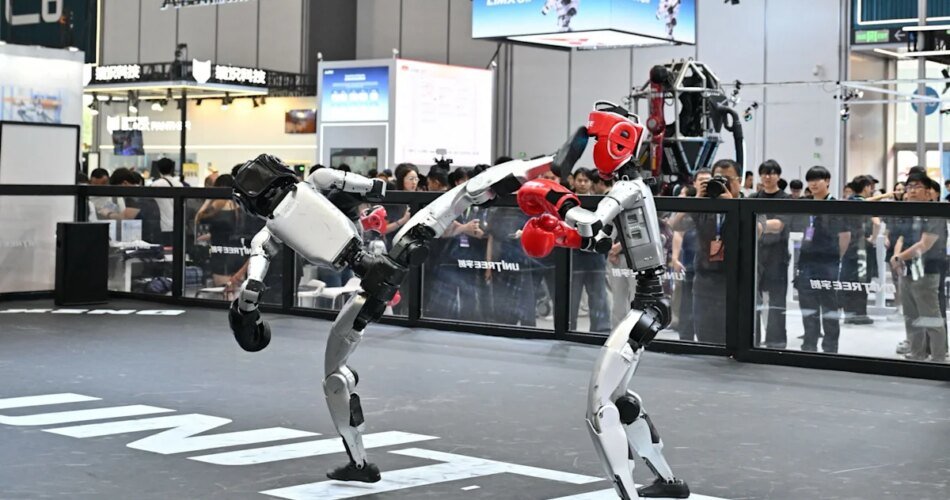

Shares in the Chinese business behind a line of kung fu robots have surged more than 600pc after its public listing.
Unitree, which is China’s biggest humanoid robot company, soared to a £48bn valuation on Wednesday after it floated on Shanghai’s Star market.
Chinese investors flocked to grab a piece of the 10-year-old company, which captured the world’s attention in February when its humanoid robots performed martial arts and backflips on stage at China’s Spring Festival Gala.
The Hangzhou-based business was listed at 150.8 yuan (£16.52) per share, raising 6.1bn yuan in new funds. The shares then surged by as much as 629pc to 1,100 yuan.
Wang Xingxing, the 36-year-old founder, became an immediate billionaire with his stake worth around 110bn yuan – or around £12bn.
Unitree leads a growing clutch of Chinese tech companies racing to develop high-functioning, commercially viable humanoid robots.
Beijing is poised to pour more than £100bn into funding the industry’s growth, hoping to emulate China’s success at building a collection of popular electric vehicle brands from scratch.
The country produced 16,000 humanoid robots last year, and officials estimated that about 100,000 could be churned out in 2026. China has excelled in developing robots even as its AI labs have been forced to play catch-up with Silicon Valley.
It has outpaced Western rivals such as Tesla in commercialising the humanoid robots. Elon Musk’s business has produced only a few hundred bipedal Optimus robots so far.

Unitree is also a global leader in robot dogs, selling 18,000 four-legged robots last year. Robot dogs are increasingly being tested by the world’s militaries for carrying supplies or even weapon systems.
Donald Trump banned imports of Chinese robots last month, warning they could be controlled and weaponised by Beijing.
Unitree has ambitions for its humanoid robots. It has released video of robot soldiers doing military drills and robot care workers picking up dirty clothes and sorting medications.
The company sold 5,500 humanoid robots last year and claimed to have made a profit in 2025.
Humanoid robots are still expensive and often have limited functionality, hampered by the need for sharper AI and lighter batteries.
But Mr Xingxing told Time magazine last month that Chinese humanoid robotics were between two and 10 years away from a breakthrough “ChatGPT moment”.
Bank of America has forecast that there could be 10 million humanoid robots by 2035, rising to three billion by 2060.
DeepSeek, one of China’s biggest AI firms, took a 2.3pc stake in Unitree in the stock market float, signalling that it would work with Unitree on improving the robots’ brains.
Investors now expect other Chinese robotics companies to weigh up listing on either the Shanghai or Hong Kong exchanges.
Source link