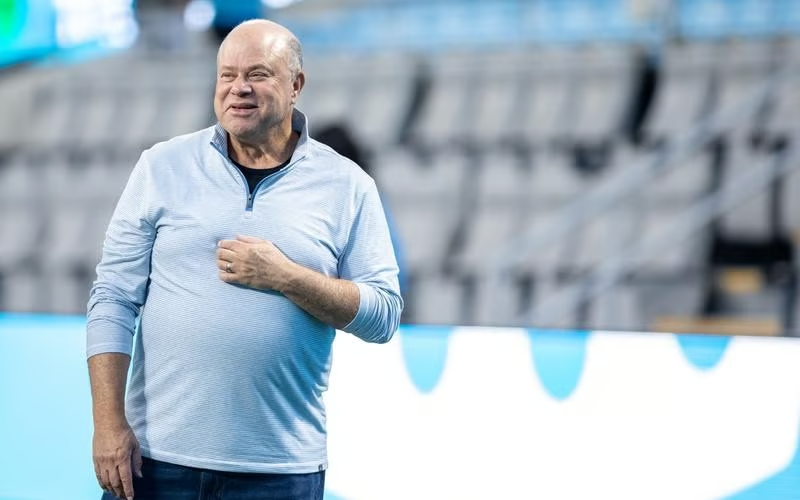
Sandisk(SNDK -9.01%) stock peaked on June 22, when it touched $2,354.39. Somewhere inside that same quarter, David Tepper’s Appaloosa sold every share it owned.
The fund’s second-quarter 13F, filed with the SEC on Aug. 14, shows zero Sandisk shares as of June 30. At the end of March, it had reported 281,250 of them, worth about $179 million — about 3% of its reported holdings.
The growth stock has fallen about 31% from the June peak as of this writing.
The position was new, too. Sandisk appears nowhere in Appaloosa’s year-end 2025 filing, so the stake was built and unwound inside about six months.
After all, a 13F reports holdings on one day, the quarter’s last, and says nothing about when inside those three months a sale happened. That limit matters more than usual here.

Image source: Getty Images.
A 258% quarter
To me, the interesting part isn’t that he sold. It’s the quarter he sold into. Sandisk shares rose about 258% between the end of March and the end of June, and the exit sits somewhere along that climb.
Appaloosa may have sold in April, closer to the March price, or in June, near the top. The filing looks the same either way. So nobody should call this a top tick.
What can be said is what the position became. Had the fund simply kept its 281,250 shares, the June 30 close of $2,273.73 would have priced them near $640 million, against the $179 million reported three months earlier.
In other words, Tepper walked away from the most vertical stretch of one of the market’s most vertical stocks. That takes discipline, or skepticism, or both.
The Micron trim that doubled anyway
The filing shows the same instinct applied to the fund’s bigger memory bet. Appaloosa sold 690,000 shares of Micron(MU -7.02%) during the quarter, cutting the position by about 41%. But the quarter outran the selling. Micron’s stock rose more than 240% over those three months (its biggest quarterly gain on record, according to CNBC), so the trimmed stake’s reported value still doubled to about $1.13 billion. Micron ended June as the fund’s second-largest holding, at nearly 15% of reported assets.
Add it up, and Appaloosa spent the quarter selling memory stocks yet finished with more memory dollars than it started with — about $1.13 billion, up from $741 million.

Today’s Change
(-7.02%) $-70.99
Current Price
$940.76
Key Data Points
Market Cap
Day’s Range
$926.64 – $978.67
52wk Range
$113.46 – $1255.00
Volume
37.3M
Avg Vol
49.4M
Gross Margin
72.60%
Dividend Yield
0.06%
Where the new money went
The heaviest buying went to the companies funding the artificial intelligence build-out, including three of the magnificent seven stocks helping fund the AI build-out.
Indeed, Appaloosa added about 15% more Amazon shares, which was already the fund’s largest position. The position now stands at nearly $1.2 billion.
Additionally, the fund increased its Taiwan Semiconductor stake by about 24%, making it its third-largest holding at $788 million.
The whole portfolio got bigger, too. Reported holdings totaled about $7.7 billion at quarter-end, versus $5.9 billion three months earlier.
Reportedly back in already
Then there’s the part the filing can’t show.
According to CNBC, citing a person familiar with the matter, Appaloosa bought a bigger position in memory stocks after the quarter ended than what it sold during the second quarter.
That report changes the reading considerably. Sandisk spent stretches of late July more than 50% below its June high, and Micron pulled back hard as well. If Appaloosa was buying into that weakness, the exit arguably looks less like a verdict on the memory boom and more like profit-taking ahead of a valuation reset. Sell high, keep the option of coming back lower.

Today’s Change
(-9.01%) $-161.07
Current Price
$1,625.78
Key Data Points
Market Cap
Day’s Range
$1600.20 – $1724.99
52wk Range
$43.20 – $2354.39
Volume
18.7M
Avg Vol
13.8M
Gross Margin
71.47%
However, a tip about unreported buying deserves more skepticism than a filing. The purchases, whatever they were, won’t show up until November’s 13F — and then only if he still held them on Sept. 30. Tepper may also have changed course again since.
So I’d resist the tidy version of this story, bullish or bearish. The filing doesn’t show a fund fleeing memory: The dollars at quarter-end say the opposite. And it doesn’t show a fund riding the boom with conviction either, because the two positions that defined that boom were cut hard while they were still working.
What the record supports is narrower. Tepper sold Sandisk somewhere inside its biggest quarter, kept a Micron bet that got larger even as he trimmed it, and reportedly kept trading the group after the books closed. The stock he left hasn’t seen its June 30 close again — though an Aug. 13 investor day has since pulled it well off its July lows.
Source link