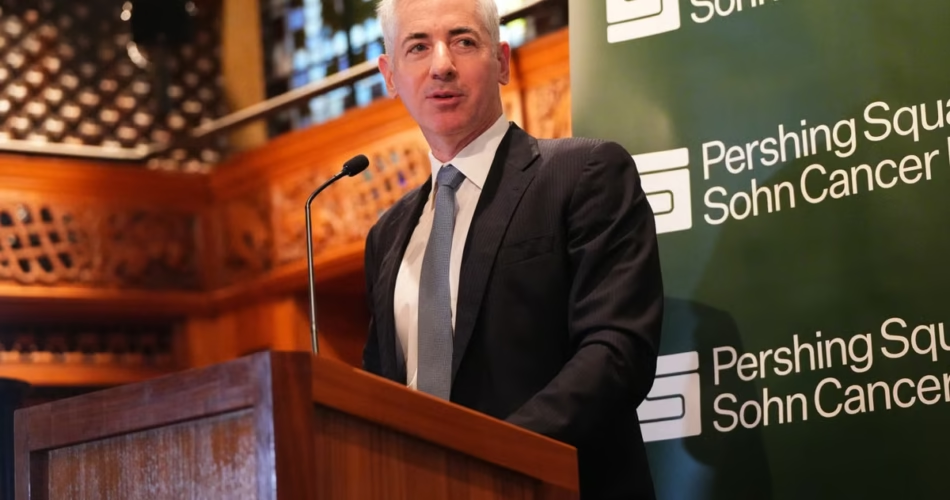
Billionaire investor Bill Ackman has made quite a name for himself in the investing world.
Since its inception in 2004, his company, Pershing Square Holdings, has generated a cumulative return of 2,530%, or a compound annual return of 15.6%. The broader benchmark S&P 500 has generated a cumulative return of roughly 964% and a compound annual return of 11%.
Ackman and his team typically run a concentrated portfolio of 10 to 12 stocks through Pershing Square Capital Management (PSCM), the investment manager of Pershing Square Holdings.
Recently, through the issuance of a closed-end fund and a management company based in the U.S., Pershing Square USA and Pershing Square jointly raised another $5 billion in capital, which is already being deployed.
In the second quarter, PSCM sold its entire stake in Alphabet and purchased another tech stock that’s up 65,100% since its initial public offering.
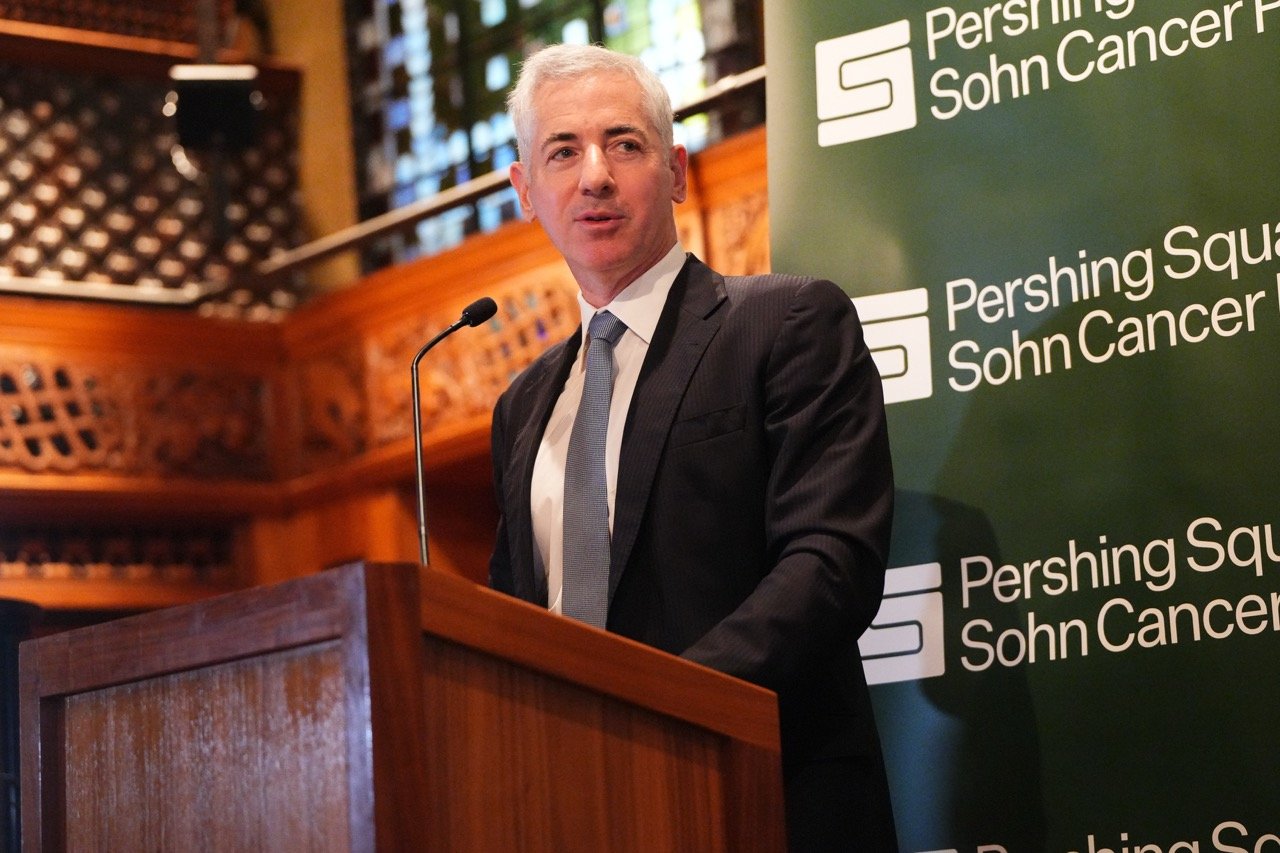
Bill Ackman. Image source: Getty Images.
Selling Alphabet after a fantastic run
Pershing initially bought Alphabet in the first quarter of 2023.
Artificial intelligence was still in its early days, and investors were trying to figure out where Alphabet would fit in and how its large search business might be affected. However, Alphabet did not waste any time and rolled out AI overviews atop most Google search results in a bid to increase engagement. It also introduced its own family of large language models, Gemini, which have proven competitive in the space.
While Ackman and Pershing owned Alphabet, the company also faced a significant threat from a U.S. Department of Justice (DOJ) lawsuit alleging that Google had acted as a monopoly in the digital advertising space.
A federal judge concluded that the company had done what it was being accused of, but ultimately stopped short of imposing some of the stricter punishments that the DOJ recommended, such as forcing Alphabet to divest itself of its Chrome browser.
The judge also said Alphabet could continue paying Apple to make Google the default search engine in its Safari web browser.
Interestingly, part of the reason for what many described as a muted punishment was the emerging competition from AI, which made Google less of a monopoly. Ackman and Pershing sold most of their stake in Alphabet in the first quarter of this year, then unloaded the remaining shares in the second quarter.
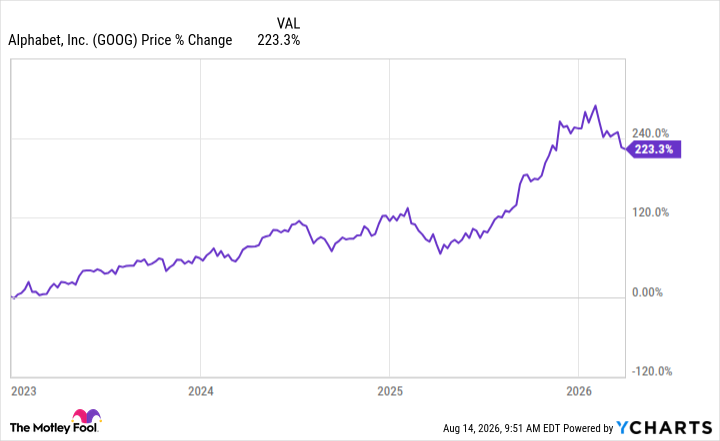
Following the selling of Alphabet in the first quarter, Ackman wrote on X, “… our sale of $GOOG was not a bet against the company. We are very bullish long term on Alphabet. But at current valuations and in light of our finite capital base, we used $GOOG as a source of funds for $MSFT [Microsoft].”
Buying the beaten-down king of streaming
In the second quarter, Pershing purchased more than 13 million shares of Netflix (NFLX -2.74%), giving it a position valued at over $934 million and making up close to 5% of the total portfolio.
In Pershing’s recently released interim report, Ackman and Chief Investment Officer Ryan Israel said they bought Netflix after the stock fell roughly 50% from an all-time high in June 2025, and its forward earnings multiple had declined from 40 to 21 times.

Today’s Change
(-2.74%) $-2.14
Current Price
$76.02
Key Data Points
Market Cap
Day’s Range
$75.47 – $78.53
52wk Range
$65.08 – $126.71
Volume
478.1K
Avg Vol
42.7M
Gross Margin
49.53%
Netflix began to struggle after it tried to acquire most of the assets of Warner Bros. Discovery, only to end up in a bidding war. Netflix ultimately walked away from the deal, reaping a $2.8 billion termination fee in the process.
But now Netflix stock is struggling again as investors worry about reported declines in engagement and competitive threats from short-form video and AI-generated videos, two concerns that Ackman and Israel believe are overblown.
Ackman and Israel believe short-form video is much more likely to cut into viewing time for linear television or “lower quality streaming services” than to affect a company like Netflix.
“To that end, the ramp up in short-form video consumption has been most acute over the past two years yet has had no discernible impact on the company’s results,” they wrote in Pershing’s interim report. “On AI, we believe concerns understate the cost of generating long-form, high-quality video, which remains among the most compute-intensive AI tasks. If compute costs remain elevated, Netflix’s ability to amortize content across the largest user base in the industry remains a highly valuable competitive advantage.”
AI should also help Netflix deliver better content recommendations to consumers and achieve more effective ad targeting.
I agree with Ackman and Israel’s thesis here. Netflix can further embed AI into its business while also expanding into new content forms, whether those are podcasts, live television, or even shorter-form content.
With all that in mind, I like the risk-reward proposition for Netflix stock.
Source link