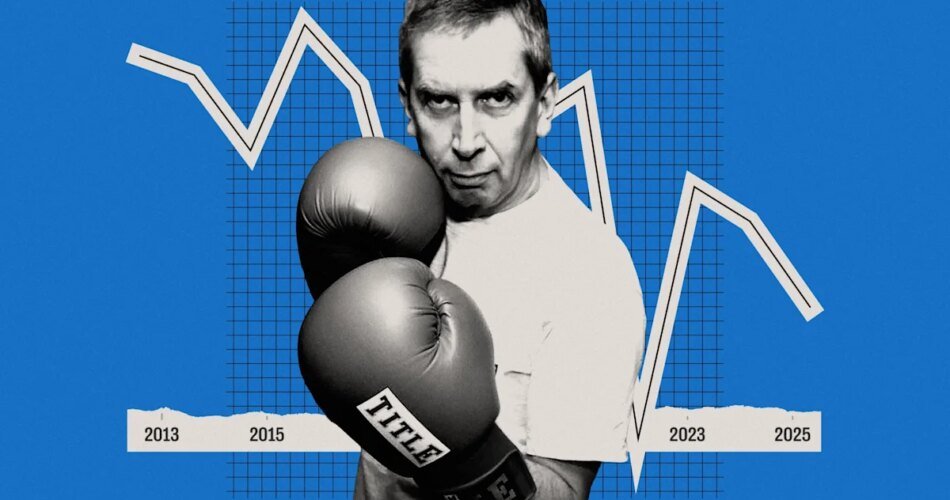
How Britain’s favourite fund manager lost his way – and billions of pounds
Christmas 2021: Terry Smith was on top of the world.
Smith – one of the City’s most distinguished fund managers – had just earned a near-£30m payday from the performance of his flagship fund, Fundsmith Equity, which had swelled beyond recognition since its inception.
Over the course of a decade, Fundsmith Equity had grown to just shy of £29bn of assets under management (AUM), according to data from Morningstar, and reigned as the UK’s largest fund from 2019.
Until it didn’t.
Smith’s “do nothing” mantra and refusal to chase momentum or popular investment themes earned him years of strong performance and plaudits to boot. The veteran fund manager was dubbed “the English Warren Buffett” by disciples of his approach of identifying well-priced businesses and holding them indefinitely.
Since then, however, performance has dipped, lagging comparable funds in its sector as well as the MSCI World index, its benchmark. Concurrently, Fundsmith Equity’s AUM dropped sharply.
From its peak in December 2021, Fundsmith’s assets more than halved to £12.1bn – an outflow of almost £17bn in less than five years.
It has failed to outperform the MSCI World since 2020 and was usurped as Britain’s largest fund by a St James’s Place strategy in 2025.
Two years ago, The Telegraph made a bold call and removed Fundsmith from its annual 25 best funds list, a judgment that raised eyebrows at the time but continues to prove prudent.
During its decline, Smith has been forced to speak to the media to answer for his fund’s failings. Although he remains reticent about speaking publicly, long gone are the days in which he demanded interviews took place via email. He declined requests for comment on this piece.
So, what happened? How did Smith lose his Midas touch? And is his recent pivot away from his trademark laissez-faire approach an indication of terminal decline?
The lore of Terry Smith
After graduating with a degree in history, Smith spent more than a decade working as an analyst in the City. It was there that his interest in stocks grew.
Those who knew Smith said he was often keen to emphasise his modest upbringing; he started work at just 14 in a Tesco warehouse. As the son of an East London lorry driver, his background informed his desire to amass wealth and work hard.
His lorry-driving father also worked in an asbestos plant and died from asbestos poisoning when Smith was a young adult. He told The Times in 2010 that he remembered “very distinctly saving up to buy a bar of soap at Christmas, just to be clean on the day”.
After turning down the chance to continue in academia, Smith took a graduate job at Barclays bank, where he rose to become manager of its Pall Mall branch. He then moved into a role at the stockbroker BZW.
“I was offered a lectureship, but turned it down for vulgar commercial considerations, like making some money,” Smith told a business trade magazine in 2010.
Smith’s controversial first book, Accounting for Growth, topped the bestsellers charts in 1992 – Stephen Lock
Even during his years as an analyst, Smith was renowned for being outspoken. While working for BZW during the 1980s, he published a “sell” note on BZW’s parent company, Barclays PLC, which urged investors to dump their Barclays shares.
As a high-performing analyst, he jumped ship to UBS in 1990, but was dismissed after publishing Accounting for Growth, an exposure of accounting practices used by companies to massage profits and hoodwink investors.
What began as a note to City colleagues later became a bestselling book and briefly overtook Stephen Hawking’s A Brief History of Time to claim the No. 1 spot in the bestsellers chart.
At the turn of the millennium, Smith became chief executive of the London stockbroker Collins Stewart, a decade before he founded Fundsmith.
Sources within the fund management space described Smith as highly ambitious, “ruthless”, but charming when he needed to be.
“He’s got a personality where it feels like he’s a friend and the philosophy of the fund has always been quite simple for people to understand,” said a portfolio manager at a City firm.
His reputation as a shrewd businessman was mirrored by his sporting pursuits, which included white-collar boxing, triathlons and martial arts.
Smith has said of himself: “I’m often described as ‘outspoken’. I don’t view this as a criticism” – Stuart Clarke/REX/Shutterstock
Shortly after the 2008 financial crisis, Smith opted to set up on his own. Founded in late 2010, Fundsmith Equity embodied Smith’s “do nothing” credo, with a focus on delivering superior performance for a reasonable price and investing in “quality growth” companies.
The fund’s annual return was immediately strong and returned almost 8.5pc in 2011, compared with the MSCI World’s -4.8pc loss, according to data from Morningstar. Fundsmith Equity continued to outperform the MSCI World every year until 2021.
During that time, it amassed significant assets, breaking the £1bn mark in January 2013. Six years later, it was crowned the UK’s largest fund and by the end of 2021, it had become a near-£29bn juggernaut. Fundsmith was one of the best-loved holdings of small, private investors.
“Fundsmith took a great concept (invest like Warren Buffett), and launched at an opportune time, when high-quality companies traded at low multiples post-2008,” said Kamal Warraich, head of fund research at wealth management firm Canaccord.
“The quantitative easing era also likely bolstered returns of many long-duration assets, which the fund was overexposed to during this period,” he added.
Smith gradually upped sticks and left the UK for the tropical Indian Ocean island of Mauritius, where he became a resident in 2017, three years after he established an office there.
He is currently building a museum on the island for his collection of around 200 classic cars and has shipped over world-class boxing and karate equipment to support the Beau-Bassin/Rose Hill Kickboxing Club.
Fund manager stardom
With such an enormous number of investors and tens of billions in assets to match, Smith was elevated to “star fund manager” stature, a rarefied club that included names such as Neil Woodford, Richard Buxton, Nick Train, Fidelity’s Anthony Bolton and Scottish Mortgage’s James Anderson.
At the time, funds run by managers who invest based on their own convictions far outweighed those that simply copied a benchmark. The former, known as active funds, accounted for a larger share of investors’ money and indices were less concentrated in large technology stocks.
In 2020, actively managed funds represented 82.1pc of UK funds under management – excluding exchange-traded funds (ETFs) – but just 75.1pc by the end of Q1 2026, data from the Investment Association show.
“There has been a huge rise in passive investing, which means the bigger companies keep getting bigger regardless of whether companies are good or not. This has been to the detriment of active managers and made it harder to outperform,” explained Darius McDermott of Chelsea Financial Services.
In 2025, just 16pc of active UK equity managers outperformed their passive alternative, a report from AJ Bell found.
The suspension of trading in the once-£10.1bn Woodford Equity Income fund also left some investors trapped in a strategy run by a previously esteemed fund manager, leading some to reconsider their portfolio.
“Star fund managers will always be a part of the industry and our culture, but there will likely be fewer of them going forward,” said Warraich.
From ‘do nothing’ to do a lot
In Smith’s 2021 investor letter, he wrote: “No investment strategy will outperform in every reporting period and every type of market condition. So, as much as we may not like it, we can expect some periods of underperformance.”
Fundsmith’s performance figures had started to fall.
By the end of 2022, it had shed almost £7bn from its AUM after ending the year with a -13.7pc loss, the first full year it underperformed the MSCI World in its history – which returned -7.8pc.
Despite outflows, Smith remained steadfast in his commitment to his style. This was echoed over the next few years, even as investors abandoned Fundsmith and performance continued to grind to a halt.
“The ‘do nothing’ principle has not worked,” said Dan Coatsworth, of AJ Bell.
“He was too slow to sell underperforming companies, missing major red flags at Estée Lauder, Novo Nordisk and PayPal. There were plenty of signs that things weren’t working out, yet he gave management the benefit of the doubt,” he added.
Smith finally sold Fundsmith’s position in Novo Nordisk during the first six months of 2026, despite the stock’s poor performance since its mid-2024 high. Shares in the Danish pharmaceutical giant have fallen 26pc over the past 12 months.
“Investors pay for active management, yet from the outside it appeared that portfolio decisions were made at a sloth-like pace,” said Coatsworth.
Smith’s quality growth bias had also been out of favour for some time.
“Fifteen years ago, when Fundsmith launched, valuation was far less important for quality investors because the entire market was inexpensive,” explained Mark Ellis, of Nutshell Asset Management.
But higher volatility in markets instead rewarded more nimble fund managers, a trend incongruous with Smith’s raison d’être.
Simon Woodacre, of Quilter Cheviot, argued the fund’s “low-turnover approach may have resulted in prolonged exposure to businesses facing structural challenges or operational difficulties”.
Questions were also raised about Fundsmith’s size. Smith does not disclose the exact size of Fundsmith’s portfolio holdings, so investors have found it difficult to ascertain how agile Smith has been.
Ben Yearsley, of investment consultancy Fairview Investing, said: “Fundsmith became and still is a super tanker. There is no optimum fund size, but this has felt too big for many years.”
But, as Smith’s 2026 letter emerged, it was clear something had changed the manager. Smith pivoted from “do nothing” to do anything.
“Our portfolio turnover hit a high of 51pc in the first half of this year as we made significant changes in the portfolio,” he said.
While Smith continued to back his fund’s established approach, he acknowledged it might “fall foul” – but only of an illogical market.
He pledged to be “more active in the future” and “take more account of momentum”.
Smith vowed that increased stock turnover would not lead him to “hug the index” but acknowledged that he had “no insight into how or when this passive-led momentum market will end, other than to say badly”.
Last year, Fundsmith Equity returned investors less than 0.9pc, well below the MSCI World’s 12.7pc. So far in 2026, investors who have stuck by Fundsmith are down 3.2pc.
Canaccord’s Warraich said: “I think the appeal has certainly diminished. Adapting processes is one thing, but changing a fundamental tenet of the philosophy is something else altogether.”
For owners or potential buyers of Fundsmith Equity, the style shift and years of turgid returns have raised eyebrows, yet some remain optimistic.
One investor told Telegraph Money: “Smith’s recent changes appear to be a realisation that the backdrop has changed and he and his team have been slow to respond to that, but the changes they have now enacted are a means of freshening up his portfolio.”
Another – Clifford Brown, 99 – has stuck with his investment through the down years. He bought Fundsmith in 2016 and it remains his top holding.
“I like the fact that he holds a limited number of funds. I have never considered selling. I have confidence he will correct any mistakes,” said Brown.
“We can all make mistakes. Acknowledging them is the secret.”