
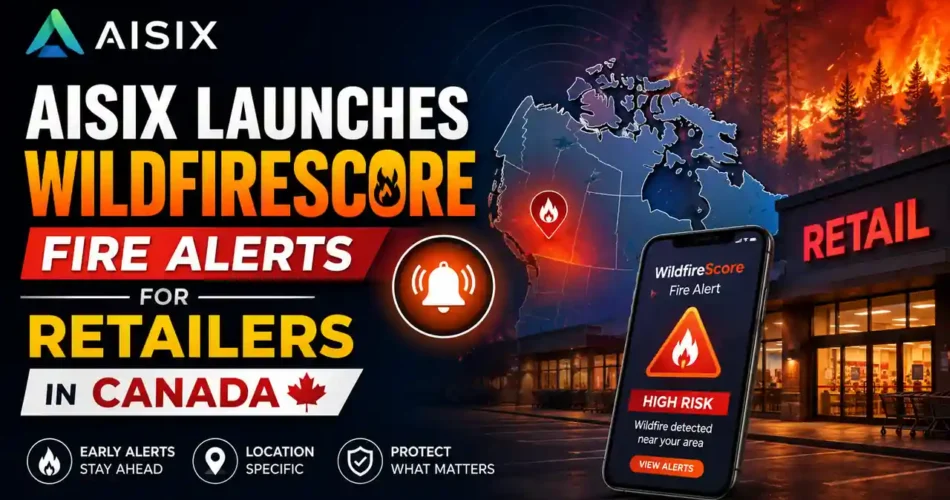
AISIX Solutions Launches Fire Alerts for WildfireScore Retail Application
AISIX Solutions has introduced real-time fire alerts inside its WildfireScore Retail application, giving Canadian retailers a faster way to monitor wildfire risk and protect people, inventory, and property. [web:8]
What the New Fire Alerts Feature Does
The fire alerts module pushes timely notifications when wildfire risk rises near a retail location or portfolio of stores. Instead of checking dashboards manually, managers can receive signals tied to changing conditions so they can trigger preparedness steps earlier.
Key capabilities include:
- Location-based risk monitoring for individual stores or multi-site portfolios across Canada.
- Threshold-driven alerts when wildfire risk scores cross predefined levels.
- Actionable insights to support decisions on staffing, closures, inventory protection, and communications.
This is especially valuable in provinces with recurring wildfire seasons, where even moderate changes in risk can affect logistics, insurance, and safety planning.
Why Retailers Need Wildfire Risk Intelligence
Wildfires can disrupt retail operations through smoke, evacuations, road closures, power outages, and supply-chain delays. A structured risk view helps retailers:
- Protect staff and customers by aligning operations with official guidance and local conditions.
- Safeguard inventory and assets with earlier preparation for smoke, heat, or evacuation scenarios.
- Reduce downtime by planning alternate routes, suppliers, or temporary closures in advance.
- Support insurance and compliance with documented risk monitoring and decision logs.
For chains with many locations, a centralized tool reduces the burden on regional managers who previously relied on scattered news feeds and social media updates.
How WildfireScore Retail Works
WildfireScore Retail is built on AISIX’s Wildfire 3.0 API and underlying wildfire risk data. The application translates complex environmental and geographic inputs into simple risk scores and reports that non-technical users can understand.
Typical workflow for a retailer:
- Onboard locations by adding store addresses or coordinates into the platform.
- Set alert thresholds based on risk tolerance, operational policies, and local regulations.
- Monitor dashboards for portfolio-wide risk heat maps and site-level details.
- Receive fire alerts via configured channels when conditions change.
- Execute playbooks for communication, safety, and continuity based on the alert level.
Because the system is designed for the general public and businesses, it can be used by head office risk teams as well as regional or store-level managers.
Data Sources and Government Context
Wildfire risk in Canada is closely tied to data and guidance from federal and provincial authorities. Retailers using tools like WildfireScore should align their internal playbooks with official sources such as:
- Natural Resources Canada (NRCan) – national information on wildfires, research, and mapping.
https://www.nrcan.gc.ca - Canadian Interagency Forest Fire Centre (CIFFC) – interagency coordination and national fire situation reports.
https://ciffc.ca - Provincial wildfire management agencies – for example:
- BC Wildfire Service: https://bcwildfire.ca
- Alberta Wildfire: https://wildfire.alberta.ca
These government sites publish seasonal outlooks, active fire maps, evacuation notices, and fire-danger ratings that can complement commercial risk scores. A robust retail risk program will reference both proprietary analytics and official advisories.
Benefits for Multi-Site Retail Portfolios
Chains with dozens or hundreds of locations gain the most from a centralized wildfire alert system.
Operational Continuity
- Identify at-risk stores before conditions worsen.
- Pre-position resources such as generators, air filtration, or temporary staffing.
- Coordinate with logistics partners on alternative routing when highways are affected.
Safety and Duty of Care
- Align opening hours and on-site staffing with local fire-danger levels.
- Support managers with clear triggers for early closure or remote work.
- Document risk-based decisions for internal audits and insurer reviews.
Cost and Insurance Considerations
- Demonstrate proactive risk management to insurers and brokers.
- Potentially reduce losses from smoke damage, spoiled inventory, or emergency repairs.
- Improve negotiation position by showing structured monitoring and response processes.
Integrating Fire Alerts into Retail Playbooks
To get maximum value, retailers should embed WildfireScore alerts into existing emergency and continuity plans.
Suggested Steps
- Define alert levels (e.g., Watch, Warning, Critical) and map them to specific actions.
- Assign roles for who receives alerts, who approves operational changes, and who communicates with staff and customers.
- Link to communication templates for SMS, email, or in-app notifications to employees.
- Test the workflow before peak fire season with simulated alerts and tabletop exercises.
- Review after each event to refine thresholds, contacts, and response steps.
This turns raw risk data into a repeatable process that reduces confusion during high-stress periods.
Security, Privacy, and Responsible Use
Retailers should treat wildfire risk data as part of their broader enterprise risk and security posture.
- Limit access to location and alert data to authorized personnel.
- Store configuration and response logs securely, following internal IT policies.
- Use the tool as a decision-support system, not a replacement for official evacuation orders or government directives.
When in doubt, always prioritize instructions from local emergency management and provincial wildfire authorities.
Who Should Use This Feature
WildfireScore fire alerts are most relevant for:
- National and regional retail chains with stores in wildfire-prone provinces.
- Property and asset managers overseeing retail portfolios.
- Risk, safety, and continuity teams in head offices.
- Franchise networks that need consistent risk guidance across locations.
Small independent retailers in high-risk areas can also benefit from simplified risk scores and alerts, even if they manage only one or two sites.
Getting Started with WildfireScore Retail
Retailers interested in the new fire alerts can:
- Review product details and use cases on the AISIX Solutions website and investor materials.
- Contact AISIX via their investor relations or media contacts for commercial inquiries.
- Map their store locations against historical fire seasons to prioritize rollout by region.
A phased rollout—starting with highest-risk provinces and largest sites—often delivers the quickest ROI.
FAQ
What is AISIX WildfireScore Retail?
WildfireScore Retail is a wildfire risk intelligence application from AISIX Solutions that provides risk scores, reports, and now real-time fire alerts for retail locations in Canada.
How do the new fire alerts work?
The system monitors wildfire risk near your stores and sends alerts when risk scores cross thresholds you define, helping you act before conditions become critical.
Which countries does WildfireScore Retail support?
The current public application focuses on wildfire risk scores and reports in Canada, using AISIX’s Wildfire 3.0 API and data.
Can I use this for a single store or only large chains?
Both. The tool supports individual locations and multi-site portfolios, so independent retailers and large chains can use the same risk framework.
Do I still need to follow government evacuation orders?
Yes. WildfireScore is a decision-support tool. Always follow official guidance from local emergency management and provincial wildfire agencies.
Where can I find official Canadian wildfire information?
Key sources include Natural Resources Canada (https://www.nrcan.gc.ca), the Canadian Interagency Forest Fire Centre (https://ciffc.ca), and provincial services like BC Wildfire (https://bcwildfire.ca) and Alberta Wildfire (https://wildfire.alberta.ca).
