(Bloomberg) — CXMT Corp.’s ascent to the pinnacle of Chinese markets heralds a potentially consequential shift away from private-sector giants toward a new generation of hardware companies more closely aligned with Beijing’s strategic ambitions.
Most Read from Bloomberg
The memory chipmaker — considered central to China’s AI infrastructure buildout — overtook Tencent Holdings Ltd. as the country’s most valuable company last week, surpassing half a trillion dollars of capitalization. Days earlier, Unitree Robotics’ initial public offering drew frenzied retail demand, with the tranche for mom-and-pop investors subscribed more than 5,500 times. Both are intricately linked to Beijing’s effort to catch and surpass the US in a technology with the potential to transform economies.
For the better part of a decade, Tencent, Alibaba Group Holding Ltd. and the giants of the mobile era drew investor attention at the expense of staid state-backed and old-economy stalwarts. That began to change in 2020 when Beijing cracked down on an increasingly powerful private sector — precipitating a decline that culminated with CXMT’s ascent.
Big tech names have again largely languished this year, dinged by prolonged economic and consumer malaise. Alibaba, even with its pivot to AI, is down about 16% this year. Tencent has given up close to 27% in market value. Even Xiaomi Corp. has lost the luster from its electric-vehicle foray, down more than a third.
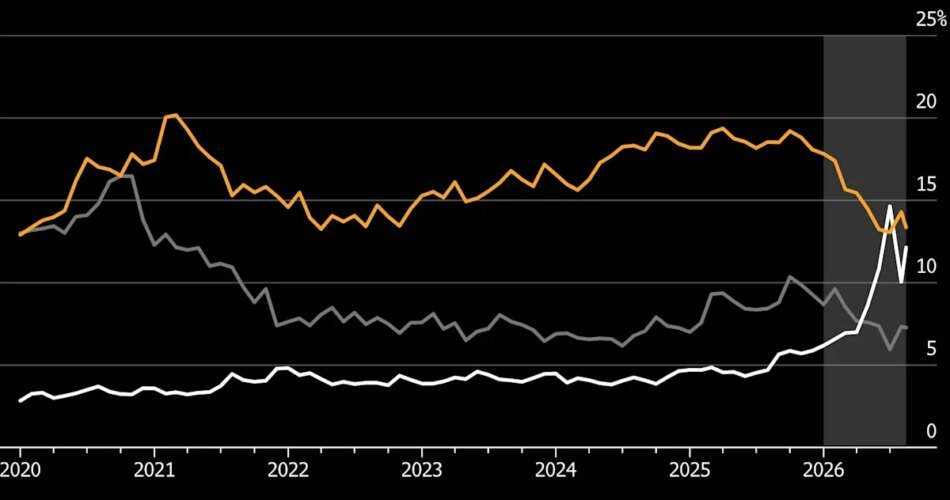
The weighting of China’s hardware sector — including CXMT — briefly overtook both retailers and software in the MSCI China All Shares Net Total Return Index this year, data compiled by Bloomberg show.
Online retailers such as Alibaba and JD.com Inc. have seen their combined weight shrink from more than 15% in 2020 to roughly 7% in August, while hardware climbed from under 3% six years ago to more than 12%. China’s chip-heavy Star50 Index rose about 28% this year, while the Hang Seng Tech Index — which counts Alibaba and Tencent among its heavyweights — shed nearly 15%.
“This is inevitable,” said Leonid Mironov, a Hong Kong-based fund manager at Gavekal Capital Ltd. “Look at Tencent’s cashflow — it’s gone negative, and a lot of it is going to the hardware guys like CXMT. This is the dynamic in the US as well. At some point the platforms will have to show that they can make money off this. For hardware guys, they are showing it right now.”
The AI boom is delivering runaway demand to suppliers of the hardware required: processors from the likes of Nvidia Corp. as well as fast memory from CXMT, SK Hynix Inc. and Samsung Electronics Co. But the market is harder to navigate on the software side. This dynamic is amplified in China, where the government acts as kingmaker for various industrial sectors — and has designated AI infrastructure as well as robots key priorities to pursue, develop and expand.
President Xi Jinping has called for game-changing breakthroughs, against the backdrop of China’s intensifying rivalry with the US for AI supremacy. At a minimum, Beijing seeks to ensure China’s self-sufficiency in critical areas. Those do include software and AI developers such as Alibaba — but the industry remains locked in a margin-eroding price war.
China has narrowed the gap in areas such as AI model development and inference-processing chips, helped by homegrown champions from DeepSeek to Huawei Technologies Co. But Beijing still needs more pioneers to break new ground in fields including advanced chipmaking for data centers and cognitive AI for the next generation of humanoid machines.
“China’s AI build-out will increasingly define equity and IPO leadership across Hong Kong and mainland Chinese markets,” Bloomberg Intelligence senior analyst Francis Chan said. “IPO pipelines are AI-led, featuring firms like Moonshot AI, Yangtze Memory, Shein and Unitree Robotics.”
Unitree is expected to begin trading in Shanghai as early as this week, testing the investor community’s appetite for AI hardware. CXMT, now three weeks into its life as a public company, is up more than 500% since its debut. Conviction about China’s prospects in the AI race is growing, and new products from the likes of Z.AI Co., Alibaba and DeepSeek support that thesis. But most of the bets on that rise are landing on hardware providers with greater immediate visibility on revenue and profits.
“If you look at the tech cycle, it is always the hardware set that goes first before the software set can come in,” said Kelvin Tay, chief investment officer for Asia at Pictet Wealth Management. “I’m quite sure that at some point this move into software will come back.”
To be sure, tech stocks have proven volatile in the AI age and sentiment can swing dramatically. Alibaba alone has gone through cycles of optimism and skepticism around its high level of AI spending — alternately seen as a burden or a foundation for long-term growth.
The clearer trend for now is companies aligned with Beijing’s priorities, especially if they’re making hard-to-get hardware or developing real-world AI applications.
“Valuations are propped up by the idea that self-sufficiency will create a larger total addressable market for those companies,” Morningstar Inc. analyst Jing Jie Yu said. “Regulatory uplift or support becomes a consistent valuation push factor for these companies.”
–With assistance from Sangmi Cha, Dong Lyu and Jiyeun Lee.
Most Read from Bloomberg Businessweek
©2026 Bloomberg L.P.