

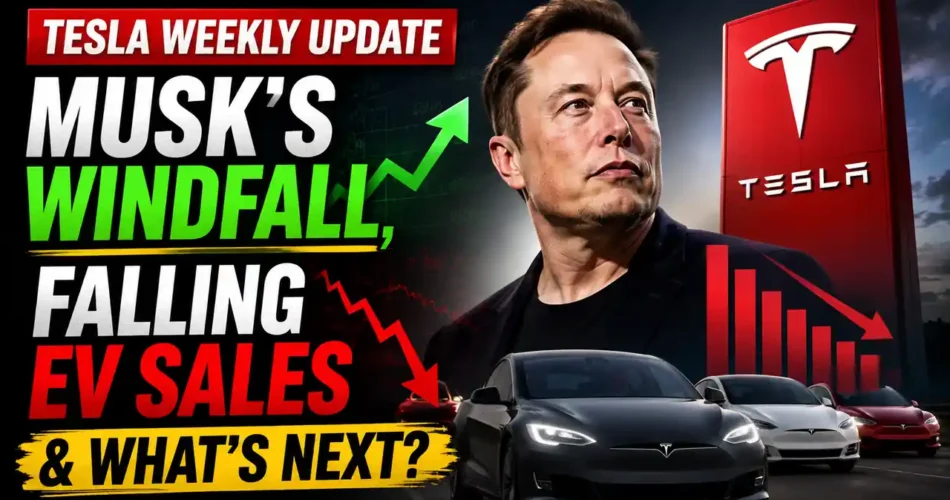
This Week in Tesla: Elon Musk’s Financial Windfall, EV Sales Fall and More
Tesla remained one of the most closely watched companies in the world this week as investors weighed a striking mix of developments involving CEO Elon Musk, electric-vehicle demand, artificial intelligence, robotics and the company’s ambitious spending plans.
The latest headlines highlight a growing contrast at Tesla. Musk’s potential financial rewards have reached extraordinary levels, while the company’s traditional automotive business continues to face questions about pricing, competition and regional demand. At the same time, Tesla is putting increasingly large amounts of money behind technologies that could eventually make the company less dependent on selling cars.
Elon Musk’s Tesla Pay Package Draws Fresh Attention
One of the biggest Tesla stories this week centered on Elon Musk’s compensation. A new report examining executive pay found that Musk’s 2025 Tesla compensation was valued at roughly $158 billion, making it an extraordinary outlier compared with compensation received by other corporate executives.
The figure has renewed debate over the relationship between executive rewards and employee compensation. According to reporting based on AFL-CIO data, Musk’s compensation was more than 2.5 million times the pay of a median Tesla worker in 2025.
The enormous valuation is closely connected with Tesla’s stock-based and performance-linked compensation arrangements. Unlike a conventional annual salary, much of Musk’s potential wealth is tied to Tesla’s share performance and achievement of specified corporate objectives.
That distinction is important for investors. The headline value of a compensation package does not necessarily represent cash paid directly to the CEO. Much of the economic value depends on Tesla’s future performance and the eventual value of equity awards.
Why Musk’s Potential Windfall Matters to Tesla Investors
Musk’s compensation is more than a corporate-governance story. It is also closely connected to Tesla’s long-term strategy.
The company’s leadership wants Tesla to expand beyond traditional automobile manufacturing and become a major player in autonomous driving, artificial intelligence, robotics and energy technology. Musk’s compensation structure is designed to keep his incentives closely connected with the company’s valuation and strategic targets.
For supporters, the arrangement can be viewed as a way to align the CEO with shareholders. If Tesla achieves dramatic growth in value, Musk receives substantial rewards. Critics, however, argue that compensation on such a scale raises questions about corporate governance, dilution and whether shareholders are paying too much for executive leadership.
Tesla’s EV Business Faces a Mixed Sales Picture
Electric-vehicle sales remain another major focus for Tesla watchers. The company continues to operate in a highly competitive global market where established automakers and rapidly growing Chinese EV manufacturers are competing for customers.
Tesla’s sales picture is not uniform across regions. Some markets have shown improvement, while other areas have experienced significant weakness. In China, for example, reports have pointed to a sharp decline in Tesla’s domestic retail sales during July even as the broader battery-electric vehicle market performed better.
At the same time, Tesla’s China-made vehicle deliveries, which include exports from the Shanghai factory, have shown strong year-over-year growth. That means headline factory figures can tell a different story from domestic retail demand.
This distinction matters because Tesla’s Shanghai operation serves both Chinese customers and international markets. A strong production or export number does not necessarily mean that local consumer demand is equally strong.
Competition Is Becoming More Difficult
Tesla’s competitive environment has changed dramatically since the company established itself as the dominant name in modern EVs.
Chinese automakers are expanding their electric lineups, while traditional manufacturers continue to introduce new battery-powered models. Consumers now have more choices in areas such as price, vehicle size, range, charging capability and technology.
For Tesla, maintaining growth may therefore require more than simply producing additional vehicles. The company must convince customers that its software, charging network, autonomous-driving capabilities and brand remain worth paying for.
Pricing and Margins Remain Important
Another challenge is the relationship between vehicle deliveries and profitability. Price reductions can encourage consumers to buy more cars, but aggressive discounts can also reduce the amount Tesla earns per vehicle.
That tension was visible in Tesla’s recent financial performance. The company delivered more than 480,000 vehicles during the second quarter of 2026, but profitability came under pressure as Tesla increased spending and dealt with lower pricing and other headwinds.
Tesla’s own investor-relations release reported 480,126 deliveries in the quarter, including 467,762 Model 3 and Model Y vehicles. The company also deployed 13.5 gigawatt-hours of energy-storage products.
Tesla Is Spending Heavily on AI and Robotics
Perhaps the most important long-term Tesla story is the company’s transformation from an automaker into a broader technology business.
Tesla is investing heavily in autonomous driving, robotaxis, artificial intelligence infrastructure and humanoid robots. These projects require significant capital, research spending and engineering resources.
During the second quarter, Tesla’s capital expenditures reached roughly $5.8 billion, while free cash flow turned negative. The company has also indicated that full-year capital spending could exceed $25 billion.
That spending level creates a difficult balancing act. Investors must decide whether today’s cash investment can produce substantially larger revenue and profits in the future.
Robotaxis Could Change Tesla’s Business Model
Tesla’s autonomous-driving ambitions are particularly important because a successful robotaxi network could create recurring revenue from vehicles already manufactured by the company.
Instead of earning money primarily when a customer buys a car, Tesla could potentially generate additional revenue through software, autonomous transportation services and fleet operations.
However, autonomous driving remains a technically and commercially challenging field. Safety, regulation, reliability, customer trust and operating economics all have to be addressed before robotaxis can become a massive source of revenue.
Energy Storage Provides Another Growth Avenue
Tesla’s energy business is another part of the company’s diversification strategy. Battery-storage products can serve households, businesses and large-scale energy projects.
The company deployed 13.5 GWh of energy-storage products in the second quarter, demonstrating that its business is no longer solely dependent on vehicle deliveries.
Energy storage could become increasingly important as electricity demand grows and grids require additional flexibility. Batteries can help store electricity and provide power when renewable generation is unavailable or demand rises.
Tesla’s Q2 Results Show the Core Challenge
Tesla’s second-quarter results captured the central investment debate surrounding the company.
Revenue increased to about $28.24 billion, but net income fell to roughly $1.11 billion. Adjusted earnings per share were approximately 33 cents, below Wall Street expectations at the time.
The numbers show why Tesla investors are looking beyond vehicle delivery totals. A company can sell more cars while still experiencing pressure on earnings if pricing declines, expenses rise or investment increases faster than revenue.
Tesla has made it clear that it is willing to accept substantial near-term spending in pursuit of longer-term opportunities in AI, autonomous driving and robotics.
What Investors Will Watch Next
Several factors could shape Tesla’s performance in the coming months.
1. Global EV Demand
Investors will monitor whether vehicle demand improves across major markets and whether Tesla can defend its market share against increasingly aggressive competitors.
2. Automotive Margins
Sales growth will matter, but profitability will matter just as much. Investors will watch pricing, incentives and the cost of producing each vehicle.
3. AI and Robotaxi Progress
Tesla’s valuation increasingly depends on expectations surrounding autonomous driving and AI. Evidence that these businesses are becoming commercially viable could provide a major boost to investor confidence.
4. Capital Spending
The scale and speed of Tesla’s investment program will remain under scrutiny. Investors will want to see whether billions of dollars in additional spending eventually produce meaningful returns.
5. Elon Musk’s Role
Musk remains central to Tesla’s identity and strategy. His leadership can be an advantage when the company needs to pursue ambitious projects, but his broad business interests and controversial public profile can also create additional risks for shareholders.
The Bigger Picture for Tesla
This week’s developments reinforce a simple point: Tesla is no longer just an electric-car story.
The company is trying to build a future around autonomous vehicles, AI, robotics, energy storage and software while its traditional automobile business faces tougher competition and pressure on margins.
That creates both opportunity and risk. If Tesla’s technology ambitions succeed, the company’s addressable market could become much larger than the global automobile market alone. If those projects take longer than expected to generate meaningful profits, investors could remain focused on the company’s declining margins and enormous capital requirements.
Musk’s potential financial windfall adds another layer to the story. His rewards are closely tied to Tesla’s future value, meaning the interests of the CEO and shareholders are, in important respects, linked to the company’s ability to deliver its ambitious targets.
Frequently Asked Questions
What happened with Elon Musk’s Tesla compensation?
Recent reporting highlighted a 2025 Tesla compensation valuation of about $158 billion for Musk. The figure is largely connected to equity and performance-based awards rather than a conventional cash salary.
Are Tesla EV sales falling everywhere?
No. Tesla’s sales performance varies significantly by market. Some regions have experienced declines, while others have shown improvement. China, Europe and the United States can produce very different results at the same time.
How many vehicles did Tesla deliver in Q2 2026?
Tesla reported 480,126 vehicle deliveries during the second quarter of 2026. Model 3 and Model Y deliveries accounted for the overwhelming majority of the total.
Why is Tesla spending so much money?
Tesla is increasing investment in artificial intelligence, autonomous driving, robotaxis, robotics, manufacturing infrastructure and energy technology. Management expects capital spending to remain unusually high as these projects expand.
Could robotaxis become a major Tesla business?
Potentially. A successful autonomous ride-hailing network could give Tesla a recurring revenue stream beyond vehicle sales. However, technological development, regulation, safety and commercial scalability remain important challenges.
What is the biggest Tesla risk right now?
A key risk is that the company’s ambitious AI and robotics investments may take longer or cost more than expected to produce significant financial returns. At the same time, the automotive business must remain competitive and profitable.
Conclusion
Tesla’s latest headlines show a company navigating a major transition. Elon Musk’s extraordinary compensation highlights the enormous expectations surrounding Tesla’s future, while uneven EV sales demonstrate the challenges facing its core automotive business.
At the same time, Tesla is betting billions on technologies that could redefine the company. For investors, the central question is no longer simply how many electric vehicles Tesla can sell. It is whether AI, autonomous driving, robotics and energy can ultimately justify the company’s huge ambitions and investment requirements.
For now, Tesla remains a high-profile combination of automotive manufacturing and technology speculation. The next phase of its story will depend on whether those ambitious promises translate into sustainable growth, stronger margins and meaningful cash generation.
Sources for further reading
Tesla Investor Relations: Tesla financial results and company updates.
U.S. Securities and Exchange Commission: Tesla SEC filings.
The article above is freshly structured and rewritten rather than copied from the source material. Key current figures were cross-checked against Tesla’s investor-relations disclosures and recent reporting.

