

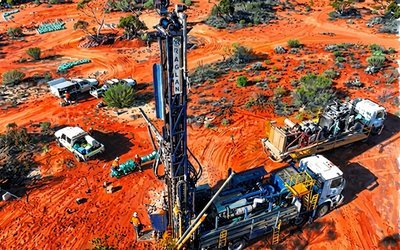
Barton Gold (ASX: BGD) (OTCQB: BGDFF) has confirmed new mineralisation within a shallow zone of existing high-value ‘starter pit’ outlines in Phase 2 resource upgrade drilling at its Tunkillia project in South Australia.
Latest broad assays from the 39,000-metre reverse circulation campaign yielded best high-grade results of 6m at 6.61 grams per tonne gold from 70m including 1m at 32.4g/t from 73m, and 11m at 2.87g/t gold from 79m including 1m at 10.6g/t from 88m.
The assays are expected to support the potential to extend Tunkillia’s total mineralisation, increase the mineral resource estimate within pit outlines of the optimised scoping study released in May 2025, and increase the grade profile of mineralisation in Tunkillia’s pre-feasibility study (PFS).
Multiple work programs are currently underway to support the Tunkillia PFS, a planned mining lease application, and project financing discussions.
These include flora, fauna, and water surveys and monitoring, along with Aboriginal and cultural heritage surveys and work program clearances, technical studies for a tailings storage facility and other non-process infrastructure, and the evaluation of prospective renewable energy solutions for reduced reliance on diesel power supply.
Expanded Phase 2 Campaign
Barton’s Phase 1 drilling at Tunkillia returned broad assays that infilled modelled mineralisation in the high-value S1 and S2 zones of the main Area 223 open pit.
The Phase 2 campaign was subsequently expanded to target further areas of interest within the pits including Area 51, which showed potential for a new domain of mineralisation.
S1 and S2 are modelled to produce 365,000 ounces gold and 923,000oz silver during the first 27 months of Tunkillia’s operations, at an average cash cost of $1,429 per ounce gold.
The latest Phase 2 assays include the first results from the expanded program and appear to support potential new high-grade mineralisation that could further enhance S1 and S2 economics.
Barton expects receipt of the final batch of Phase 2 results in the next few months, after which it will prepare comprehensive and representative cross-sections of all assays.
Robust Project Economics
Managing director Alexander Scanlon said the Phase 2 campaign had delivered encouraging results.
“This campaign was expanded after the early analysis of infill assays identified a potential new domain of high-grade mineralisation within Tunkillia’s S1 and S2 starter pit outlines.”
“These drive the project’s robust economics, and are modelled to yield $1.8 billion operating profit during the first 30 months at current gold and silver prices,” he said.
“Given that the average grade driving these economics is 1.05g/t gold, we believe the new assays are exceptional and could materially boost Tunkillia’s already remarkable early operating economics.”
Barton is targeting publication of the PFS in the early part of 2027.
Source link
Author

- Ytv Market News
- Share-market news writer and analyst with deep experience covering equities, commodities, forex, and cryptocurrencies for readers in the USA, UK, Canada, and Australia. Ytv Market News delivers timely market updates, practical trading insights, and clear explanations of macro and company-level catalysts that move prices. Combines on-the-ground financial reporting with technical analysis, using concise charts and actionable ideas to help investors and traders make smarter decisions.
Latest entries
 AustraliaAugust 31, 20262 incredible ASX ETFs I’d buy for long-term returns
 Politics News TodayAugust 31, 2026Accused NC killer mom plans insanity defense — as retired judge says more may follow Lindsay Clancy strategy
 Forex NewsAugust 31, 2026Why is Swiss Franc gaining despite potential SNB intervention to limit currency upside? | FXStreet
 Crypto NewsAugust 31, 2026Where is Cardano heading next? | FXStreet


