

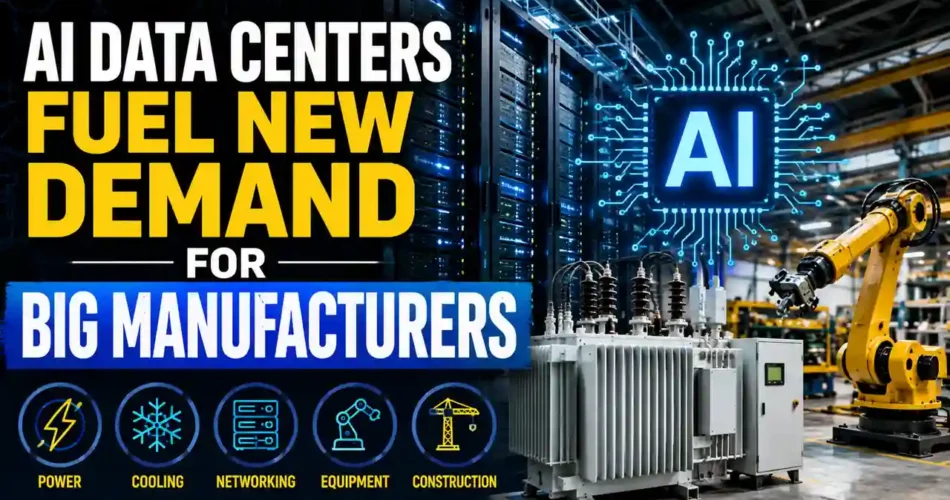
Big Manufacturers Find New Demand in Equipping AI Data Centers
The artificial intelligence boom is creating a new growth opportunity for manufacturers far beyond software and semiconductor companies. As technology companies, cloud providers, and enterprises expand AI computing capacity, manufacturers supplying the physical equipment needed to build and operate data centers are seeing a fresh source of demand.
AI data centers require enormous amounts of electricity, advanced cooling systems, high-capacity electrical infrastructure, networking equipment, and reliable industrial systems. This is creating opportunities for established manufacturers that may not develop AI models or processors but provide the infrastructure that makes large-scale computing possible.
AI Is Creating a New Industrial Demand Cycle
The AI boom initially appeared to be primarily a technology story involving chip designers, cloud providers, and software developers. However, expanding AI computing capacity has revealed a much broader infrastructure requirement.
Large AI models require powerful computing systems that are commonly assembled into dense server clusters. These clusters consume significant quantities of electricity and generate substantial heat. Data-center operators therefore need additional infrastructure to power, cool, connect, and protect these systems.
This creates opportunities for manufacturers producing transformers, switchgear, generators, cooling systems, electrical components, cables, racks, pumps, and industrial controls.
Why Physical Infrastructure Matters
A sophisticated AI processor cannot operate without the infrastructure surrounding it. Electricity must reach the facility, power must be distributed safely, and heat generated by computing equipment must be removed efficiently.
Consequently, investment in AI computing can trigger additional spending across several layers of the industrial supply chain. New computing capacity can therefore translate into demand for a wide range of physical equipment.
Power Equipment Is Becoming Especially Important
One of the biggest challenges associated with AI data centers is electricity availability. High-performance computing clusters can require substantially more power than many conventional workloads.
As operators build larger facilities, they need equipment capable of handling higher electrical loads. Manufacturers of transformers, electrical distribution systems, circuit breakers, switchgear, backup generators, and related products can therefore benefit from data-center expansion.
In some regions, access to electricity and grid connections has become an important factor when determining where new data centers can be developed. This increases the importance of electrical infrastructure and the manufacturers that supply it.
Transformers and Grid Infrastructure
Transformers play a critical role in moving electricity between different voltage levels. Rising electricity demand from data centers can increase the need for additional transformer capacity both inside facilities and throughout supporting power networks.
Manufacturers serving this market could benefit from long-term infrastructure investment. At the same time, limited production capacity and extended lead times can affect project schedules and costs.
Cooling Technology Creates Another Opportunity
AI computing equipment produces substantial amounts of heat. Traditional air-cooling systems can become more challenging to use as server racks become increasingly dense.
This is increasing interest in advanced cooling technologies, including liquid cooling and other high-efficiency approaches. Manufacturers supplying pumps, heat exchangers, cooling distribution systems, chillers, and thermal-management equipment could see stronger demand as AI facilities become more power-dense.
Why Liquid Cooling Is Gaining Attention
Liquid cooling can transfer heat efficiently in certain high-density computing environments. As AI accelerators become more powerful and servers become more densely packed, operators are evaluating cooling systems capable of handling higher thermal loads.
However, liquid cooling will not necessarily be used in every data center. Facility design, cost, equipment compatibility, maintenance requirements, and operating conditions all influence technology choices.
Construction Companies Are Also Benefiting
The AI infrastructure boom is not limited to equipment manufacturers. Building a large data center requires construction services, engineering expertise, electrical installation, mechanical systems, security infrastructure, and specialized project management.
Large industrial and construction companies can therefore participate in AI-related spending by helping customers build facilities designed for high-density computing.
Data-center construction can require significant quantities of steel, concrete, electrical equipment, cooling machinery, backup power systems, and networking infrastructure. Each project can consequently create demand across a broad ecosystem of suppliers.
Networking Equipment Adds Another Layer of Demand
AI systems depend on rapid communication between computing units. Training large models can require thousands of processors to exchange data quickly, making high-performance networking an important component of AI infrastructure.
This creates demand for high-speed switches, optical components, cables, network adapters, and other connectivity technologies.
Data Centers Are Becoming More Complex
The modern AI data center is increasingly an integrated industrial system rather than simply a building filled with servers. Electricity, cooling, networking, monitoring, security, and automation must operate together continuously.
This complexity can favor established manufacturers with decades of experience producing mission-critical industrial equipment. Their products may receive less attention than AI processors, but they remain essential to keeping computing infrastructure operational.
Established Manufacturers See a New Growth Market
For major manufacturers, AI infrastructure provides an opportunity to diversify revenue sources. Companies that traditionally served utilities, industrial customers, commercial buildings, or telecommunications markets may now find AI data centers becoming an increasingly important customer segment.
This opportunity can be attractive because many established manufacturers already have production facilities, engineering expertise, global distribution networks, and relationships with major customers.
Instead of building completely new businesses, these companies can adapt existing technologies to the rapidly expanding data-center market.
Supply Constraints Could Support Pricing Power
Strong demand does not automatically translate into higher profits. Manufacturers must manage raw-material prices, labor expenses, transportation costs, factory capacity, and delivery schedules.
However, companies operating in markets with limited manufacturing capacity may gain pricing power when orders significantly exceed available supply.
Long lead times for specialized electrical equipment and other infrastructure components can encourage customers to place orders well in advance. This can provide manufacturers with greater visibility into future revenue, although it also creates pressure to meet production and delivery commitments.
What Investors Should Watch
Investors evaluating the AI boom may want to look beyond the most recognizable technology companies. The infrastructure supporting AI expansion could create opportunities for businesses operating in industrial, electrical, construction, cooling, and networking markets.
Important indicators include order backlogs, data-center-related revenue, capacity expansion, profit margins, capital expenditure, customer concentration, and management commentary about future demand.
AI Infrastructure Risks
The AI infrastructure opportunity also carries risks. Data-center projects can be delayed by permitting issues, electricity constraints, financing challenges, equipment shortages, or changes in technology.
AI investment could also become more efficient over time. Improvements in chips, software, model architecture, and computing efficiency could reduce the infrastructure required for certain workloads.
Manufacturers expanding production too aggressively could also face excess capacity if the pace of data-center construction slows.
The Bigger Picture
The growth of AI is increasingly becoming an industrial story as well as a technology story. Every new computing cluster requires power, cooling, networking, construction, monitoring, and maintenance.
This creates a broad ecosystem of companies that can benefit from AI spending even if they do not manufacture processors or develop AI software.
For major manufacturers, the opportunity is particularly significant because they can leverage existing technologies and production capabilities to serve a rapidly expanding market. If AI data-center construction remains strong, suppliers of critical infrastructure could become some of the less obvious beneficiaries of the technology investment cycle.
Frequently Asked Questions
Why are manufacturers benefiting from AI data centers?
AI data centers require large amounts of electrical, cooling, networking, construction, and mechanical equipment. Manufacturers supplying these products can therefore gain additional demand as data-center capacity expands.
Which types of manufacturers could benefit?
Potential beneficiaries include manufacturers of electrical equipment, transformers, cooling systems, generators, networking hardware, cables, industrial controls, racks, pumps, and related infrastructure.
Why does AI require more data-center infrastructure?
AI workloads often use high-performance computing systems that consume significant electricity and generate substantial heat. Supporting this equipment requires advanced power distribution and thermal-management infrastructure.
Is liquid cooling becoming more important?
Liquid cooling is attracting attention because it can provide efficient heat removal for high-density computing environments. Adoption will depend on facility design, economics, equipment requirements, and operational considerations.
Can industrial companies benefit without making AI chips?
Yes. AI computing requires a large physical infrastructure ecosystem. Companies supplying power, cooling, construction, networking, and facility-management equipment can participate in AI-related investment without producing processors or software.
What risks should investors consider?
Investors should consider project delays, changing AI technology, supply-chain constraints, customer concentration, rising costs, excess manufacturing capacity, and the possibility that AI infrastructure spending could slow.
Conclusion
The AI boom is creating demand well beyond companies developing AI models and processors. As data centers expand, manufacturers are finding new opportunities to supply the electricity, cooling, networking, construction materials, and industrial systems required to keep AI infrastructure running.
For investors, this broader supply chain offers another way to understand the economic impact of artificial intelligence. The companies receiving the most attention may be developing the technology, but the manufacturers building the infrastructure around it could play an equally important role in supporting the next phase of AI growth.
5 U.S. Government Sources for Further Reference
U.S. Department of Energy – Powering America’s AI Future: Data Center Resource Hub
U.S. Department of Energy – Data Centers and Servers
U.S. Department of Energy – Data Center Energy Efficiency
U.S. Department of Energy – Best Practices Guide for Energy-Efficient Data Center Design
Congressional Research Service – Data Centers and Cloud Computing: Information Technology Infrastructure for Artificial Intelligence

