

Bullish Puts $100 Million Behind the AI Credit Boom
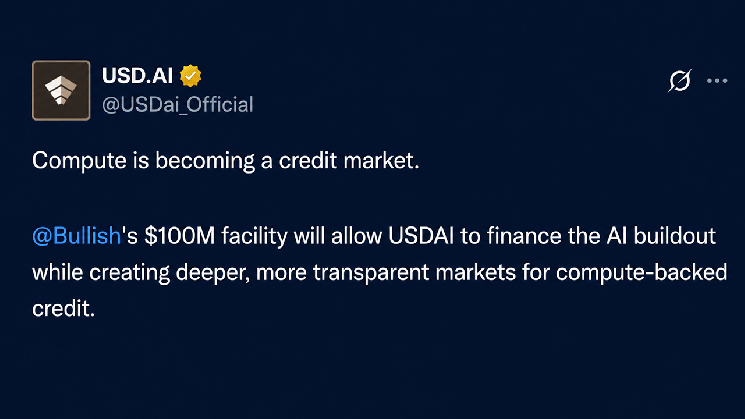
It seems that two big trends are coming together right now: private credit for AI capex, and the tokenization of real-world assets (RWAs). This week, Bullish, the NYSE-listed institutional crypto platform and parent of the news publication Coindesk, announced that it was lending $100 million to USD.AI. The firm plans to leverage the funds for loans to businesses that build artificial intelligence (AI) and related infrastructure.
Essentially, the AI firms leverage their highly valuable computer chips (GPUs) as a guarantee. Bullish believes that the money involved in this new type of lending is huge, noting that it is actually larger than many older, familiar types of borrowing vehicles.
“Bullish is targeting a capital-intensive sector that has rapidly emerged as one of the largest in private credit, with a scale that eclipses legacy debt markets such as auto loans and home equity lines of credit (HELOCs),” the company said.
Bullish Bets on Bringing Real-World Assets Onchain
Block.one co-founder and CEO Brendan Blumer established Bullish in Hong Kong in 2020. After Friday’s announcement, the company’s shares on NYSE were down 2%, but five day stats show a 10.5% gain, and the stock has climbed more than 44% over the last month.
Thomas Cowan, Head of Tokenization at Bullish, stated that his company strongly believes that real, physical items should be connected to digital money systems, and this deal represents that stance.
“Our commitment to USD.AI reflects a conviction we’ve believed since our first investment in the protocol: that credible, well-structured real-world assets belong onchain,” Cowan remarked. “USD.AI’s onchain transparency gave us the visibility to underwrite this facility with the same institutional diligence we apply across our platform, and backing it is a meaningful step toward bringing tokenized assets to institutional scale.”
GPU Collateral Faces Its Ultimate Stress Test
At the same time, the concept comes with some risks. The price of GPUs can drop very fast. They also become outdated quickly when better ones are invented. As of Saturday, Aug. 29, 2026, GPU prices are high, especially Nvidia consumer cards with more VRAM, and valuations have been climbing again this summer, not easing. The real test will happen if a borrower cannot pay back their loan.
Source link
Author

- Ytv Market News
- Share-market news writer and analyst with deep experience covering equities, commodities, forex, and cryptocurrencies for readers in the USA, UK, Canada, and Australia. Ytv Market News delivers timely market updates, practical trading insights, and clear explanations of macro and company-level catalysts that move prices. Combines on-the-ground financial reporting with technical analysis, using concise charts and actionable ideas to help investors and traders make smarter decisions.
Latest entries
 Commodities NewsAugust 30, 2026Egypt, Masdar Accelerate Wind, Solar, Battery Projects
 Crypto NewsAugust 30, 2026Stablecoins: Banks Refuse Any Compromise on Yields
 Investing InsightsAugust 30, 2026Europe’s central bankers fear more turbulence in testy U.S. relations
 Crypto NewsAugust 30, 2026JPMorgan stablecoin: why the biggest bank wants in now


