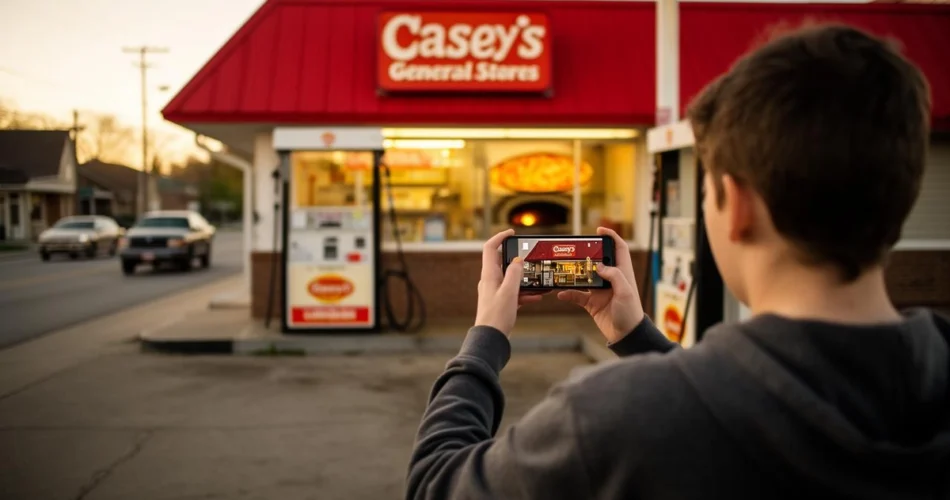
A convenience store chain rooted in America’s smallest towns has quietly assembled a pizza operation that now ranks among the country’s largest, even as the broader quick-service pizza category cools. Casey’s General Stores, the Iowa-based Fortune 500 company known for its red-roofed gas stations, has seen its stock climb more than 50% over the past 12 months, pushing its market capitalization to roughly $28 billion.
Bank of America Research recently crunched the numbers and concluded that Casey’s ranks as the fifth-largest pizza chain in the United States when measured by prepared food and dispensed beverage sales. Tom Brennan, the company’s chief merchandising officer, confirmed the ranking in an interview with Fortune, adding that Casey’s also holds the position of fourth-largest liquor license holder and third-largest convenience store operator in the country.
“You don’t hear the other big pizza players talk about Casey’s,” Brennan said. “But at the same time, it’s evident from our growth … we’re taking share as we continue to grow.”
Casey’s absence from most pizza-industry rankings is itself telling. PMQ Pizza Magazine’s 2025 Pizza Power Report, which tracks U.S. sales at chains built specifically around pizza, lists Domino’s ($9.03 billion in 2023 U.S. sales), Pizza Hut ($5.38 billion), Little Caesars ($4.43 billion) and Papa John’s ($3.86 billion) as the top four dedicated pizza chains — Casey’s does not appear at all. The fifth-place ranking instead measures something different: total prepared food and dispensed beverage revenue across all of Casey’s roughly 3,000 stores, a category that includes pizza alongside sandwiches, breakfast items and fountain drinks. The two yardsticks are not directly comparable, which is part of why a gas-station chain can out-earn national pizza brands by one measure while remaining invisible on another.
The chain is approaching 3,000 locations, with nearly half situated in towns of 5,000 people or fewer and about two-thirds in communities under 20,000 residents. That footprint spans 19 states, concentrated heavily in the Midwest but increasingly stretching into new territory.
A Digital Following Built on Scratch-Made Dough
While Casey’s has long been a fixture for Midwestern drivers buying diesel, ice, and lottery tickets, a younger audience is discovering the brand through a distinctly modern channel: social media. TikTok and YouTube have cultivated a durable genre of “gas-station pizza” content, where creators approach heat-lamp fare with low expectations and emerge genuinely impressed. Casey’s appears frequently in these videos, with creators highlighting its scratch-made dough and on-site pizza ovens.
Brennan said the company’s social team has measured a 600-basis-point increase in Gen Z engagement over the past three years. “What underpins all of this is just this incredible fandom and brand love that we’ve generated,” he said.
The executive attributed the momentum to something an algorithm cannot replicate. “It’s really built on decades of delivering high-quality pizza and food, a great experience.” He described the chain as the “gathering spot” for its communities, pointing to newer offerings like Sauced Wings, which launched as a pilot in January 2025 and has already expanded to nearly 900 stores, with a full chain rollout planned over the next two years.
From One Iowa Service Station to a Category of One
The company traces its origins to 1968, when Donald Lamberti opened a converted service station in Boone, Iowa. Brennan said he has spoken with Lamberti about the founder’s original strategy: “Hey, this will probably work in the next small town.”
“Literally, they just went from small town to small town, building Casey’s,” Brennan said.
That approach created what Wall Street analysts describe as a defensible moat. Most national brands have little interest in developing sites in communities too small to justify the investment, leaving Casey’s to operate largely uncontested. Pizza joined the menu in 1984, followed by the breakfast pizza roughly two decades later — a combination of sausage gravy, egg, and cheese that Brennan calls “iconic.”
The strategy also insulates the company from broader industry headwinds. The roughly $31 billion quick-service pizza category turned negative in 2025, according to Technomic — a 0.3% sales decline following a razor-thin 0.6% gain in 2024. The Wall Street Journal reported in January 2026 that America appeared to be “falling out of love with pizza.”
Brennan acknowledged the trend but said Casey’s operates under different conditions. “About half of our stores don’t have a national pizza competitor within what we consider a competitive rating,” he said. When Casey’s enters a nearby town, “we’re bringing something that hasn’t been really on offer there. And it’s resonating.”
The Economics of the Three-Legged Stool
Bank of America’s analysis highlighted the financial logic behind Casey’s food push. Prepared food and beverages carried an estimated 58% gross margin in fiscal 2025, more than double the company’s overall margin of approximately 23.5%.
Brennan described the model as “three legs of the stool,” with food, convenience, and merchandise each supporting the others. Pizza is the “crown jewel” of the food business, he said, but the brand’s real strength comes from operating as a “category of one.”
| Metric | Casey’s Performance |
|---|---|
| 12-month stock gain | More than 50% |
| Market capitalization | $28 billion |
| Prepared food gross margin (fiscal 2025) | ~58% |
| Overall gross margin (fiscal 2025) | ~23.5% |
| Food away-from-home inflation (3 years) | ~14% |
| Casey’s prepared food price increase (3 years) | ~5% |
Note: Figures sourced from Bank of America Research and company disclosures cited in Fortune reporting.
The company has deliberately kept prices below prevailing market rates. Citing inflation data, Brennan noted that food away-from-home prices have risen about 14% over the past three years, while Casey’s prepared food and dispensed beverage business has increased only 5%. “We can leverage the other parts of the business to make the total P&L work while we invest, essentially, to grow food,” he said.
Texas and the Next Frontier
Brennan sees Texas as the chain’s most promising growth market. Iowa, with roughly 3 million people, supports about 550 Casey’s locations. Texas has approximately 30 million residents and, in his view, significant room to expand. “We see that as Casey’s country,” he said, pointing to small towns along the Interstate-35 corridor that lack comparable offerings.
The executive also offered perspective on the broader gas-station food phenomenon. He spent three years at 7-Eleven in the Mid-Atlantic a little over a decade ago, where his stores posted the highest food sales in the enterprise nationally. The reason, he said, had nothing to do with operational differences from other 7-Elevens: “Wawa and Sheetz had legitimized eating at a gas station.”
Brennan, who serves on the retail board of the National Association of Convenience Stores, said the industry’s “collegiality” is distinctive. “We certainly are supportive of each other,” he said. “We’re definitely in competition, but at the same time, the more good operators we have who really deliver delicious food in our channel, it lifts everybody up.”
As for his personal favorite, the breakfast pizza with bacon is difficult to beat, Brennan said. But a newer menu item has captured his attention: the four-cheese pizza, featuring provolone, mozzarella, cheddar, and a “post-bake shake” of cheese seasoning. “It is a game-changer.”
Source link
Author

- Ytv Market News
- Share-market news writer and analyst with deep experience covering equities, commodities, forex, and cryptocurrencies for readers in the USA, UK, Canada, and Australia. Ytv Market News delivers timely market updates, practical trading insights, and clear explanations of macro and company-level catalysts that move prices. Combines on-the-ground financial reporting with technical analysis, using concise charts and actionable ideas to help investors and traders make smarter decisions.
Latest entries
 Investing InsightsAugust 30, 2026Is Export-Fueled Volume Growth Altering The Investment Case For Kinder Morgan (KMI)?
 UsaAugust 30, 2026Ameresco CEO Sakellaris Buys 5,000 Shares for $113,300. Is This a Sign Renewable Energy Projects are Taking Off?
 Politics News TodayAugust 30, 2026Ricardo Pacheco jailed for Baldwin Park bribery and marijuana permits
 Market Movers TodayAugust 30, 20263 Cash-Burning Stocks We Find Risky