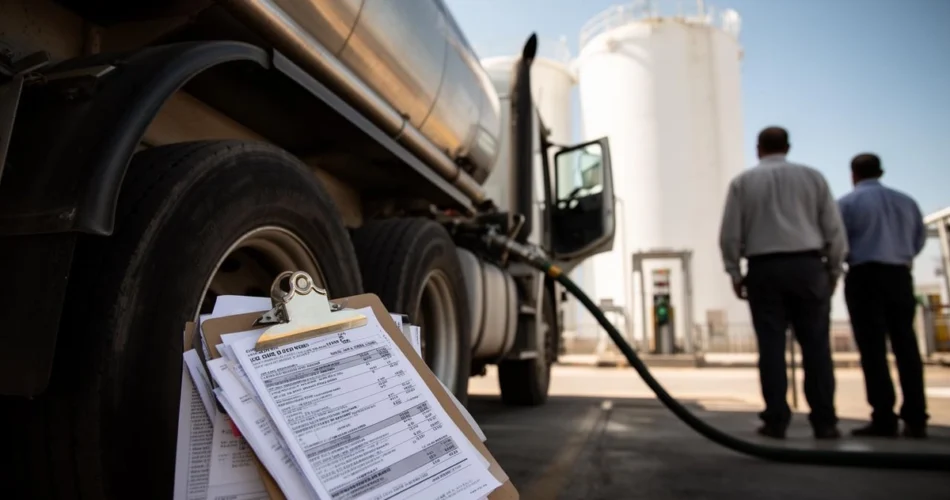
A federal lawsuit has cast a shadow over the discount gas station chain that drew presidential praise for slashing prices this summer, with a Georgia-based fuel supplier alleging it was never paid for nearly $4 million worth of gasoline that ended up at Freedom Fuel Network locations.
Mansfield Oil Company of Gainesville filed the complaint on Aug. 19 in the U.S. District Court for the Eastern District of Pennsylvania, claiming that New Jersey businessman Syed Kazmi and his company, KRSM Inc., lifted more than a million gallons of fuel from a terminal in Twin Oaks, Pennsylvania, between late May and early July without remitting payment.
The lawsuit states that KRSM had been a Mansfield client since 2022 and took the fuel under a commercial credit agreement that deferred payment. The Twin Oaks terminal — a Sunoco-branded fuel rack, according to a Politico review of the litigation — sits within 35 miles of the vast majority of Freedom Fuel Network stations, and at least 10 Pennsylvania locations listed on the network’s website received some of the disputed fuel, according to Urs Broderick Furrer, an attorney representing Mansfield.
“KRSM was able to sell such fuel for such low prices and garner such publicity because it never paid Plaintiff for such fuel,” the complaint reads.
KRSM pushed back forcefully against the characterization. Paul Toner, a lawyer for Kazmi and KRSM Inc., described the matter as “an account dispute over fuel invoices, mis-priced by Mansfield.” In a court declaration filed Aug. 25, Kazmi wrote that he “did not agree that the amounts Mansfield demanded were correct or owing,” citing discrepancies in the invoices including charges that appeared to have been double counted.
A federal judge on Friday ordered Kazmi and KRSM to maintain at least $2.75 million in a bank account while the case proceeds, according to court records.
From Presidential Praise to Legal Scrutiny
The Freedom Fuel Network burst into the national spotlight in early July when President Donald Trump celebrated the chain’s $3.47-per-gallon price point on Truth Social, a figure the president noted was set in honor of his status as the nation’s 47th president. At the time, pump prices had spiked due to the Iran war, and Freedom Fuel’s rates sat roughly 40 cents below market levels.
Note: National gasoline prices had been unusually volatile in the months before Trump’s post. According to AAA data, the U.S. average for regular gasoline was $2.98 a gallon the day before the Iran war began, spiked to a wartime high of $4.56 on May 21, 2026, and eased through June before climbing back above $4 in late July as fighting resumed. By late August 2026 the national average stood at roughly $4.08 to $4.10 a gallon — about 40% above the pre-war level.
“A VERY smart Retailer, located throughout the Northeast, is stepping up” to lower gas prices, Trump wrote. “This Retailer is taking the lead, and others should follow. They are doing this because they love the U.S.A.”
The White House later posted a video of drivers filling up at one of the stations and thanking Trump for the low prices. A White House official told The Washington Post that the administration has had “zero contact or dealings” with Kazmi and KRSM Inc.
The network was legally formed on June 25, when Randy Brown and Yoni Gontownik submitted incorporation documents to Delaware. Brown is a special-teams coach for the Baltimore Ravens who has described himself as “a proud Trump supporter,” while Gontownik is a New Jersey-based investor who previously worked for the energy and commodity group Mercuria. Neither responded to requests for comment.
The web of parties around the case looks like this:
Public records list Syed Kazmi’s brother, Shamikh, as the facility operator for several Freedom Fuel stations — at least six, according to a review of state business filings. A source familiar with the Freedom Fuel business said KRSM and Syed Kazmi “are not associated with the Freedom Fuel Network in any capacity,” while the network’s website has dismissed what it called “misinformation and baseless speculation.”
A Pattern of Legal Claims
The Mansfield lawsuit is the latest in a string of legal actions against the Kazmi brothers and their companies, which have been sued more than a dozen times in recent years for alleged financial misconduct including fraud and unpaid debts. In several cases, default judgments were entered after the defendants failed to respond to charges.
| Year | Allegation | Outcome |
|---|---|---|
| 2021 | Shamikh Kazmi accused of taking $667,000 in fuel over 10 days without full payment | Default judgment entered; repayment ordered |
| 2022 | 7-Eleven accused KRSM of stealing tens of thousands of dollars in cigarettes | Judgment for plaintiff in 2024 |
| 2026 | Mansfield alleges KRSM took $4 million in fuel without payment | Pending; $2.75 million account freeze ordered |
Note: Court records show default judgments in several cases after defendants failed to respond to charges. KRSM disputed the 7-Eleven allegations, claiming the retailer breached the contract first.
The current lawsuit also alleges that KRSM is not authorized to conduct business in Pennsylvania or New Jersey at all. Neither state regulatory office responded to requests for comment.
Market Impact and Unanswered Questions
Since the initial publicity wave, prices at Freedom Fuel stations have risen but remained below competitors’ rates as of early August, according to a Washington Post analysis. The network has also expanded, adding four stations to reach a total of 29 locations.
The lawsuit does not name Freedom Fuel Network or its stations as defendants, nor does it accuse them of wrongdoing. It also does not specify what portion of the $4 million in disputed fuel went to network locations, leaving open the question of whether station operators were aware of any payment issues.
The case highlights the opacity surrounding the network’s business model, which analysts questioned from the outset. When the chain first announced its discount pricing, industry observers noted that selling gasoline 40 cents below market would be difficult to sustain without some form of subsidy or unconventional supply arrangement.
The litigation now offers at least a partial explanation for how the pricing was possible, though the full picture remains contested. As the case moves forward in federal court, it will likely draw continued attention given the presidential connection and the broader questions it raises about fuel supply chains in the Northeast.
Mansfield’s attorney Furrer was direct in his assessment of the defense’s framing. “KRSM has failed to pay for fuel that they lifted off of Mansfield’s account,” he said in a statement. “That is not an accounting dispute.”
Source link
Author

- Ytv Market News
- Share-market news writer and analyst with deep experience covering equities, commodities, forex, and cryptocurrencies for readers in the USA, UK, Canada, and Australia. Ytv Market News delivers timely market updates, practical trading insights, and clear explanations of macro and company-level catalysts that move prices. Combines on-the-ground financial reporting with technical analysis, using concise charts and actionable ideas to help investors and traders make smarter decisions.
Latest entries
 Crypto NewsAugust 30, 2026The Persistence of Retail Demand: The Structural Challenge for the BCRA in the Face of Currency CoverageRetail savings exceeded $3.460 billion in July. This inelastic demand raises questions about the liquidity available for future financial commitments.
 Investing InsightsAugust 30, 2026Hyatt (H) Stock May Be 8% Undervalued As Cash Flow Holds Up
 UsaAugust 30, 2026Here’s the Maximum Social Security Increase You Could Get From a 3.6% 2027 COLA
 AustraliaAugust 30, 20262 ASX shares with dividend yields above 9.5%