

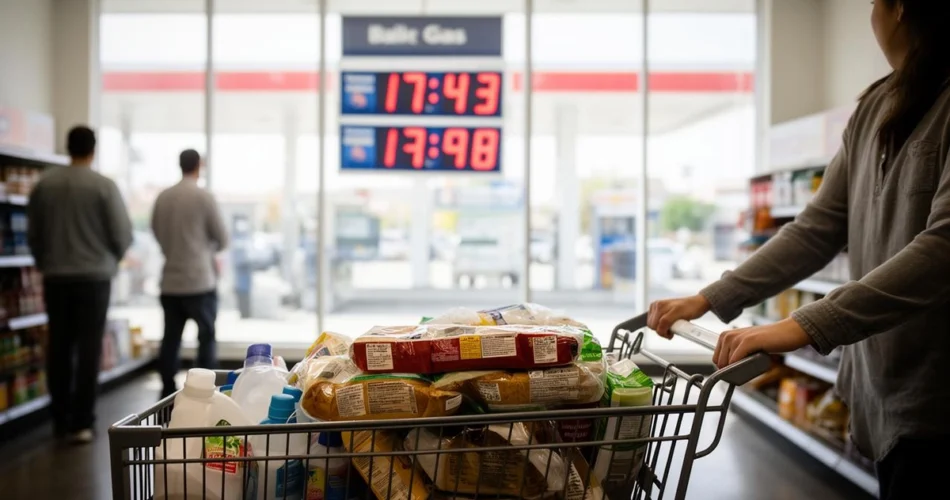
The US consumer market is splitting into two worlds at a startling pace. The nation’s two largest “dollar store” discount retailers, Dollar General (DG) and Dollar Tree (DLTR), released earnings on Thursday (the 27th) that both beat market expectations, revealing a paradoxical picture: low-income households are being forced by high gas prices to shrink their shopping radius and scrutinize every dollar spent, while high-income households are still walking confidently into discount stores, filling their carts with non-essential items.
Dollar General posted a 3.5% year-over-year increase in same-store sales last quarter, marking its fifth consecutive quarter of traffic growth. The company also raised its full-year sales forecast to a range of 2.5% to 2.9% and announced it would resume its share buyback program in the second half. The positive news sent shares soaring as much as 8% intraday, before settling at a 2.5% gain to close at $125.89 (approximately NT$4,000).
Dollar Tree, which operates more than 9,000 stores, reported a 3.7% year-over-year increase in same-store sales, marking the first time in four quarters that average customer traffic returned to growth. However, the company’s profit forecast for the current quarter fell short of Wall Street expectations, and with its full-year revenue target unchanged, shares closed down 3.9% at $127 (approximately NT$4,000).
High Gas Prices “Pin” Consumers Close to Home
Executives at both companies pointed to the same critical variable: fuel prices. Persistently high gasoline prices are changing how Americans shop—reducing the frequency of long drives to big-box stores and shifting everyday purchases to discount stores closer to home.
Dollar General executives stated explicitly on the earnings call that elevated gasoline prices are forcing consumers to shop less frequently and to spend at locations closer to home, directly boosting store traffic. Jefferies analyst Corey Tarlowe put it bluntly: “In an environment of elevated gasoline prices, we believe Dollar General is a retail format that consumers are increasingly relying on.”
Dollar Tree CEO Todd Vasos echoed that observation. On the analyst call, he said: “Most notably, rising and increasingly volatile fuel prices are forcing consumers to place even greater emphasis on value and affordability.”
However, both CEOs simultaneously warned that higher fuel costs will erode profit margins in the second half of this year. That means discount retailers may be winning foot traffic, but they may not be able to fully convert that into profit.
Middle- and Upper-Income Shoppers Join the “Treasure Hunt”
The uptick in discount store performance isn’t being driven solely by struggling low-income households. Dollar Tree CEO Vasos revealed that the retailer saw sales growth across all income brackets, with the year-over-year increase driven primarily by middle- and upper-income households. He noted: “The inflationary environment continues to put budget pressure on all families, particularly lower-income consumers.”
Dollar General is also adjusting its product mix to respond to this trend. The company, which operates more than 21,000 stores across the US, is increasing the share of general merchandise in its overall product assortment, targeting demand from lower-income consumers seeking cheaper apparel, home goods, and toys.
This phenomenon of “high earners also hunting for bargains,” coexisting with high-income households’ continued purchases of non-essential items, paints a picture of widening economic divergence in America: on one end, consumers are deferring discretionary spending and calculating every dollar with precision; on the other, there remains ample room to stock up on non-essentials at discount stores.
Tariff Refunds Serve as an Earnings “Booster Shot”
Buried in both companies’ earnings reports is an easily overlooked tailwind: IEEPA tariff refunds from the US government. Dollar General projects fiscal 2026 earnings per share of $7.80 to $8.00 (approximately NT$250), of which $0.25 (approximately NT$7.9) comes from tariff refund contributions. Dollar Tree raised its full-year EPS guidance to $7.70 to $8.05, with tariff refunds contributing approximately $0.60 (approximately NT$19).
Dollar Tree CEO Vasos said the company reinvested a substantial portion of the tariff refunds received in the most recent quarter back into the business to strengthen its price competitiveness, including promotional campaigns for the summer holiday season and price reductions on everyday items.
Dollar stores have now joined the ranks of retailers from Walmart (WMT) to Target in deploying a portion of tariff refunds toward price cuts, lowering prices on thousands of items across groceries and general merchandise to stimulate consumption.
Walmart’s Warning Signal and the Oil Price Shadow
The discount duo’s strong performance, contrasted with retail giant Walmart’s (WMT) rare miss on quarterly sales reported last week, further underscores the reality of weak consumer spending. Walmart has long served as a barometer for US consumer sentiment, and its underperformance suggests overall retail momentum is cooling.
Meanwhile, US President Donald Trump has warned that fuel prices could remain elevated as the conflict with Iran continues to escalate. If oil prices stay high, discount stores’ traffic tailwind may persist, but margin pressure will follow just as closely.
The two discount retailers’ earnings reports collectively point to an emerging new normal in consumer behavior: high gas prices are reshaping Americans’ shopping radius, pushing more consumers toward value-focused stores near home; and the entry of middle- and upper-income households means “saving money” is no longer the exclusive domain of low-income families, but rather a collective behavior that cuts across income brackets.
Source link
Author

- Ytv Market News
- Share-market news writer and analyst with deep experience covering equities, commodities, forex, and cryptocurrencies for readers in the USA, UK, Canada, and Australia. Ytv Market News delivers timely market updates, practical trading insights, and clear explanations of macro and company-level catalysts that move prices. Combines on-the-ground financial reporting with technical analysis, using concise charts and actionable ideas to help investors and traders make smarter decisions.
Latest entries
 CanadaAugust 29, 2026ADDITIONAL INVESTMENT IN CANADA NICKEL COMPANY INC. BY AVENIR MINERALS LIMITED
 Commodities NewsAugust 29, 2026Agriculture, Petroleum Ministries Deny Cut to 2.4 Mn-Ton Fertilizer Subsidy Quota
 Crypto NewsAugust 29, 2026U.S. Military Maintenance Backlog Exceeds $285 Billion
 Investing InsightsAugust 29, 2026Why Is Toyota Motor (TSE:7203) Putting Its Next Lexus EV In China First?


