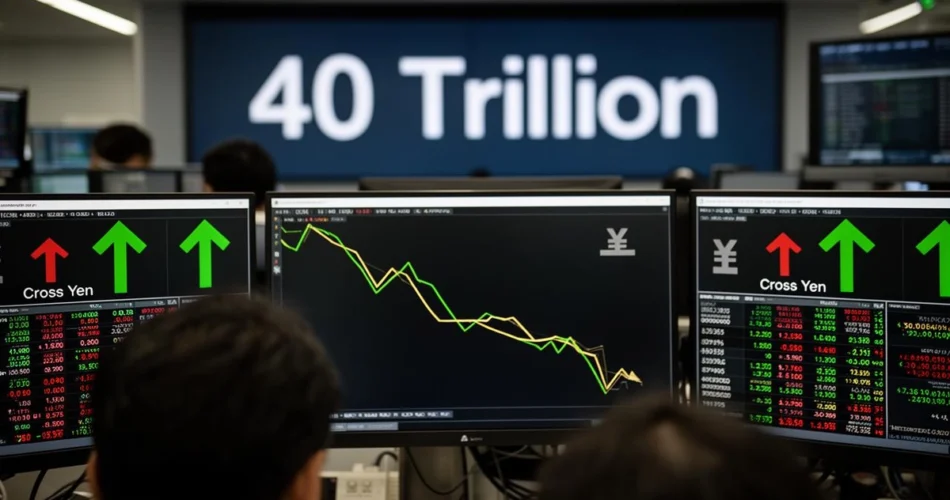
Debasement trade is expanding as capital flows into gold, Bitcoin, the euro, Swiss franc, and Australian dollar, driven by mounting U.S. fiscal concerns. Meanwhile, the yen is increasingly viewed as a currency saddled with the same fiscal and debt problems, making it an unlikely beneficiary of dollar weakness. Market attention is beginning to shift away from USD/JPY toward cross-yen pairs such as AUD/JPY and CHF/JPY.
Debasement originally means “lowering the quality of currency,” a practice dating back to ancient Roman emperors and English kings who reduced the precious metal content of coins to erode currency value. In modern markets, debasement trade refers to capital flight into physical and alternative assets during periods when confidence in fiat currencies—particularly the U.S. dollar as the world’s reserve currency—is shaken by fiscal expansion or excessive monetary easing.
U.S. Fiscal Anxiety as the Trigger
The backdrop is mounting concern over U.S. fiscal health. U.S. federal debt surpassed $40 trillion (approximately ¥6,403 trillion) for the first time in history on August 19, and the fiscal deficit for the ten months through July has already exceeded the full-year deficit of the previous fiscal year.
On August 19, the U.S. Treasury Department announced it would expand the per-operation cap on buybacks of Treasury securities with at least 10 years remaining to maturity from $2 billion (approximately ¥320 billion) to at least $4 billion (approximately ¥640 billion), aimed at supporting liquidity in the long-term Treasury market. While long-term and ultra-long-term yields initially declined following the announcement, they subsequently resumed their upward climb—hardly a sign that fiscal anxieties have been dispelled. Market analyst Itsuo Toshima noted that the Treasury’s actual action paradoxically made fiscal concerns feel more concrete and real.
The Dollar Index, which measures the greenback’s overall strength against a basket of currencies, fell to the mid-98 level last week, sinking to a three-month low. It is already down 3% from its late-July peak. Meanwhile, gold (London spot) approached $4,700 per troy ounce on August 25, a three-month high, with gains exceeding 8% over the past week. Bitcoin/USD also surged to $81,000, a three-month high.
A survey published by the European Central Bank (ECB) in June showed that gold accounted for 27% of global official reserve assets in 2025, surpassing U.S. Treasuries (22%) for the first time in roughly 30 years. While valuation gains from rising gold prices played a role, the data underscores the underlying strength of the shift from currencies to gold.
Ray Dalio, founder of U.S. hedge fund Bridgewater, also weighed in on August 21 via LinkedIn, warning that without changes to U.S. fiscal policy, a debt crisis could arrive “within three years (plus or minus two years)” and recommending that investors allocate 10–15% of assets to gold. The de-dollarization trend is becoming a structural shift rather than a temporary speculative move.
Why the Yen Isn’t Being Bought
Dollar selling driven by debasement trade has translated relatively straightforwardly into gains for the euro, the Swiss franc—traditionally viewed as a safe-haven currency—and the Australian dollar, which has a high correlation with gold. These currencies are well-positioned as “alternatives to the dollar.”
The yen, by contrast, appears unable to ride this wave, likely because it is perceived as a currency facing the same fiscal and debt challenges. In theory, dollar weakness should exert upward pressure on the yen, but in practice the yen has failed to attract sustained buying and remains range-bound.
In foreign exchange trading on August 28, the yen was roughly flat at ¥159.34 per dollar. While it has given back some of the gains from intervention, it is still up 1.3% for the month. The euro traded at $1.1652 and the British pound at $1.3597, both near one-week lows but on track for a second consecutive monthly gain. The Australian dollar hit a three-month high of $0.72, supported by rate-hike speculation.
Market attention is focused on Federal Reserve Chair Kevin Warsh’s speech scheduled for August 28 at Jackson Hole. Investors are seeking clues about how he intends to approach monetary policy and inflation control. However, expectations are somewhat tempered given his known opposition to explicit forward guidance on interest rates.
OCBC FX strategist Sim Moh Siong noted in a research note that “uncertainty surrounding the Fed’s reaction function and concerns that policymakers may be de-emphasizing inflation control are heightening market attention on Chair Warsh’s Jackson Hole remarks.” He added that for the dollar to decline meaningfully following the Treasury’s buyback announcement, there would need to be evidence that the Fed is prepared to support capping Treasury yields—a scenario he views as unlikely.
Traders are pricing in a roughly 35% probability of a rate hike at the September FOMC meeting, rising to 75% by December. The 10-year U.S. Treasury yield remains elevated at 4.676%.
Cross-Yen Pairs Offer Better Opportunities
For USD/JPY, the 160 level is viewed as extremely heavy resistance, particularly given the history of coordinated intervention. Until the Bank of Japan’s path of consecutive rate hikes becomes clearer, selling dollars against the yen appears premature, and a wait-and-see approach seems prudent.
If so, buying cross-yen pairs such as AUD/JPY and CHF/JPY on dips represents a more efficient way to capture the debasement trade theme. While the yen is unlikely to be bought on its own, the Australian dollar and Swiss franc are well-positioned as alternatives to the dollar.
Debasement trade has resurfaced repeatedly since the second Trump administration took office in 2025. Repeated demands for Fed rate cuts raising concerns about central bank independence, sweeping reciprocal tariffs, and stated intentions regarding Greenland. Each time these risks come into focus, confidence in the dollar is called into question, and gold and Bitcoin are bought as “stateless assets” in a recurring pattern.
Tomio Shida of the Japan Metal Economics Research Institute noted that while last year’s gold rally was somewhat overextended, driven primarily by ETF inflows, the underlying current of shifting from currencies to gold persists even as circumstances evolve.
As long as uncertainty surrounding U.S. fiscal policy continues, investors should remain mindful of the structural flow of capital from the dollar into gold, Bitcoin, the euro, Swiss franc, and Australian dollar. Given that the yen is unlikely to be bought on its own, responding through dip-buying in cross-yen pairs appears to be the most reasonable approach for now.
Source link
Author

- Ytv Market News
- Share-market news writer and analyst with deep experience covering equities, commodities, forex, and cryptocurrencies for readers in the USA, UK, Canada, and Australia. Ytv Market News delivers timely market updates, practical trading insights, and clear explanations of macro and company-level catalysts that move prices. Combines on-the-ground financial reporting with technical analysis, using concise charts and actionable ideas to help investors and traders make smarter decisions.
Latest entries
 Crypto NewsAugust 29, 2026SEC moves to exempt EU debt futures under US rules
 Investing InsightsAugust 29, 2026Is Argan (AGX) Undervalued After Its Sector Led Selloff?
 UsaAugust 29, 2026After CrowdStrike’s “Best Quarter in Company History” and Explosive Stock Market Gains, Is It Too Late to Buy?
 Crypto NewsAugust 29, 2026Crypto VC funding: RQD* raises $74M, Fasset gets $68M