

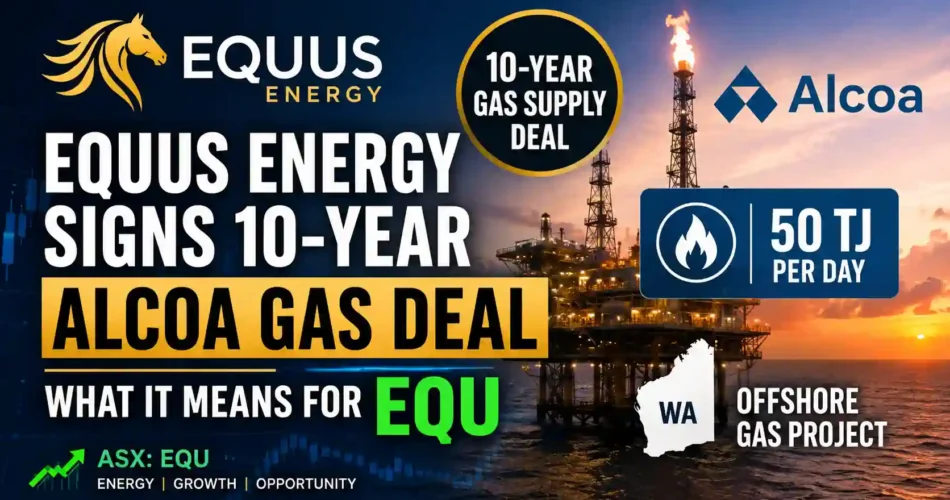
Equus Energy Finalises 10-Year Alcoa Supply Deal for Offshore WA Gas Project
Equus Energy Limited (ASX: EQU) is moving forward with its Equus Gas Project in Western Australia after progressing a long-term gas supply arrangement with Alcoa of Australia. The agreement is an important commercial milestone for the offshore gas development and could provide Equus with a major industrial customer if the project reaches production.
The arrangement involves potential gas supplies of approximately 50 terajoules (TJ) per day to Alcoa for 10 years, subject to applicable conditions and the successful development of the Equus project. For Equus, the agreement provides greater visibility around future domestic gas demand while supporting the company’s broader strategy of developing its large offshore resource base.
Equus Energy and Alcoa Gas Deal Explained
The relationship between Equus and Alcoa is centred on the development of the Equus Gas Project, located offshore Western Australia in the northern Carnarvon Basin.
Under the commercial arrangement, Alcoa can provide staged funding of up to US$30 million to support development activities, including pre-front-end engineering and design (pre-FEED) and FEED work, subject to agreed milestones and conditions.
If the project progresses through development and reaches commercial production, Alcoa is expected to receive approximately 50 TJ of gas per day over a 10-year period. That represents roughly 182 petajoules of gas over the full term.
The arrangement could be particularly important because Alcoa operates major alumina refining facilities in Western Australia, where reliable energy supplies are critical to industrial production.
Why the Equus Gas Project Matters
The Equus Gas Project is located approximately 200 kilometres northwest of Onslow on Western Australia’s North West Shelf.
The region is one of Australia’s most important oil and gas provinces, with extensive offshore resources, LNG infrastructure and established processing facilities.
Equus has been assessing development options designed to take advantage of existing infrastructure. A tie-back approach could potentially reduce the capital required compared with constructing an entirely standalone offshore and onshore system.
Large Offshore Resource Base
Equus has reported an independently certified 2C contingent resource of approximately 1.7 trillion cubic feet (Tcf) of gas, together with around 38 million barrels of condensate.
This resource gives the company a substantial base from which to develop a potential long-term production project. The presence of condensate could also provide an additional revenue stream alongside natural gas.
Equus Energy owns and operates the project and has been progressing technical and commercial work aimed at moving the asset toward development.
How the Alcoa Agreement Could Reduce Project Risk
Offshore gas developments can require significant investment before production begins. Companies must secure financing, obtain regulatory approvals, complete engineering studies and establish reliable routes to market.
A long-term gas customer can help address some of the commercial uncertainty associated with a new project.
For Equus, the Alcoa arrangement provides a potential anchor customer for domestic gas. The funding component can also help finance important development activities without relying entirely on additional equity funding.
However, investors should remember that a long-term supply agreement does not automatically mean the project will enter production. The project still faces development, financing, regulatory and technical requirements.
Equus Advances Its Tie-Back Strategy
Equus has been investigating ways to connect its offshore gas resources with existing infrastructure in Western Australia.
The company’s development strategy has focused on identifying cost-effective infrastructure solutions that could potentially serve both the domestic gas market and international LNG opportunities.
Why Existing Infrastructure Is Important
Using existing infrastructure can potentially reduce the capital intensity of a new gas development. It may also allow a project to reach commercial production more efficiently than a completely greenfield development.
Equus has examined potential infrastructure connections involving established facilities in the North West Shelf region. The final development concept will depend on technical studies, commercial negotiations, infrastructure access and project economics.
Pre-FEED and Development Work
Pre-FEED studies are an important step in determining whether a major resource can be converted into a commercially viable project.
For Equus, development studies are designed to assess areas such as offshore facilities, pipelines, processing requirements, infrastructure connections, LNG opportunities and condensate handling.
The work is also expected to improve estimates of project costs and development schedules. Those details will be important when Equus engages potential development partners, financiers and infrastructure operators.
Western Australia’s Gas Market Adds to the Opportunity
The Equus project is also being developed against a changing Western Australian gas market.
Western Australia is a major LNG-producing state, but its domestic gas market depends on a combination of existing and new supply sources. As some mature fields decline, additional resources may become increasingly important.
Equus has highlighted Australian Energy Market Operator forecasts pointing to potential future supply pressures in Western Australia’s domestic gas market.
This environment could create opportunities for new gas developments that can deliver reliable domestic supply while also accessing existing infrastructure.
What the Deal Means for Alcoa
For Alcoa, the agreement provides a potential additional source of long-term natural gas for its Western Australian operations.
Gas is an important energy input for alumina refining, meaning long-term supply security can be strategically valuable for large industrial consumers.
The proposed 50 TJ per day allocation from Equus could represent a meaningful portion of Alcoa’s future gas requirements in Western Australia.
The relationship therefore creates a potential benefit for both parties: Equus gains a prospective anchor customer, while Alcoa gains exposure to a potential future domestic gas supply source.
What Happens Next for Equus Energy?
The next stage of the Equus story will focus on converting technical studies and commercial agreements into a development plan.
Key Milestones Investors Should Watch
- Completion of pre-FEED and development studies.
- Selection of a preferred offshore development concept.
- Confirmation of infrastructure access arrangements.
- Progression toward FEED activities.
- Regulatory and environmental approvals.
- Potential selection of strategic development partners.
- Further domestic gas and LNG offtake agreements.
- Project financing and funding arrangements.
- Progress toward a Final Investment Decision (FID).
Partnering is likely to remain an important part of Equus’ strategy. A major offshore gas project requires substantial technical and financial resources, making the participation of experienced infrastructure, energy or investment partners potentially significant.
Equus Energy Stock Outlook
For investors following ASX: EQU, the Alcoa agreement represents one of the more significant commercial developments surrounding the company.
The potential 10-year supply relationship gives Equus greater visibility around future domestic demand. The associated funding arrangement may also support the next stages of project evaluation.
However, Equus remains a development-stage energy company. The investment case therefore involves considerably more uncertainty than that of an established gas producer with operating assets and recurring production.
Investors should monitor future announcements covering resource updates, project costs, infrastructure agreements, financing, regulatory approvals, strategic partnerships and the eventual FID.
Potential Risks for Investors
Despite the positive commercial development, the Equus project still faces several risks.
Development Risk
Offshore projects can encounter technical challenges, cost increases and delays. Engineering studies will determine whether the proposed development can be delivered within an acceptable budget.
Funding Risk
The company will require substantial capital to move from studies into construction and production. Additional funding arrangements or strategic partners may therefore be required.
Commodity Price Risk
Gas prices and LNG market conditions can influence the economics of major energy projects. Changes in market conditions could affect project returns.
Regulatory Risk
Offshore gas projects must satisfy environmental, regulatory and other approval requirements. Delays in obtaining approvals can affect development schedules.
Frequently Asked Questions
What is the Equus Gas Project?
The Equus Gas Project is an offshore gas development located in Western Australia’s northern Carnarvon Basin, approximately 200 kilometres northwest of Onslow.
How much gas could Equus supply to Alcoa?
The proposed arrangement provides for approximately 50 TJ of gas per day over a 10-year period, subject to the applicable project and agreement conditions.
How long is the Alcoa gas agreement?
The proposed gas supply period is 10 years, providing Equus with a potential long-term domestic customer once the project reaches commercial production.
How much funding is associated with the agreement?
The arrangement provides for staged funding of up to US$30 million toward eligible project development activities, subject to agreed conditions and milestones.
Is Equus Energy already producing gas?
No. The Equus Gas Project remains in the development phase. The company is progressing technical, commercial, regulatory and financing activities before a potential Final Investment Decision.
Does the Alcoa agreement guarantee future gas production?
No. The agreement is an important commercial milestone, but future gas deliveries depend on the successful development of the project and satisfaction of the relevant contractual and regulatory conditions.
What is the main opportunity for EQU investors?
The central opportunity is the potential commercialisation of a large offshore gas resource using existing Western Australian infrastructure, supported by domestic demand and potential LNG markets.
Bottom Line
Equus Energy’s 10-year gas supply arrangement with Alcoa represents a significant step in the development of the Equus Gas Project.
The proposed supply of approximately 50 TJ per day provides Equus with a potential long-term industrial customer, while the associated funding can help advance technical and engineering work.
The broader investment story remains centred on whether Equus can successfully convert its substantial offshore resource into a commercially viable producing asset.
With a large contingent resource, access to established Western Australian infrastructure and potential domestic and LNG markets, Equus has several important catalysts ahead. However, investors should continue to assess project funding, development costs, regulatory approvals, infrastructure arrangements and progress toward FID before drawing conclusions about the company’s long-term valuation.
Disclaimer: This article is for informational purposes only and does not constitute financial or investment advice. Investors should conduct independent research and review official ASX and company announcements before making investment decisions.

