

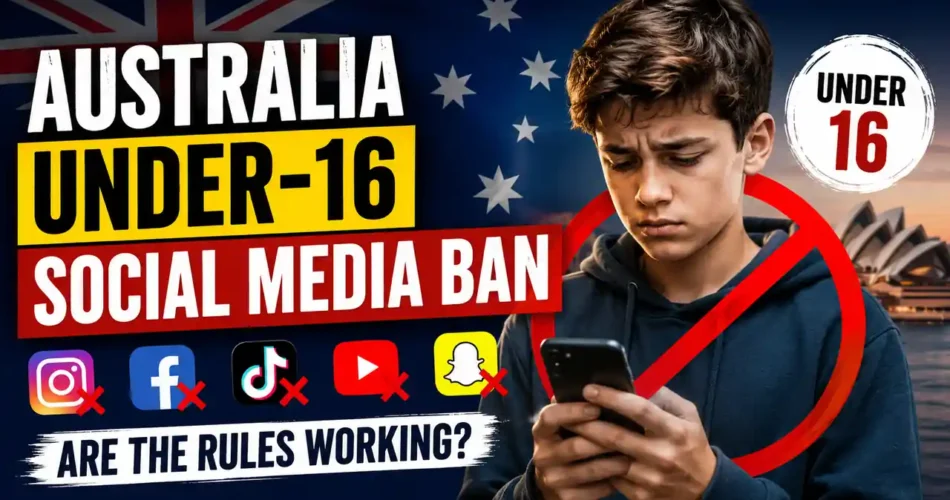
Australia’s Under-16 Social Media Ban Faces Scrutiny as Tech Firms Urge Caution Over Early Data
Australia’s world-first social media restrictions for children under 16 are facing renewed scrutiny as major technology companies argue that early data should be interpreted cautiously. The debate comes as lawmakers and regulators examine whether platforms are doing enough to prevent children below the age threshold from accessing covered social media services.
Representatives from major technology companies, including Google’s YouTube, Meta, Snapchat and TikTok, have faced questions from an Australian Senate inquiry examining the implementation of the restrictions. The companies have pointed to the evolving nature of age-assurance technology and warned that early figures may not provide a complete picture of the policy’s effectiveness.
What Is Australia’s Under-16 Social Media Ban?
Australia introduced its landmark restriction on social media accounts for people under the age of 16 in December 2025. The policy was designed to prevent children below 16 from maintaining accounts on social media platforms covered by the legislation.
The Australian government has defended the measure as an important step toward protecting children from potential online harms, including harmful content, excessive platform use, online exploitation and other risks associated with social media.
The policy has attracted international attention because Australia became the first country to introduce such a broad nationwide age restriction. Governments in other countries are now watching Australia’s experience as they consider their own approaches to online child safety.
Early Data Raises Questions About Enforcement
One of the biggest challenges facing Australia’s policy is enforcement. Early research suggested that a large proportion of minors continued to use social media several months after the restrictions came into effect.
Australia’s eSafety Commissioner Julie Inman Grant has said early data indicated that platforms still had work to do to prevent underage users from accessing their services. At the same time, regulators have acknowledged that enforcement is an ongoing process and that more data will be required before the long-term effectiveness of the policy can be assessed.
Technology companies have urged lawmakers not to treat the initial figures as a final assessment of the ban. They argue that enforcement systems are still being improved and that the technology used to determine a person’s age is developing rapidly.
Why Age Verification Is Difficult
Determining whether an individual is below 16 is more complicated than simply asking users to enter their date of birth. Platforms must identify potentially underage users while also reducing the risk of incorrectly restricting adults.
Age-assurance systems can rely on several different signals, including information provided by users, account activity, technological age estimation and other verification methods.
Technology companies have highlighted the difficulty of accurately distinguishing between users who are close to the legal threshold. A system designed primarily to separate adults from children may not automatically be accurate enough to distinguish a 15-year-old from a 16-year-old.
Meta Reports Hundreds of Thousands of Account Removals
Meta has provided figures showing the scale of its enforcement efforts in Australia. The company reported that it had deactivated approximately 756,000 Australian accounts suspected of belonging to users under 16 between the period before the restrictions began and June 2026.
The figure included approximately 462,000 Instagram accounts and 294,000 Facebook accounts. Meta had previously reported removing roughly 500,000 accounts by March, meaning its enforcement activity continued to increase over subsequent months.
Meta has also said it uses artificial intelligence and behavioural signals to identify accounts that may belong to underage users. The company has introduced measures designed to prevent users whose accounts have been removed from simply registering again.
However, the large number of removals also highlights the continuing challenge facing platforms. Removing hundreds of thousands of accounts does not necessarily establish how many underage users remain undetected.
YouTube and TikTok Continue Enforcement Efforts
YouTube has also reported significant enforcement activity. Google told the Australian inquiry that approximately 740,000 holders of Google accounts had been prevented from accessing YouTube in Australia under the restrictions.
However, the company has cautioned against interpreting the early figures as evidence that the policy has either succeeded or failed. YouTube says its age-assurance systems are continuing to evolve as the company gains more experience enforcing the Australian requirements.
TikTok has similarly described its enforcement process as ongoing. The platform said it removed approximately 550,000 accounts when the restrictions came into effect and has continued removing accounts believed to belong to underage users.
Australia Considers Tougher Penalties
Australia is also considering whether existing enforcement powers and penalties are strong enough to encourage compliance.
Proposed changes could increase the maximum financial penalty facing technology companies to A$99 million. Lawmakers are also considering giving the eSafety Commissioner stronger investigative powers, including greater authority to request information and documents from technology platforms and age-assurance providers.
Higher penalties could increase pressure on companies to strengthen their systems. For regulators, the objective is to ensure that platforms have sufficient incentives to prevent children under 16 from maintaining accounts.
For technology companies, however, enforcement must be balanced against privacy, accuracy and the risk of mistakenly blocking legitimate users.
Privacy Is a Major Concern
Age verification creates an important privacy debate. A system that requires users to provide government-issued identification could potentially offer stronger age verification, but it could also involve the collection of sensitive personal information.
Less intrusive approaches may protect privacy more effectively but could be less accurate. This creates a difficult balance between child protection and data protection.
The issue is particularly important because Australia’s policy could influence legislation in other countries. Governments considering similar restrictions will need to determine how age should be established and which organizations should be responsible for verifying it.
Could Australia’s Model Spread Globally?
Australia’s experiment is being closely monitored internationally. Governments in Europe and other regions have considered restrictions designed to limit children’s access to social media.
The United Kingdom has examined proposals involving stronger protections for younger users, while France has pursued its own restrictions on children’s social media access. These developments demonstrate that concerns about online safety are becoming increasingly important in technology regulation.
However, Australia’s approach may not be copied exactly. Other countries face different constitutional, legal and privacy requirements, meaning policymakers must determine whether similar measures can work within their own legal systems.
What Happens Next?
The next stage of Australia’s policy will likely focus on enforcement data and the performance of age-assurance systems.
Regulators will continue assessing whether platforms are complying with their responsibilities, while lawmakers consider whether stronger penalties and investigative powers are necessary.
Technology companies are also expected to continue improving their detection systems. The effectiveness of the policy will ultimately depend on whether these improvements significantly reduce the number of under-16 users able to maintain or create accounts.
The Key Test for Australia
The most important question is whether enforcement becomes more effective over time. If the number of underage users accessing covered platforms falls substantially, the Australian government could point to that as evidence that its approach is working.
If large numbers of minors continue finding ways around the restrictions, lawmakers could face pressure to introduce additional measures or reconsider aspects of the policy.
Protection Versus Digital Access
Australia’s social media restrictions represent a much larger debate about the responsibilities of technology companies and governments in protecting children online.
Supporters argue that children should receive stronger protection from harmful content, online exploitation and potentially addictive platform features. They believe technology companies should take greater responsibility for ensuring that young users are not exposed to unnecessary risks.
Critics, however, have raised concerns about privacy, freedom of expression, enforcement difficulties and the possibility that children could move to less-regulated online services.
The debate is therefore no longer simply about whether children should use social media. It also concerns who should verify a person’s age, what information should be collected and how governments can protect children without creating disproportionate restrictions on privacy and digital access.
Conclusion
Australia’s under-16 social media ban remains one of the world’s most closely watched experiments in digital regulation. Early data suggesting that many minors continued to access social media has increased pressure on technology companies and regulators.
At the same time, companies including Meta, YouTube and TikTok have reported removing or restricting large numbers of accounts and argue that their enforcement systems are still developing.
The coming months will be important for determining whether Australia’s approach can significantly reduce underage social media use. The outcome could have consequences far beyond Australia as governments around the world consider new ways to protect children online.
Frequently Asked Questions
What is Australia’s under-16 social media ban?
Australia’s policy restricts people under 16 from holding accounts on covered social media platforms. It was introduced as a major measure intended to strengthen online protections for children.
Is Australia’s social media ban working?
It is still too early to make a definitive assessment. Early data indicated that many minors continued to access social media, while platforms have reported removing large numbers of accounts and improving their enforcement systems.
How many accounts has Meta removed?
Meta reported that it had deactivated approximately 756,000 Australian Instagram and Facebook accounts suspected of belonging to users under 16 between the period before the restrictions began and June 2026.
How many YouTube users have been restricted?
Google told the Australian inquiry that approximately 740,000 holders of Google accounts had been prevented from using their accounts to access YouTube in Australia.
What penalties could social media companies face?
Australian lawmakers are considering measures that could increase the maximum penalty for companies to A$99 million and expand the investigative powers available to the eSafety Commissioner.
Why are technology companies asking for caution?
Technology companies argue that the available data comes from an early stage of enforcement. They also say age-assurance technology is continuing to develop and that early figures should not be treated as a final measure of the policy’s success or failure.
Could other countries introduce similar restrictions?
Yes. Governments in several countries are examining stronger restrictions on children’s social media access. Australia’s experience could provide important evidence for policymakers considering similar laws.

