

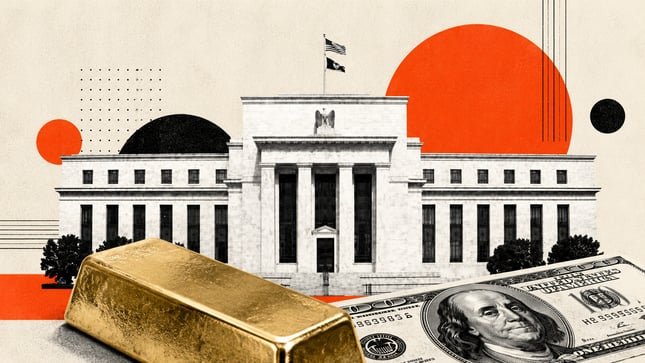
Gold (XAU/USD) prices extend losses to over 2.50% on Friday as market participants digest hawkish comments from Federal Reserve (Fed) Chair Kevin Warsh at Jackson Hole. Rising US Treasury yields and overall US Dollar strength are the two drivers of the sudden weakness in precious metals. The XAU/USD pair trades at $4,473, after hitting a high of $4,629.
XAU/USD extends losses as Jackson Hole remarks revive Fed tightening risks
Warsh commented that he still sees inflation as a priority, leaning hawkish as he recognized that underlying inflation measures haven’t improved. He stated that the Fed must be confident inflation is returning to its 2% goal, or otherwise “we have work to do.”
In his prepared remarks, he acknowledged that consumer spending is healthy and that the labor market is solid. Nevertheless, when speaking about price stability, Warsh acknowledged that the figures were “more concerning,” suggesting that the Fed would focus on tackling inflation.
Immediately after his remarks, money markets priced in a 50% chance of a 25-basis-point rate hike by the Fed at the September 16 meeting. As of writing, investors trimmed the odds to nearly 44%, but for December, they see an 82% chance, according to Prime Terminal.
The Greenback is rising by over 0.60%, as measured by the US Dollar Index (DXY), which tracks the value of the American currency against six other currencies. The DXY sits at 99.72, underpinned by the jump in US Treasury yields. The US 10-year Treasury yield has soared by 5.5 basis points to 4.728%.
The rise in US yields is attributed to market participants increasing their bets on a rate hike by the Fed at the September meeting. The odds stand at 43%, up from 34% a day ago, according to Prime Market terminal.
Other data showed the Nonfarm Payrolls Annual Revision coming in at -79K, below forecasts of 183K, improving from the previous revision of -911K. Also, the University of Michigan (UoM) Consumer Sentiment in August was 51.7, above estimates of 51, but deteriorated compared to July’s print.
US households expect inflation over the next year to ease from 4.2% to 4%, while over five years, expectations remain steady at 3.3%, in line with forecasts.
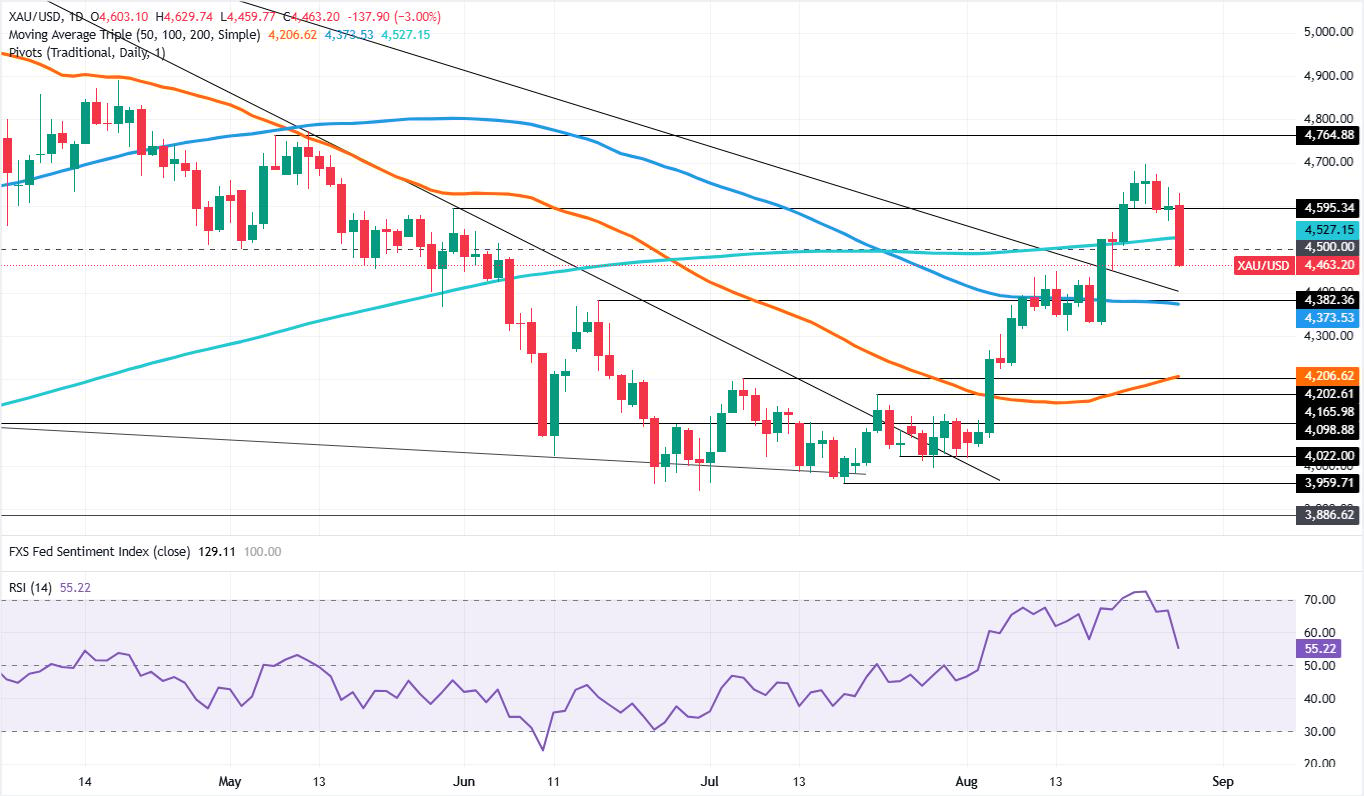
XAU/USD technical analysis: Gold’s tumbles below $4,500
Gold’s price action showed that the yellow metal almost tested the 200-day Simple Moving Average (SMA) at $4,527. However, it reversed part of the move on Warsh’s remarks, pushing back above the psychological $4,550 area.
From a momentum standpoint, buyers remain in charge as the RSI is above its 50 level. Nevertheless, the index has recently been trending lower, an indication that, in the short term, sellers are stepping in.
XAU/USD falling below the 200-day SMA opened the door to a move below $4,500. The next area of interest would be the 100-day SMA at $4,374.
For buyers, the first resistance is $4,500. Once reclaimed, the next stop is the 200-day SMA at $4,527, followed by $4,600. A decisive breakout could open the door to challenge the August 27 daily high at $4,643 ahead of the elusive $4,700.
(This story was corrected on August 28 at 18:38 to say Warsh instead of Warren in the technical analysis section.)
Fed FAQs
Monetary policy in the US is shaped by the Federal Reserve (Fed). The Fed has two mandates: to achieve price stability and foster full employment. Its primary tool to achieve these goals is by adjusting interest rates.
When prices are rising too quickly and inflation is above the Fed’s 2% target, it raises interest rates, increasing borrowing costs throughout the economy. This results in a stronger US Dollar (USD) as it makes the US a more attractive place for international investors to park their money.
When inflation falls below 2% or the Unemployment Rate is too high, the Fed may lower interest rates to encourage borrowing, which weighs on the Greenback.
The Federal Reserve (Fed) holds eight policy meetings a year, where the Federal Open Market Committee (FOMC) assesses economic conditions and makes monetary policy decisions.
The FOMC is attended by twelve Fed officials – the seven members of the Board of Governors, the president of the Federal Reserve Bank of New York, and four of the remaining eleven regional Reserve Bank presidents, who serve one-year terms on a rotating basis.
In extreme situations, the Federal Reserve may resort to a policy named Quantitative Easing (QE). QE is the process by which the Fed substantially increases the flow of credit in a stuck financial system.
It is a non-standard policy measure used during crises or when inflation is extremely low. It was the Fed’s weapon of choice during the Great Financial Crisis in 2008. It involves the Fed printing more Dollars and using them to buy high grade bonds from financial institutions. QE usually weakens the US Dollar.
Quantitative tightening (QT) is the reverse process of QE, whereby the Federal Reserve stops buying bonds from financial institutions and does not reinvest the principal from the bonds it holds maturing, to purchase new bonds. It is usually positive for the value of the US Dollar.
Source link
Author

- Ytv Market News
- Share-market news writer and analyst with deep experience covering equities, commodities, forex, and cryptocurrencies for readers in the USA, UK, Canada, and Australia. Ytv Market News delivers timely market updates, practical trading insights, and clear explanations of macro and company-level catalysts that move prices. Combines on-the-ground financial reporting with technical analysis, using concise charts and actionable ideas to help investors and traders make smarter decisions.
Latest entries
 UsaAugust 28, 2026LifeVantage Corporation (LFVN) Releases Q4 2026 Earnings: Revenue Falls Short
 Crypto NewsAugust 28, 2026Solana Price Today Surges Past $110 as ETF inflows hit record highs
 Investing InsightsAugust 28, 2026Sungrow Power Supply H1 Net Profit Falls Over 30% to 5.26 Billion Yuan; Proposes 6.4 Yuan Dividend Per 10 Shares — BigGo Finance
 GermanyAugust 28, 2026UK stocks close higher after Warsh’s comments

