

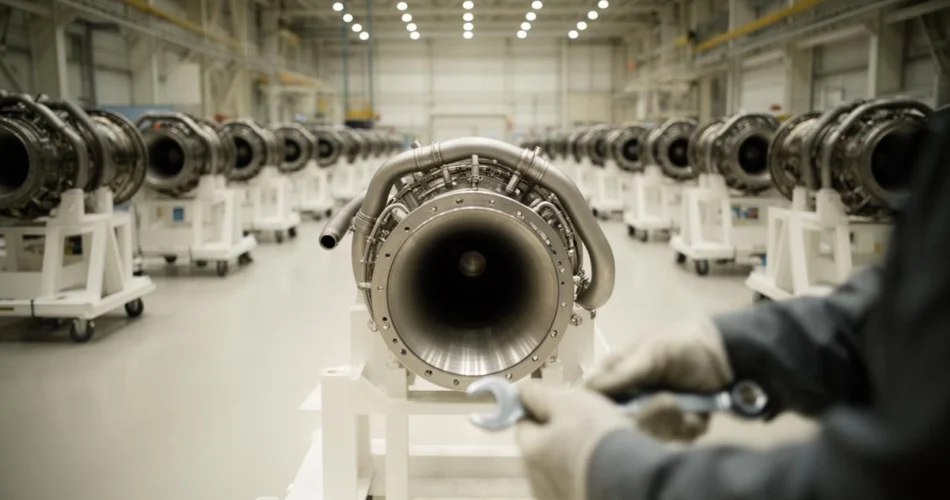
When Peter Beck walks through Rocket Lab’s Long Beach engine facility, he passes rows of 3D printers running around the clock, a full-size Electron rocket, and engine components made from proprietary alloys. But the most important artifact in the building may be a vending machine stocked not with snacks but with tape and electrical components. Beck mentions it almost as an aside. The point, he says, is operational velocity: engineers grab what they need without queueing at a storeroom.
That small detail captures the philosophy Beck is trying to institutionalize at Rocket Lab — a company he argues is misunderstood by investors who fixate on its rockets. Speaking on the Sourcery podcast during a rare on-site tour, Beck laid out a contrarian thesis: Rocket Lab’s moat is not the launch vehicle. It’s the full stack of spacecraft components, mission operations, and disciplined capital allocation surrounding it. And that moat, he insists, cannot be replicated with capital alone.
The most consequential test of that philosophy sits in the same building. It’s called Archimedes, a stage-combustion engine designed not to be exceptional but to be forgettable.
The race to build the most boring engine in spaceflight
Every rocket engine is a monument to compromise. Performance is typically the god, and engineers push materials and combustion temperatures to the knife’s edge to extract every second of specific impulse. Beck describes the result in blunt terms: engines that run for 190 seconds on a first stage, then never fire again.
Archimedes is a deliberate rejection of that tradition. “This is the first engine that is just not designed to be like that,” Beck said. “It’s designed to be like the most benign engine that you could possibly imagine so that you can just run and run and run and run and never ever think about it.”
The design numbers tell the story. An expendable engine needs roughly five minutes of life — Rutherford, which powers Electron, gets exactly that as its acceptance test. Archimedes must complete 40 starts and run for one hour cumulative before Rocket Lab will consider it qualified for reuse.
| Engine | Vehicle | Propellant | Cycle | Reusability | Qualification |
|---|---|---|---|---|---|
| Rutherford | Electron | Kerosene (RP-1) | Electric pump | Expendable | ~5 minutes |
| Archimedes | Neutron | Methane/oxygen | Stage combustion | Reusable | 1 hour, 40 starts |
The shift from expendable to reusable isn’t a marginal adjustment. It fundamentally changes what an engine is. “An expendable engine needs to run for 190 seconds on the first stage and then it never needs to run again,” Beck explained. “Whereas a reusable vehicle, especially the way we’re doing it, we want it to just run and run and run and run.”
That difference cascades through every design choice. Methane was selected over kerosene specifically because it burns clean — no soot residue in the regenerative cooling channels, no carbon buildup. A kerosene engine after a firing is, in Beck’s words, covered in “soot and black crap everywhere.” A methane engine comes back as shiny stainless steel. The chamber pressure is deliberately low for a stage-combustion cycle, reducing internal temperatures and extending component life. The tradeoff: lower pressure makes ignition harder.
Beck is candid about the engineering tension. “You create these things that are ultimately good, but you create a whole lot of problems along the way.”
Those problems required three to four years of development, a timeline Beck says reflects the unforgiving reality of stage-combustion engines. Unlike simpler cycles, a stage-combustion engine cannot be meaningfully tested component by component. The turbo pump and injector must be integrated before the first hot fire. Beck recounts an early test where the engine leaned out and consumed its own injector — literally leaving a hole where the component had been — yet the propellants continued mixing and producing thrust. That’s not a failure narrative; it’s a description of how hardware-rich development works when you can’t simulate everything.
The facility itself is a monument to opportunistic capital allocation. The Long Beach building was purchased out of the Virgin Orbit bankruptcy for $16 million, after Beck and his team piled into golf carts to inspect it during the sale process. He estimates it contained over $100 million in equipment. “It was a fantastic contribution from Sir Richard Branson to the space industry,” Beck noted, with evident satisfaction.

3D printing as manufacturing speed, not gimmickry
The tour’s centerpiece is one of the industry’s largest 3D printing operations, churning out engine components in Inconel superalloys, copper, titanium, and a proprietary material developed specifically for Archimedes. The longest single print runs about 3.5 days. A new machine arriving next year — the first of its kind in the world, Beck says — will be able to print an entire Archimedes engine in a single pass, roughly the height of the CEO himself.
But Beck is careful not to oversell the technology. “We’re not stupid. We don’t like 3D print bolts and all that sort of stuff,” he said. The philosophy is selective: use additive manufacturing where it collapses complexity, merges multiple parts into one, and accelerates production. “At the end of the day, it’s all about speed and cost.”
The production math is already visible. Rocket Lab produces one Rutherford engine per day — a rate that has put over 930 of the engines into space cumulatively. Archimedes is currently emerging at one engine every eight days, slower but in an entirely different class of complexity. The turbo pump alone delivers 15,000 horsepower.

Vertical integration from rocket to applications
The tour includes a full Electron rocket, a carbon composite vehicle that has flown 93 times — the second most frequently launched rocket in the world behind SpaceX’s Falcon 9. Beck is quick to note that Rocket Lab builds everything in-house: tanks, engines, software, flight computers, reaction wheels, solar panels. “We build everything in this vehicle,” he said. “Every piece of hardware, every piece of software, tanks, engines, you name it. I think that’s one of the key successes of the company is just that vertical integration.”
That integration philosophy extends far beyond launch. The same logic is being applied to Rocket Lab’s space systems division, which now generates the majority of the company’s revenue. Beck frames the pending acquisition of Iridium Communications — announced as “just the start of our applications layer” — as part of a deliberate architecture for what major space companies will look like.
“I’ve always believed like the big space companies of the future going to all look a little bit the same,” Beck said. “They’re going to have their own rocket because access to space is key. They’re going to have their own ability to build as many satellites as they need, and they’re all going to have applications.”
It’s a striking claim: the future of the space industry is convergence on a common corporate structure, not divergence. Launch, satellite manufacturing, and applications — the full stack. SpaceX is the obvious template. Amazon’s Kuiper is another. Beck is betting that Rocket Lab joins that club.
The Iridium deal — an $8 billion enterprise-value, cash-and-stock transaction at $54 per Iridium share, a 24.1% premium to its last close before the announcement — would bring an operating constellation of 66 satellites, over 2.5 million subscribers, and roughly $870 million in annual revenue — more than Rocket Lab’s own trailing twelve-month total. The acquisition is expected to close in mid-2027, subject to Iridium shareholder and regulatory approval. It’s the fastest possible way to acquire an applications layer, and Beck is explicit that it’s just the first step.
He is equally explicit about what he’s not doing: space tourism. “Unfortunately, I’m the CEO. So, if anything ever goes bad, guess who’s knocking on the door.”
The industry is at the first email
The most provocative moment in the conversation isn’t about hardware. It’s Beck’s assessment of the industry’s maturity. Having spent 20 years in the sector, he argues the democratization of space — commercial entities routinely launching rockets — is already an achievement of the past. What comes next is uncharted.
“I think the biggest thing to be done in space hasn’t even been thought about, let alone talked about,” Beck said. “So, I think we’re at the very, very beginning of the whole process. If you want to make an analogy here, it’s like we’ve seen that first email in the beginning of the internet.”
That framing has real investment implications. If the current moment is equivalent to the first email, then today’s launch and satellite businesses are infrastructure plays — the telecom protocols and server racks of the space economy. The applications that will define the industry’s size in 20 or 30 years don’t exist yet, anymore than social media or streaming existed when the internet was a novelty for academics.
Beck also offers a warning about the industry’s information asymmetry. Space is so technically complex that even sophisticated investors struggle to evaluate claims. “People can stand up and make these claims and it’s really really hard to collaborate unless you like go five layers deep into the rocket equation.” That asymmetry, he suggests, allows poorly performing companies to keep raising capital — zombie companies that linger long after other industries would have folded.
He declines to say whether he keeps a tracking list of potentially bankrupt space companies and their facilities, though the Virgin Orbit deal suggests he knows exactly what to look for. “I can’t be saying that. That’ll get me in trouble.”
The valuation is pricing a rocket that hasn’t flown
The market is not pricing the Rocket Lab that exists today. With trailing revenue around $769 million and a market capitalization near $40–45 billion, the stock trades at roughly 50–60 times sales. That multiple only makes sense if Neutron flies successfully, ramps to meaningful cadence, and the Iridium acquisition closes as planned.
The first flight has already slipped. Once targeted for 2024, then mid-2025, then late 2025, Neutron’s debut now looks likely to land in 2027. A January hydrostatic test failure of the Stage 1 propellant tank set the program back, and the sequence of integrated testing, wet dress rehearsal, and static fire still lies ahead.
Beck’s response is to reframe the question. “The question that investors and analysts should be asking me is, ‘Pete, when’s the 10th rocket going to be on the pad?'” he said. His reasoning: by the 10th flight, reusability is sorted, production is at cadence, and the launch infrastructure is “just cranking.” The first flight validates the design. The 10th validates the business model.
It’s a defensible position for a company with real revenue, real backlog, and real government contracts — including a $397 million Space Force contract for threat-tracking satellites that Neutron will eventually deploy. That task order sits inside a much larger pipeline: the Space Force on-ramped Neutron to its National Security Space Launch (NSSL) Phase 3 Lane 1 program in March 2025, a five-year, firm-fixed-price IDIQ contract worth up to $5.6 billion across all providers, with a minimum of 30 missions to be awarded through 2029. Rocket Lab is one of only five companies eligible to bid — but every mission in that pipeline, like the Iridium deal, is contingent on Neutron actually reaching orbit. But it’s also a convenient reframing for a program that keeps slipping.
The CFO has been even more direct. Adam Spice said Rocket Lab could swing to “meaningfully adjusted EBITDA positive” within a quarter of a successful Neutron first flight. The financial inflection point is entirely dependent on a rocket that has never left the ground.
What Beck has built is a company structured to survive its founder, its industry’s booms and busts, and its own technical setbacks. The vending machine stocked with tape, the engine designed to be boring, the acquisition strategy aimed at supply-chain capture — all of it reflects a philosophy of operational discipline applied without sentiment.
But the market is patient only in theory. At 50–60 times trailing revenue, Rocket Lab is priced for a future where Neutron flies routinely, Iridium’s subscribers fold in cleanly, and the space economy’s “first email” moment matures into something far larger. Beck has made the argument that this future is being built methodically, component by component, in a factory in Long Beach. The question now is whether that argument can survive the gap between the first flight and the 10th — and whether investors who believe him are willing to wait that long.
Source link
Author

- Ytv Market News
- Share-market news writer and analyst with deep experience covering equities, commodities, forex, and cryptocurrencies for readers in the USA, UK, Canada, and Australia. Ytv Market News delivers timely market updates, practical trading insights, and clear explanations of macro and company-level catalysts that move prices. Combines on-the-ground financial reporting with technical analysis, using concise charts and actionable ideas to help investors and traders make smarter decisions.
Latest entries
 Investing InsightsAugust 28, 2026JPMorgan (JPM) Hiring Bank of America (BAC)’s David Fishman to Lead Tech M&A
 Investing InsightsAugust 28, 2026Bitcoin and US indices decline amid Fed rate hike fears 📉
 Credit Cards USAAugust 28, 2026Kroger Credit Card Is Going Away: What Cardholders Lose
 UsaAugust 28, 2026Somnigroup CEO Scott Thompson Buys 30,000 Shares for $1.9 Million. Is This a Signal to Buy SGI?


