


The iShares Semiconductor ETF (SOXX +1.95%) has exploded higher by 70% during 2026 (as of the market close on Tuesday, Aug. 25), so it’s crushing the S&P 500 (^GSPC +0.72%) and the Nasdaq-100 indexes, which have returned 12.1% and 15.6%, respectively.
The iShares Semiconductor ETF is an exchange-traded fund (ETF) that exclusively invests in American companies that design, manufacture, and distribute chips and components. It’s particularly focused on those operating in the artificial intelligence (AI) segment of the industry, which is why its three largest holdings are Nvidia (NVDA +8.74%), Micron Technology (MU -0.32%), and Advanced Micro Devices (AMD -0.89%).
Should investors still buy the iShares ETF after its blistering gain this year?

Image source: Getty Images.
America’s best chip stocks packed into one ETF
The iShares Semiconductor ETF holds just 30 stocks, which can be a recipe for volatility if Wall Street turns negative on the chip sector. Therefore, investors shouldn’t park all of their money in this fund alone, but it can certainly be a valuable addition to a diversified portfolio. In fact, investors who had no exposure to the semiconductor industry since the AI boom began to gather momentum in early 2023 have likely underperformed the broader market.
Over that three-and-a-half-year period, Nvidia, Micron, and AMD delivered a median return of 1,360%, compared to a 99% return in the S&P 500.
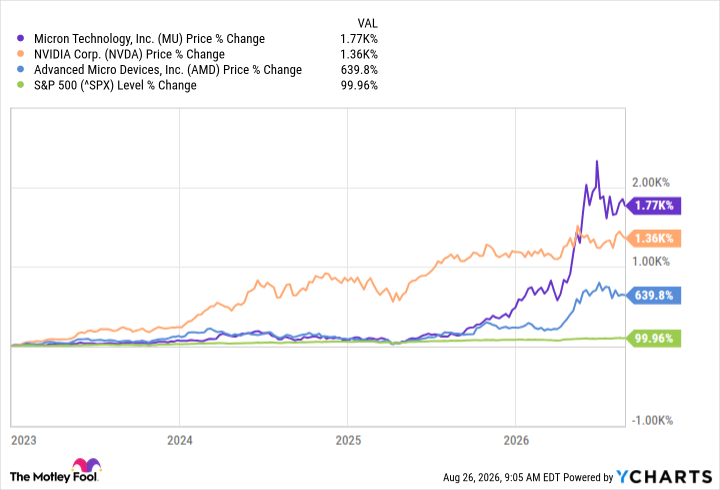
Data by YCharts.
The iShares ETF has more than one-quarter of its assets parked in those three stocks alone.
|
Stock |
iShares ETF Portfolio Weighting |
|---|---|
|
1. Nvidia |
8.98% |
|
2. Micron Technology |
8.53% |
|
3. Advanced Micro Devices (AMD) |
8.05% |
Data source: iShares. Portfolio weightings are accurate as of Aug. 24, 2026, and are subject to change.
Nvidia’s graphics processing units (GPUs) for the data center currently lead the industry in terms of performance in AI training and inference workloads. According to chief executive Jensen Huang, every leading frontier AI company plans to adopt Nvidia’s new Vera Rubin data center systems, which just started shipping.
AMD has become one of Nvidia’s top competitors. It recently launched a fully integrated data center rack called Helios, featuring specialized software and networking components designed to extract the best performance from its latest MI450 GPUs. In fact, Helios might be one of the industry’s only true alternatives to Nvidia’s Vera Rubin systems.
But neither Nvidia nor AMD could run their latest systems without high bandwidth memory (HBM), and Micron is one of the world’s top suppliers. HBM keeps data flowing to GPUs seamlessly, so without it, there would be bottlenecks that could result in sluggish performance when deploying AI chatbots and AI agents.
Outside its top three positions, the iShares ETF holds several other leading chip stocks, including Broadcom, which designs its own data center chips and networking components, and Taiwan Semiconductor Manufacturing, which fabricates chips for Nvidia, AMD, and many other semiconductor companies.
The iShares Semiconductor ETF has a great track record against the market
The iShares Semiconductor ETF has delivered a compound annual return of 14.2% since its inception in 2001, crushing the S&P 500, which returned around 9% per year over the same period. Simply put, its outperformance so far in 2026 is no fluke.

iShares Trust – iShares Semiconductor ETF
Today’s Change
(1.95%) $10.03
Current Price
$525.43
Key Data Points
AUM
$42B
Dividend Yield
0.28%
Expense Ratio
0.33%
Top Holdings
NVDA
9.04%
MU
8.60%
AMD
8.31%
But before investors buy this ETF, it’s important to remember that past performance isn’t always a reliable indicator of future results, and there are certainly reasons for caution right now. First of all, chipmakers are benefiting from severe supply shortages, giving them an unprecedented ability to dictate prices and significantly boost their profit margins. This won’t last forever, because every company in the industry is racing to build more manufacturing capacity.
Second, some cracks are forming on the demand side. Lawmakers in more than a dozen U.S. states have introduced legislation to temporarily ban the construction of new data centers while they weigh the social, financial, and environmental impacts. Plus, the soaring cost of chips and components is making AI software extremely expensive to deploy, forcing many companies, including Walmart, Uber Technologies, and Amazon, to implement strict usage caps on their employees.
According to a recent survey by UBS Group, around 60% of businesses are now directing tasks to cheaper, more efficient AI models to keep costs under control. These models typically require less computing power, so the shift could result in lower demand for chips over time.
As a result, while the iShares Semiconductor ETF has thrived during many technological booms over the last two decades, investors who buy it today might want to temper their expectations and brace for near-term volatility.
Source link
Author

- Ytv Market News
- Share-market news writer and analyst with deep experience covering equities, commodities, forex, and cryptocurrencies for readers in the USA, UK, Canada, and Australia. Ytv Market News delivers timely market updates, practical trading insights, and clear explanations of macro and company-level catalysts that move prices. Combines on-the-ground financial reporting with technical analysis, using concise charts and actionable ideas to help investors and traders make smarter decisions.
Latest entries
 Crypto NewsAugust 28, 2026Why is Bitcoin, Ethereum and XRP rally losing steam?
 CanadaAugust 28, 2026S&P Dow Jones Indices Announces Changes to the S&P/TSX Composite Index
- UkAugust 28, 2026European shares rebound ahead of Warsh speech but head for third weekly decline: DAX, CAC, FTSE100
- Crypto NewsAugust 28, 2026Solana’s (SOL) Strong Rally, The Latest Ethereum (ETH) Forecasts, and More: Bits Recap August 28


