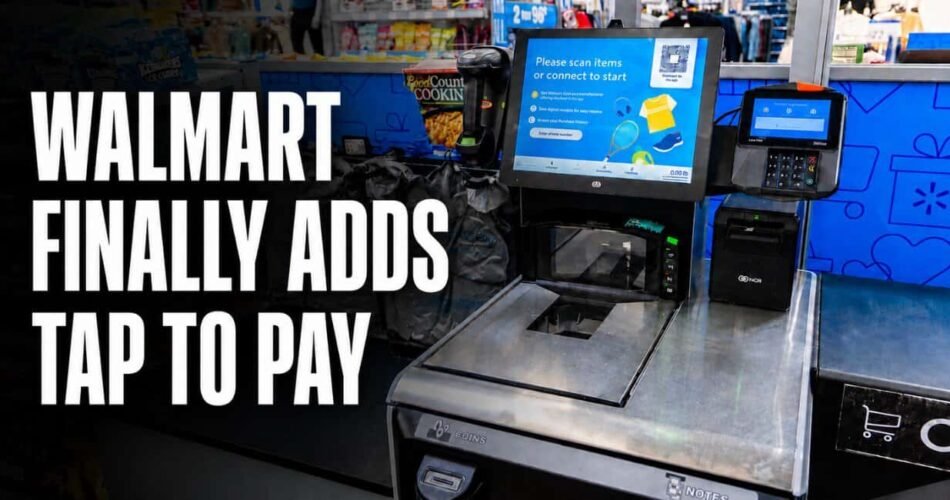
Walmart is finally tapping into tap to pay.
The payment option began rolling out Aug. 24 at select Walmart and Sam’s Club locations, with a nationwide rollout planned by the end of the year.
Walmart fuel stations are next, with tap to pay expected by mid-2027.
“We want customers and members to have choice in how they pay, so they can check out in the way that works best for them,” Walmart said in its post.
Offering tap to pay could make checkout faster and more convenient for Walmart shoppers.
The functionality could also help Walmart move customers through checkout lines more efficiently and improve their overall shopping experience.
The company led all others on the National Retail Federation’s 2026 list of top U.S. retailers by sales, ahead of Amazon.com, Costco Wholesale, and The Home Depot.
Tap-to-Pay Rollout Timeline
Source: Walmart
Aug. 24, 2026
Rollout begins
Select Walmart and Sam’s Club locations
1
End of 2026
Nationwide rollout planned
All U.S. Walmart stores and Sam’s Club locations
2
Mid-2027
Fuel stations added
Tap to pay expected at Walmart fuel stations
3
Scott Talbott, an EVP in the Industry & Government Affairs department at the Electronic Transactions Association, told CardRates the addition represents a significant change for Walmart shoppers.
“It’s huge for their customers to have a convenient choice in a payment option,” Talbott told us. “Tap to pay increases security and speed and meets consumer demand. The technology is ubiquitous, fun, and impossible to ignore.”
Talbott estimates that 70% of in-person purchases in the U.S. will be made using tap to pay in 2027, with adoption continuing to grow in the future.
The rollout could do more than reduce friction at Walmart checkout counters.
A Walmart spokesperson told Supermarket News that customers will be able to pay for their purchases with Apple Pay and Google Pay, along with other forms of contactless payment.
Walmart held off on accepting tap to pay even as the technology became common at other retailers. Apple says more than 85% of retailers in the U.S. now accept Apple Pay.
The move could also help Walmart prepare for a future in which AI agents shop and initiate payments for consumers. A report from Juniper Research projects that spending around the world via agentic commerce will hit $1.5 trillion in 2030.
Richard Crone, CEO of Crone Consulting LLC, told CardRates that payments are central to the development of agentic commerce.
“If you’re using a large language model that can shop a major purchase or complete your shopping list inside Walmart, at the end that LLM can also … drive the digital payment as well,” Crone told us.
“The move by Walmart is preparation for BYO AI, where the consumer brings their own large language model into the store or into their app.” — Richard Crone of Crone Consulting LLC
Walmart offers its own AI shopping assistant, Sparky. But Crone said Walmart will also need to accommodate AI tools selected by consumers.
“[The move by Walmart] is preparation for BYO AI, where the consumer brings their own large language model into the store or into their app,” Crone said. “It helps them select the products that match their goals and intent and helps them complete the sale.”
“But it also helps them select the right payment type that will maximize their rewards or cash back or allow them to meet their budgetary requirements,” he added.
For Walmart, accepting tap to pay may be as much about preparing for the next generation of shopping as improving checkout today.
Source link
Author

- Ytv Market News
- Share-market news writer and analyst with deep experience covering equities, commodities, forex, and cryptocurrencies for readers in the USA, UK, Canada, and Australia. Ytv Market News delivers timely market updates, practical trading insights, and clear explanations of macro and company-level catalysts that move prices. Combines on-the-ground financial reporting with technical analysis, using concise charts and actionable ideas to help investors and traders make smarter decisions.
Latest entries
 IndiaAugust 28, 2026Closing auction scrutiny deepens as wild Sensex swing worries traders
 Company Press ReleasesAugust 28, 2026PG Soft Named Sponsor of SiGMA North America 2026
 Company NewsAugust 28, 2026Die CENX-Aktie legt nach starken Quartalszahlen und Kapazitätsausbau zu
 Stock Market VideosAugust 28, 2026Apple’s Glass-Centric iPhone Is Still on Schedule to Mark Device’s 20th Anniversary