
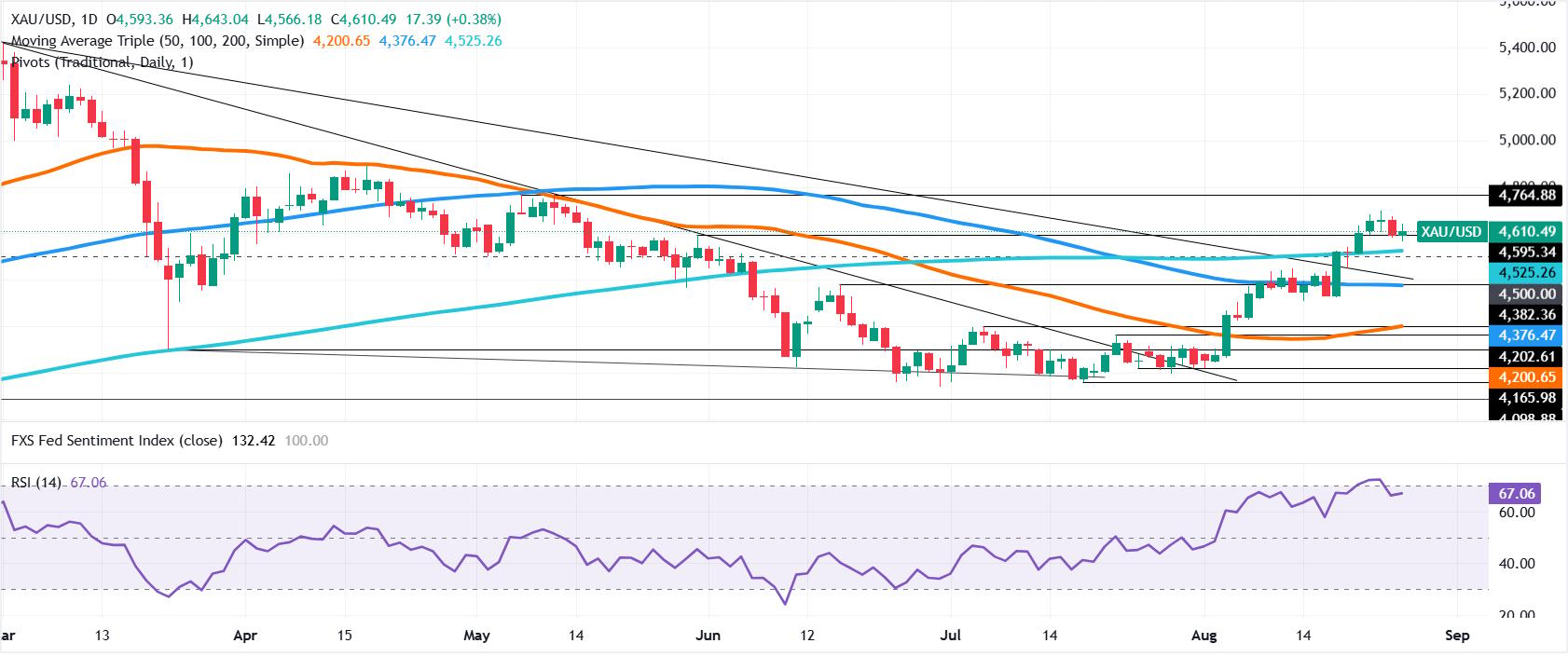
Gold (XAU/USD) extended its gains on Thursday, up 0.17% as US jobs data was solid, while the US trade deficit widened. In the meantime, investors eye Fed Chair Warsh’s speech, keeping the precious metal near familiar levels. The XAU/USD trades at $4,601 at the time of writing.
XAU/USD steadies as geopolitics and Fed risks keep traders cautious
The yellow metal resumed its uptrend on Thursday, even though the US jobless claims report was better than expected, indicating a strong labour market. The number of Americans filing for unemployment benefits dipped from 207K to 203K, below forecasts of 208K, according to the US Department of Labour.
At the same time, the US trade deficit widened from $101.4 Billion to $118.8 Billion in July, according to the US Census Bureau.
Aside from this, geopolitics continued to grab the headlines, as the Iran-Oman deal on the Strait of Hormuz doesn’t matter, according to the New York Post, citing a US official. According to an IRGC spokesman, both parties reached a deal on Wednesday, but it remains subject to internal approval and lacks US recognition.
Worth noting that Gold barely flinched following hawkish statements by Federal Reserve officials attending the Jackson Hole Symposium.
Cleveland Fed’s Beth Hammack stated that “now is the time to act given the persistence of inflation.” Earlier, the Kansas City Fed’s Jeffrey Schmid described inflation as “still stubborn” and “still sticky,” while the Chicago Fed’s Austan Goolsbee also said inflation is his top concern.
Aside from this, the focus shifts towards Fed Chair Kevin Warsh. Traders should remember that he is against forward guidance for the markets, though any remarks about the economy could provide hints about the future path of interest rates.
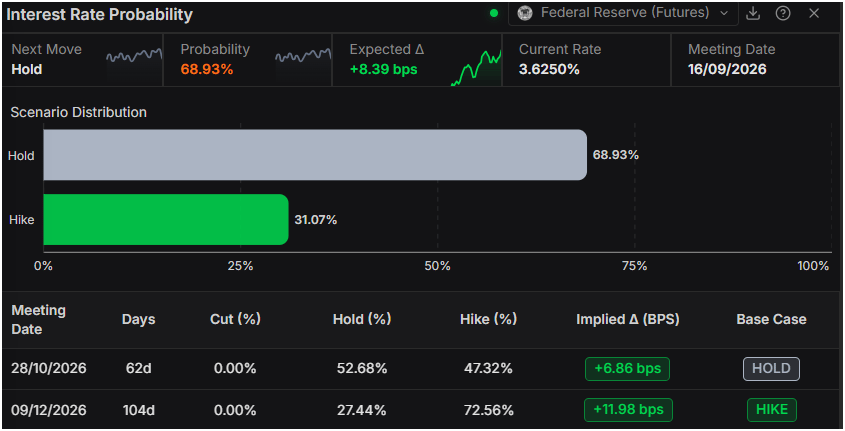
As of writing, money markets expect the Fed to hold rates unchanged at the September 16 meeting, with odds standing at 68%. However, for the December meeting, traders eye a rate hike, with the chances at 72%, according to Prime Terminal.
The US Dollar Index (DXY), which tracks the dollar’s performance against six currencies, remains steady at 99.14 after strong data were released over the past two days.
The Greenback recovered some ground, as recent US Core PCE data show that inflation remains stickier than expected and far from reaching the Federal Reserve’s 2% target.
On Friday, the US economic docket, in addition to featuring Warsh, also includes the University of Michigan Consumer Sentiment data.
XAU/USD technical analysis: Gold reclaims $4,600, but it’s poised for consolidation
Gold has climbed above $4,600, but it remains shy of a decisive break. Momentum, although bullish, is failing to propel the yellow metal towards a retest of weekly highs near $4,697, as indicated by the Relative Strength Index (RSI). Given the backdrop, further sideways action lies ahead, while traders remain uncertain about Bullion’s direction.
On the upside, the first key resistance is the psychological $4,650 mark. Above, the next ceiling level is $4,700, before buyers drive XAU/USD to May’s 7 peak at $4,764.
Downwards, bullion’s first support is $4,600. A breach of the latter would expose the August 24 daily low of $4,594. If XAU/USD achieves a daily close beneath the latter, this clears the path for a move to the 200-day Simple Moving Average (SMA) at $4,376. Ahead of challenging the August 19 swing low of $4,324 and $4,300.
Fed FAQs
Monetary policy in the US is shaped by the Federal Reserve (Fed). The Fed has two mandates: to achieve price stability and foster full employment. Its primary tool to achieve these goals is by adjusting interest rates.
When prices are rising too quickly and inflation is above the Fed’s 2% target, it raises interest rates, increasing borrowing costs throughout the economy. This results in a stronger US Dollar (USD) as it makes the US a more attractive place for international investors to park their money.
When inflation falls below 2% or the Unemployment Rate is too high, the Fed may lower interest rates to encourage borrowing, which weighs on the Greenback.
The Federal Reserve (Fed) holds eight policy meetings a year, where the Federal Open Market Committee (FOMC) assesses economic conditions and makes monetary policy decisions.
The FOMC is attended by twelve Fed officials – the seven members of the Board of Governors, the president of the Federal Reserve Bank of New York, and four of the remaining eleven regional Reserve Bank presidents, who serve one-year terms on a rotating basis.
In extreme situations, the Federal Reserve may resort to a policy named Quantitative Easing (QE). QE is the process by which the Fed substantially increases the flow of credit in a stuck financial system.
It is a non-standard policy measure used during crises or when inflation is extremely low. It was the Fed’s weapon of choice during the Great Financial Crisis in 2008. It involves the Fed printing more Dollars and using them to buy high grade bonds from financial institutions. QE usually weakens the US Dollar.
Quantitative tightening (QT) is the reverse process of QE, whereby the Federal Reserve stops buying bonds from financial institutions and does not reinvest the principal from the bonds it holds maturing, to purchase new bonds. It is usually positive for the value of the US Dollar.
Source link
Author

- Ytv Market News
- Share-market news writer and analyst with deep experience covering equities, commodities, forex, and cryptocurrencies for readers in the USA, UK, Canada, and Australia. Ytv Market News delivers timely market updates, practical trading insights, and clear explanations of macro and company-level catalysts that move prices. Combines on-the-ground financial reporting with technical analysis, using concise charts and actionable ideas to help investors and traders make smarter decisions.
Latest entries
 Stock Market VideosAugust 28, 2026Are They Setting Up A New Silver Monetary System? My Thoughts.
 CanadaAugust 28, 2026WESCAN GOLDFIELDS COMMENCES CAMP MOBILIZATION FOR 2026 DIAMOND DRILLING PROGRAM AT MUNRO LAKE PROJECT
 AustraliaAugust 28, 2026SPC Global Holdings Lifts Earnings with Shift to Higher-Margin Products
 Crypto NewsAugust 28, 20268 Years of ‘Friendship’: Internet Celebrity Di Shi Reveals He Was Defrauded of Millions by Sun Zeyu