This past June, Shell (SHEL -0.84%) CEO Wael Sawan warned that oil prices would likely continue to rise long after the current conflict with Iran ends. He believed it would take “close to a year, if not longer,” for the oil market to find balance again, with even greater challenges in the long term. However, oil prices have been trending lower recently amid talks between Iran and Oman over a deal to reopen the Strait of Hormuz, which is critical to the global oil market.
Here’s a look back at his warning, and whether the recent dip in crude prices suggests the long-term outlook for Shell and other oil stocks has changed.

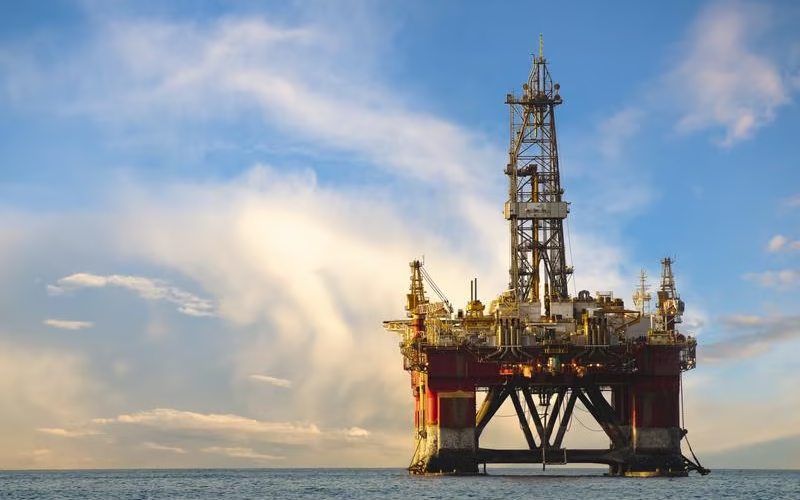
Image source: Getty Images.
What’s the latest on the Strait of Hormuz
Iran and Oman are currently working through the details of an agreement for the Strait of Hormuz. According to Iran, the countries have agreed on how to share the waterway and its revenues. A full reopening of this critical waterway — around a fifth of global oil and gas supplies flowed through it before the war — would ease the global energy supply picture.
Optimism surrounding a deal has driven down oil prices. Brent, the global oil benchmark, recently dipped below $88 a barrel, its lowest level since Aug. 10.
The global economy has navigated disruptions to the Strait of Hormuz through a series of workarounds. Members of the International Energy Agency have released oil from emergency stockpiles, including the U.S. Strategic Petroleum Reserve. Meanwhile, Saudi Arabia and the UAE have ramped up shipments via pipelines that bypass the Strait of Hormuz. Additionally, the U.S. military reported that it has helped 660 million barrels of oil pass through the Strait of Hormuz since May. These workarounds have helped keep oil prices down.

Today’s Change
(-0.84%) $-0.77
Current Price
$90.34
Key Data Points
Market Cap
Day’s Range
$90.05 – $91.35
52wk Range
$68.63 – $94.90
Volume
3.2M
Avg Vol
6.4M
Gross Margin
18.12%
Dividend Yield
3.32%
The real warning from Shell’s CEO
While Shell CEO Wael Sawan warned about the continued near-term impact of the Strait of Hormuz disruption on the oil market, his greater concern was the long-term story that could keep them elevated over the longer term. He stated at a conference in June that “prices are going to move up…That’s the story of five to 10 years.” That’s because “All the easy oil and gas has been found.” As a result, the industry will need higher prices to tap into resources that are currently uneconomic to develop.
Shell’s long-term bullish outlook for oil and gas is driving its strategic shift. It’s currently divesting underperforming assets, including its onshore renewable power business in Europe and potentially its U.S. chemicals assets. That will enable it to sharpen its focus on its upstream oil and gas operations.
The company currently plans to deliver 1 million barrels of oil equivalent per day in new production by 2030. That will enable it to fully offset production declines in its legacy assets, maintaining its liquids production at an average rate of 1.4 million barrels per day through 2030 while growing its liquefied natural gas (LNG) sales volume at a 4% to 5% compound annual rate (most LNG contracts have oil-linked pricing).
Shell is investing heavily to develop new sources of oil and LNG to capitalize on expected long-term growth in demand and prices for these commodities. The company recently signed several deals with Venezuela to develop its oil and gas resources. It also recently made a potential oil discovery offshore Egypt. Shell and its partners are also looking to expand LNG Canada. These and other moves position Shell to continue supplying the global economy with oil and LNG.
Shell remains focused on the long-term view
Oil prices have come down recently on the hopes that the Strait of Hormuz will fully reopen, increasing the supply of oil and LNG to global markets. However, that doesn’t mean Shell’s CEO is wrong on his long-term view for the oil market. With most of the easy oil and gas resources already developed, oil prices will need to rise over the next five to 10 years to support the development of currently uneconomical resources. That’s driving Shell’s continued investment in oil and LNG. While oil prices could drop in the interim, the long-term outlook suggests they’ll be higher, which would put Shell in a strong position to create value for its shareholders as it narrows its focus on growing its upstream business.
Source link
Author

- Ytv Market News
- Share-market news writer and analyst with deep experience covering equities, commodities, forex, and cryptocurrencies for readers in the USA, UK, Canada, and Australia. Ytv Market News delivers timely market updates, practical trading insights, and clear explanations of macro and company-level catalysts that move prices. Combines on-the-ground financial reporting with technical analysis, using concise charts and actionable ideas to help investors and traders make smarter decisions.
Latest entries
 UkAugust 27, 2026Lunchtime market roundup: Stocks mostly lower despite Nvidia spark
 UsaAugust 27, 2026Insider Sale: Chief Commercial Officer of $ARDX Sells 2,598 Shares
 Crypto NewsAugust 27, 2026Can SPX6900 hold its 66% weekly gain? If not, what’s next?
 Commodities NewsAugust 27, 2026TotalEnergies Exits Russia’s Sanctioned Arctic LNG 2 Project