South32 (S32) has delivered underlying net profit – the measure it reports as underlying earnings – of US$1,032 million for FY26, up 55%, on underlying EBITDA of US$2,462 million, up 28%. The group operating margin widened from 26.3% to 31.0%, return on invested capital lifted from 9.0% to 13.6%, and the board declared a fully franked final dividend of US5.4 cents – more than double last year’s US2.6 cents, and ahead of the US5.3 cents market consensus.
Almost all of the improvement came from commodity price gains through the year. Higher realised prices added US$596 million to underlying EBIT. Aluminium contributed US$435 million of that – but alumina subtracted US$504 million, so the division being sold to Alcoa netted out slightly negative. Among the assets South32 is keeping, the largest single price contributor was silver at US$331 million, ahead of copper at US$314 million.
None of the operational details were new, as South32 published its June quarter production report on 20 July. This is likely the reason for only a small share price move, despite the plus-55% headline, with the stock trading 0.8% higher to $5.18 around lunchtime.
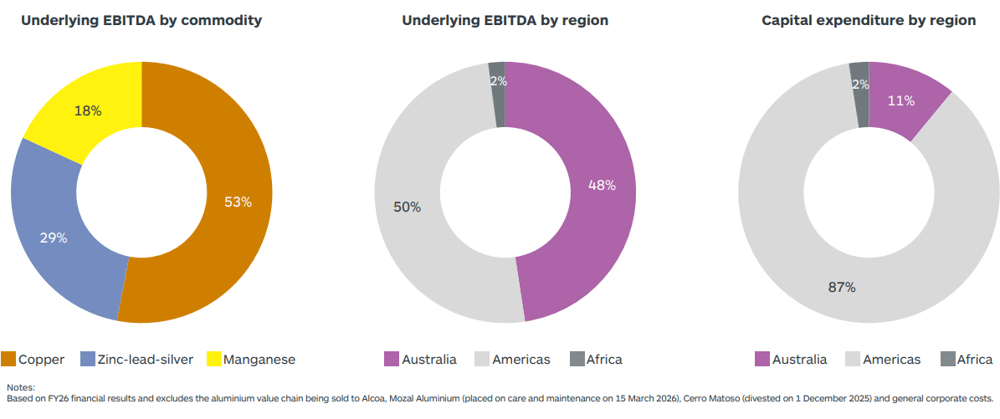
South32 Portfolio from FY26 Results, 27 August 2026.
Investment bank Citi’s initial reader appears to justify management’s strategy to divest its Aluminium business, as Cannington’s EBITDA was 5% ahead of consensus and group free cash flow 17% ahead (S32 produces zinc-lead-silver here), against a 3% miss on manganese and a 33% miss at Brazil Alumina.
“The retained base metals assets delivered above estimates, the misses were concentrated in the assets being sold, and the strong cash generation supports higher returns under the updated capital management framework post the Alcoa transaction,” Citi said, reiterating its buy rating on S32 and a $5.30 target.
In his first result as chief executive, Matt Daley framed the year as a beginning rather than an end.
“We’re repositioning South32 as an upstream, base metals-focused company, primed for growth, and we’re transforming into a simpler, stronger business with higher margin assets and reduced complexity,” Daley said. “We have a clear pathway to reaching 55% production growth in base metals coming from under construction or approved projects.”
South32 FY26 results in focus
-
Underlying revenue: US$8,108 million, up 7% vs the prior corresponding period (pcp)
-
Underlying EBITDA: US$2,462 million, up 28% vs pcp, at a 31.0% margin, up 4.7 percentage points vs pcp
-
Underlying EBIT: US$1,717 million, up 42% vs pcp
-
Underlying net profit after tax: US$1,032 million, up 55% vs pcp; underlying earnings per share US23.0 cents, up 55% vs pcp
-
Return on invested capital: 13.6%, up 4.6 percentage points vs pcp
-
Final dividend: US5.4 cents fully franked, up 108% vs pcp, taking FY26 dividends to US9.3 cents fully franked, up 55% vs pcp
-
Net cash: US$283 million, up 130% vs pcp
-
Free cash flow: US$610 million, up 136% vs pcp – of which US$503 million came from businesses South32 does not consolidate
-
Growth capital expenditure: US$711 million, up 38% vs pcp – all of it at the Hermosa project in Arizona
Of the US$610 million free cash flow reported, US$503 million was net distributions from investments in projects it doesn’t operate – a record US$401 million from the 45%-owned Sierra Gorda copper mine in Chile, and US$102 million from the manganese joint ventures as insurance recoveries related to Tropical Cyclone Megan were finalised. The businesses that South32 does operate generated US$107 million after capital expenditure, down from US$192 million, because Hermosa absorbed US$711 million. Dividends declared in respect of FY26 came to US$417 million. The takeaway: the stakes South32 doesn’t run paid for the dividend.
EBIT carries a similar caveat: Australia Manganese added US$268 million as operations resumed after Cyclone Megan, a recovery rather than a step-change. Stronger producer currencies cost US$159 million, inflation US$74 million and lower volumes US$98 million. Production still finished at 101% of guidance.
Citi placed the misses in the assets being sold, which holds for Brazil Alumina, but not for manganese. Australia Manganese restarted below plan, elevated site water levels restricting pit access, and it’s the one part of the portfolio where FY27 guidance goes backwards.
Guidance: production holds, costs and capital do not
Sierra Gorda copper equivalent production is guided 5% higher at 91.8kt in FY27 and a further 2% in FY28, on higher planned grades. Cannington holds at 290.0kt zinc equivalent across both years, with lower-grade stockpile material supplementing mined ore. Australia Manganese is the exception, guided at 2,650–2,900kwmt against 3,031kwmt in FY26, with FY28 conditional on water management approvals.
Costs at most operations move the wrong way. Cannington is guided 11% higher at US$205 per tonne, Australia Manganese 20% higher at US$3.15 per dry metric tonne unit, South Africa Manganese 9% higher at US$3.50, and Worsley Alumina higher again at US$320 per tonne. South32 attributes this to stronger producer currencies, inflation, and the cost of an extended mine life at Cannington. Only the company’s Sierra Gorda unit saw better cost guidance, down to US$17.5 per tonne from US$18.9.
Capital spending steps up with costs. Guidance for base metals and manganese, including joint ventures, rises US$395 million to US$1,500 million in FY27, with Hermosa lifting to around US$1,000 million. Two things work the other way: roughly US$125 million a year of support costs comes out once the Alcoa sale completes, though not in full until FY29, and the US$3.1 billion upfront payment would take net cash to about US$3.5 billion on the company’s own pro-forma. Completion is expected in H2 FY27, subject to shareholder approval.
Bottom line
Alumina EBITDA fell US$868 million and South32 still grew underlying net profit 55% – the clearest argument available for the portfolio it’s keeping and building. The miss that matters most is in manganese, and consider that FY27 carries US$1.5 billion of capital expenditure and higher unit cost guidance at four of the five operations that gave any. Going forward, investors should watch the Sierra Gorda distributions that funded this year’s dividend, the water approvals that decide whether Australia Manganese stops shrinking, and the upcoming shareholder vote on the Alcoa sale.
This article draws on institutional research from Citi and Morgan Stanley (August 2026), and on South32 Limited’s FY26 financial results and outlook, results presentation and accompanying chief executive commentary, all released to the ASX on 27 August 2026. It was first published on Market Index’s sister site Livewire on Thursday 27 August 2026.
Source link
Author

- Ytv Market News
- Share-market news writer and analyst with deep experience covering equities, commodities, forex, and cryptocurrencies for readers in the USA, UK, Canada, and Australia. Ytv Market News delivers timely market updates, practical trading insights, and clear explanations of macro and company-level catalysts that move prices. Combines on-the-ground financial reporting with technical analysis, using concise charts and actionable ideas to help investors and traders make smarter decisions.
Latest entries
 Crypto NewsAugust 27, 2026Revolut Launches First Euro Stablecoin EURR: Here’s Where It’s Available
 Crypto NewsAugust 27, 2026Grayscale: U.S. Treasury Buybacks are ‘Symptomatic Treatment’ as Shift to Cryptocurrency is Expected
 Stock Market VideosAugust 27, 2026Why Gold Could Beat Stocks From Here
 Investing InsightsAugust 27, 2026Bond yields are surging: Here’s why that could spell trouble