


The current decline in XRP has clearly exposed the most common misconception lately — exchange-traded funds (ETFs) do not control the token’s price; they merely confirm its status. The real price moves are still generated in the spot market.
While inflow data continues to set records — in just 24 hours, from Aug. 24 to Aug. 25, daily net inflows into spot XRP ETFs jumped 72%, rising from $13.88 million to $23.87 million, while the funds’ total assets under management reached an all-time high of $1.46 billion — the actual price on exchanges is moving in the opposite direction.
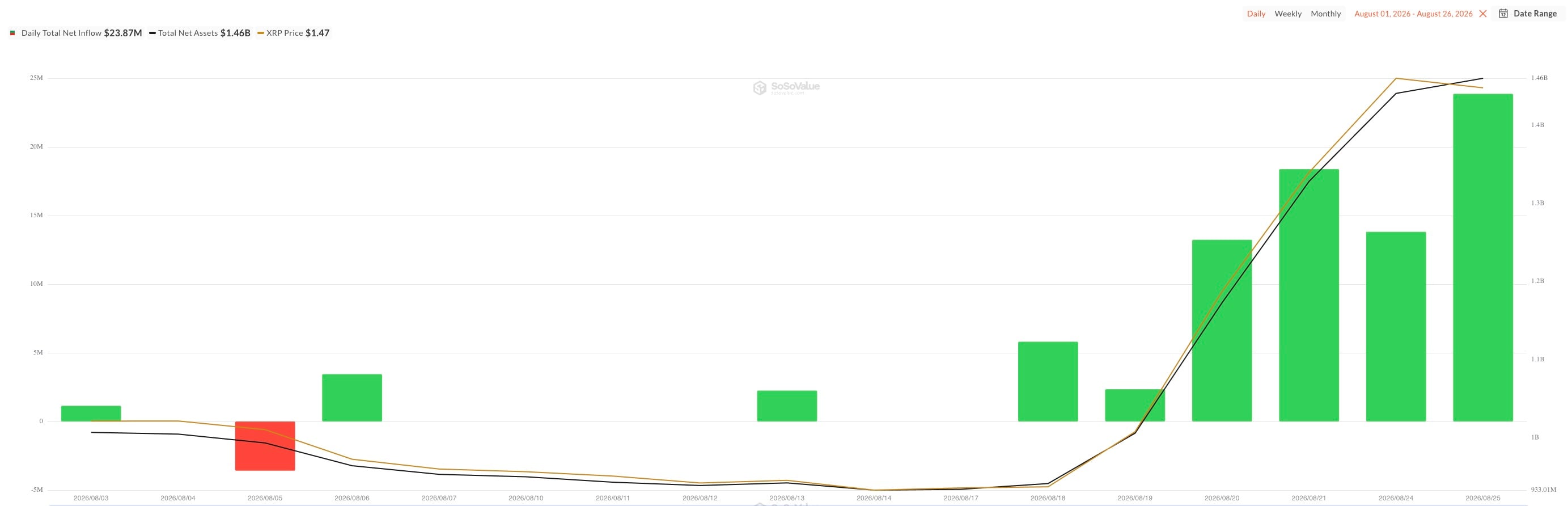
On Wednesday, XRP corrected to $1.3783, losing about 4% over the past 24 hours.
You Might Also Like

This paradox proves a simple truth: ETFs do not move the price of XRP. They can stabilize it, smooth out volatility, or reflect institutional interest, but they do not act as a growth driver.
If not ETFs, who is actually moving the price of XRP?
The real trend is now being dictated by on-chain activity, which is attempting to digest the end of a massive 20-month depression. Unlike passive, methodical ETF inflows, the real fuel behind XRP’s recent rally of more than 40% came from the actions of large strategic players.
Immediately before last week’s surge, millionaire wallets — addresses holding between 1 million and 10 million XRP — went on an aggressive buying spree, accumulating nearly 500 million tokens.
It was this large-scale accumulation by whales that pushed XRP out of a brutal downtrend that had lasted 608 days, during which the token lost 54.47% of its value, sliding from highs near $3.01 to a cycle low of $0.9939.
You Might Also Like

Once this two-year accumulation ceiling was broken, the price delivered a strong move to $1.5219, immediately pushing the daily RSI into deeply overbought territory.
The subsequent pullback became inevitable because of market psychology: retail investors who had been trapped in losses for all 608 days began taking profits and moving into cash at the first strong rebound.
The concentration of retail selling in the spot market now outweighs ETF volumes many times over, leaving the funds with only the role of a silent market stabilizer.
Source link
Author

- Ytv Market News
- Share-market news writer and analyst with deep experience covering equities, commodities, forex, and cryptocurrencies for readers in the USA, UK, Canada, and Australia. Ytv Market News delivers timely market updates, practical trading insights, and clear explanations of macro and company-level catalysts that move prices. Combines on-the-ground financial reporting with technical analysis, using concise charts and actionable ideas to help investors and traders make smarter decisions.
Latest entries
 CanadaAugust 26, 2026Canadian Investment Regulatory Organization Trading Halt
 Trading IndicatorsAugust 26, 2026The Trap Indicator by BullBearSR — TradingView
 Crypto NewsAugust 26, 2026Hyperliquid group asks CFTC to allow energy perpetuals
 Stock Market VideosAugust 26, 2026Tether Bought More Gold Than Any Central Bank


