
Personal care and home fragrance retailer Bath & Body Works (NYSE:BBWI) reported Q2 CY2026 results topping the market’s revenue expectations, but sales fell by 2.3% year on year to $1.51 billion. Its non-GAAP profit of $0.62 per share was significantly above analysts’ consensus estimates.
Is now the time to buy Bath and Body Works? Find out in our full research report.
Bath and Body Works (BBWI) Q2 CY2026 Highlights:
- Revenue: $1.51 billion vs analyst estimates of $1.50 billion (2.3% year-on-year decline, 1.2% beat)
- Adjusted EPS: $0.62 vs analyst estimates of $0.24 (significant beat)
- Management raised its full-year Adjusted EPS guidance to $2.70 at the midpoint, a 6.9% increase
- Operating Margin: 14.3%, up from 10.1% in the same quarter last year
- Free Cash Flow was $23 million, up from -$99 million in the same quarter last year
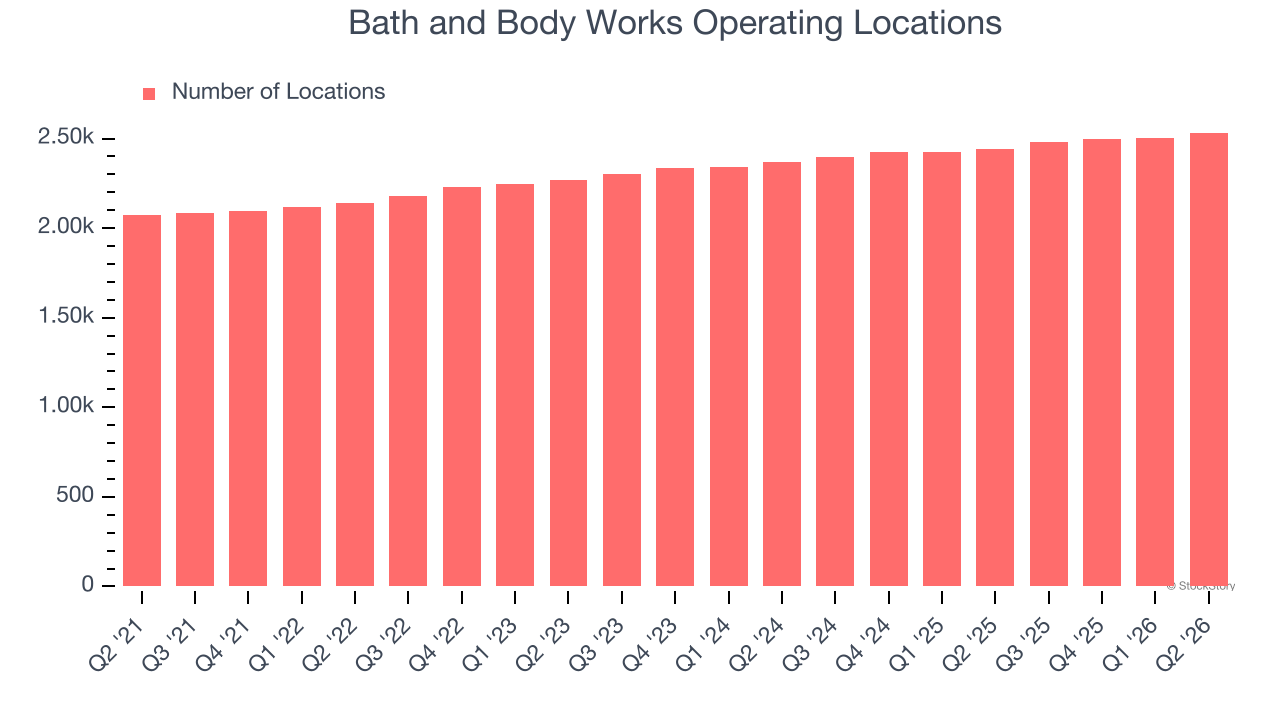
- Locations: 2,533 at quarter end, up from 2,441 in the same quarter last year
- Market Capitalization: $3.54 billion
Daniel Heaf, chief executive officer of Bath & Body Works, commented, “Our second-quarter results exceeded our sales and earnings per share guidance. Underlying business trends remain pressured, but we are seeing further evidence that elements of the Consumer First Formula are beginning to work. We delivered sequential improvement in Body Care, stronger AUR on new product innovation, improved brand discoverability, and continued momentum across our marketplace partnerships.”
Company Overview
Spun off from L Brands in 2020, Bath & Body Works (NYSE:BBWI) is a personal care and home fragrance retailer where consumers can find specialty shower gels, scented candles for the home, and lotions.
Revenue Growth
Reviewing a company’s long-term sales performance reveals insights into its quality. Any business can experience short-term success, but top-performing ones enjoy sustained growth for years.
With $7.21 billion in revenue over the past 12 months, Bath and Body Works is a mid-sized retailer, which sometimes brings disadvantages compared to larger competitors benefiting from better economies of scale.
As you can see below, Bath and Body Works’s demand was weak over the last three years. Its sales fell by 1.1% annually despite opening new stores. This implies its underperformance was driven by lower sales at existing, established locations.
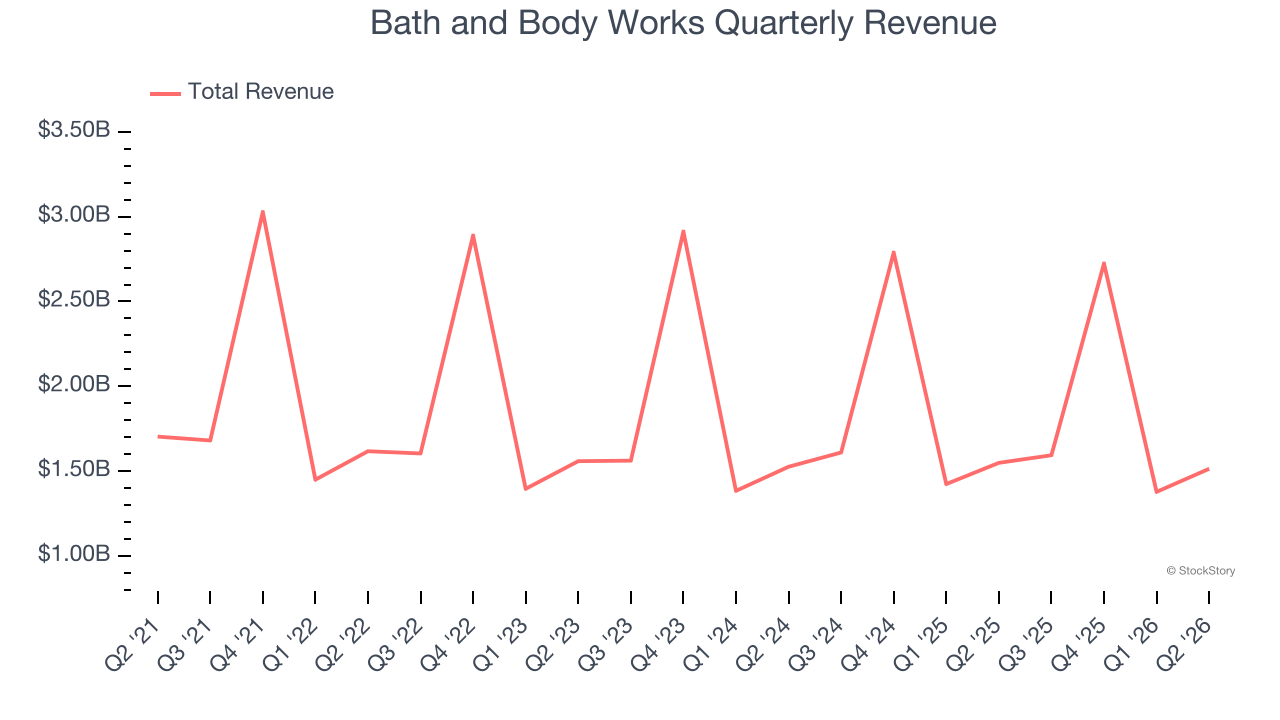
This quarter, Bath and Body Works’s revenue fell by 2.3% year on year to $1.51 billion but beat Wall Street’s estimates by 1.2%.
Looking ahead, sell-side analysts expect revenue to remain flat over the next 12 months. This projection doesn’t excite us and indicates its newer products will not catalyze better top-line performance yet.
ALSO WORTH WATCHING: Nvidia’s Quiet Partner. Nvidia’s chips cost a hundred grand. The connectors that make them work cost even more. One company makes them all.
Every AI server needs specialized infrastructure the chip companies don’t make. High-speed cables. Power connectors. Thermal sensors. This 90-year-old company built a monopoly on it. The AI boom just started. This stock is still flying under the radar. Claim The Stock Ticker Here for FREE.
Store Performance
Number of Stores
The number of stores a retailer operates is a critical driver of how quickly company-level sales can grow.
Bath and Body Works operated 2,533 locations in the latest quarter. It has opened new stores quickly over the last two years, averaging 3.5% annual growth, faster than the broader consumer retail sector.
When a retailer opens new stores, it usually means it’s investing for growth because demand is greater than supply, especially in areas where consumers may not have a store within reasonable driving distance.
Same-Store Sales
A company’s store base only paints one part of the picture. When demand is high, it makes sense to open more. But when demand is low, it’s prudent to close some locations and use the money in other ways. Same-store sales is an industry measure of whether revenue is growing at those existing stores and is driven by customer visits (often called traffic) and the average spending per customer (ticket).
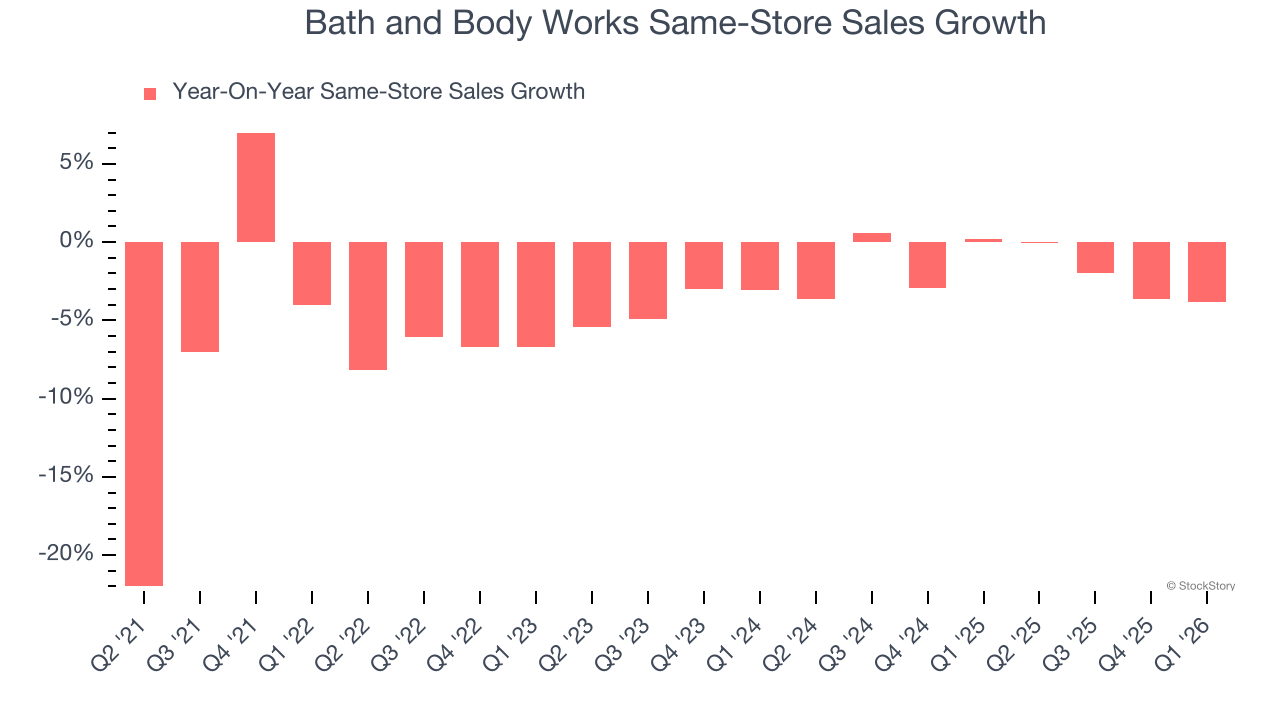
Bath and Body Works’s demand has been shrinking over the last two years as its same-store sales have averaged 1.7% annual declines. This performance is concerning – it shows Bath and Body Works artificially boosts its revenue by building new stores. We’d like to see a company’s same-store sales rise before it takes on the costly, capital-intensive endeavor of expanding its store base.
Note that Bath and Body Works reports its same-store sales intermittently, so some data points are missing in the chart below.
Key Takeaways from Bath and Body Works’s Q2 Results
It was good to see Bath and Body Works beat analysts’ EPS expectations this quarter. We were also excited its gross margin outperformed Wall Street’s estimates by a wide margin. On the other hand, its EPS guidance for next quarter missed. Overall, this print was mixed. The market seemed to be hoping for more, and the stock traded down 3.3% to $17.01 immediately after reporting.
So do we think Bath and Body Works is an attractive buy at the current price? When making that decision, it’s important to consider its valuation, business qualities, as well as what has happened in the latest quarter. We cover that in our actionable full research report which you can read here (it’s free).
Source link
Author

- Ytv Market News
- Share-market news writer and analyst with deep experience covering equities, commodities, forex, and cryptocurrencies for readers in the USA, UK, Canada, and Australia. Ytv Market News delivers timely market updates, practical trading insights, and clear explanations of macro and company-level catalysts that move prices. Combines on-the-ground financial reporting with technical analysis, using concise charts and actionable ideas to help investors and traders make smarter decisions.
Latest entries
 Crypto NewsAugust 26, 2026Why Does Your Writing Sound Like AI? a16z Editors Teach You How to Reclaim the ‘Human Touch’
 Stock Market VideosAugust 26, 2026The Reset Isn’t A Crash. It’s Already Happening.
 UsaAugust 26, 2026Will Bloom Energy Be the Next SpaceX? What the Numbers Actually Say.
 AustraliaAugust 26, 2026L1 Gold Fund raises $254.9m in placement and entitlement offers