

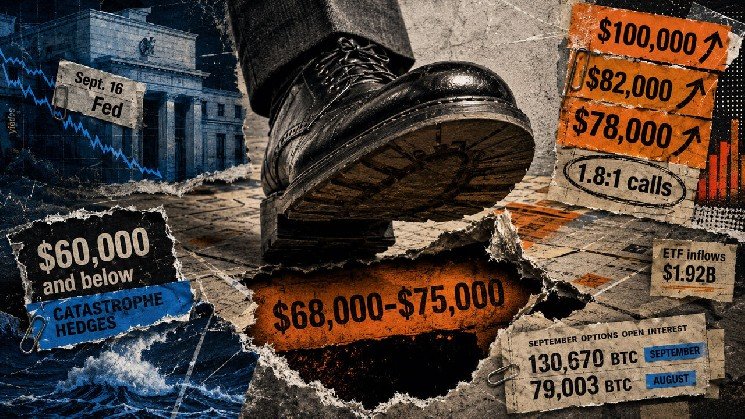
Bitcoin’s end-of-September options expiry holds 130,670 $BTC of open interest, compared with 79,003 $BTC for August, a headline gap large enough to look like traders are loading up before the Federal Reserve’s Sept. 16 decision.
DWF Labs market insights lead Martin Lee said in a note that most of that gap has nothing to do with the Fed. September and December are the two quarterly expiries in Bitcoin options, and together they hold 59.3% of all open interest, since traders often roll positions into them.
The story sits in how the market has quietly repriced its own risk.
The September book is mostly a red herring
Lee found that the top five strikes account for 31% of September’s open interest, the same concentration he sees in both December and March. If September were an aggressive, concentrated bet on the Fed, the book would probably look different from routine quarterly positioning elsewhere on the calendar.
The week of July’s Fed meeting traded 14,983 contracts, a number the DWF market insights lead described as mid-range for the summer.
The jump came weeks later, when weekly volume tripled to 64,749 contracts around Aug. 19, the same week the US Treasury announced it would at least double its long-end liquidity-support buybacks, raising the maximum operation size from $2 billion to at least $4 billion starting Sept. 9.
Reports tied that announcement to easing long-end yield stress and a revived dollar-debasement trade that lifted both Bitcoin and gold.
Bitcoin ran from $64,100 to a close near $77,000 that week, clearing out roughly $4 billion of short positions along the way. Stanley Druckenmiller has separately criticized the expanded buybacks as damaging to Treasury’s credibility, a tension that sits underneath the same rally now driving Bitcoin’s options market.
A year of cheap calls just ended
Puts had been the richer side of Bitcoin’s options market for close to a year. The December expiry printed a negative monthly median every single month from December 2025 through August 2026, with only three positive daily readings across 224 sessions.
End-September calls now trade 0.97 volatility points richer than puts, up from 4.96 points cheaper on Aug. 3, a swing of nearly six volatility points toward upside in under three weeks.
US-traded spot Bitcoin ETFs took in roughly $1.92 billion last week, their strongest weekly pace of 2026, giving traders a clear demand-side reason to chase that call bid.
September’s largest call sits at $70,000 with 11,308 contracts, a number that looks bullish until the context arrives. Bitcoin already trades 9.8% above that level, which puts the position deep in the money.
Lee said those contracts are almost certainly legacy exposure from when Bitcoin traded in the low $60,000s.
Some 27% of September’s open interest sits more than 30% away from spot, compared with 13% for the August expiry. A large share of the book sits in cheap, far-dated wings that carry little chance of ever coming into play.
The band most probably in live play sits between $78,000 and $82,000, where three separate lines together hold around 14,000 contracts, with $100,000 acting as a round-number magnet above it.
Which side of the Bitcoin book gets tested
Options positioning usually gets read by looking for the biggest wall, the largest concentration of calls or puts sitting above or below spot.
Lee’s data points to the question, “Where does the book offer the least protection?”
September’s book runs 1.8-to-1 in favor of calls, and the live upside positioning clusters between $78,000 and $100,000. The heavier downside protection sits at $60,000 and below, the kind of catastrophe insurance investors buy against a severe, disorderly decline.
Between roughly $60,000 and $75,000, the book thins out considerably. Lee said:
“A sharp move down into the low 70s would land in the thinnest part of the book.”
It is also the direction the market stopped paying a premium to protect against just last week.
The bull case has the debasement trade extending, with long yields easing further, the dollar staying weak, and ETF demand continuing at last week’s pace.
In that scenario, Bitcoin pushes toward the $82,000 to $100,000 range, and the call-heavy skew gets validated by real spot demand. The $100,000 level becomes the market’s next psychological magnet, drawing attention without functioning as anyone’s price target.
The bear case has long yields rebounding, Fed rhetoric turning hawkish into the Sept. 16 decision, or the Treasury trade simply losing momentum, sending Bitcoin down into the $68,000 to $75,000 range.
That is precisely the zone Lee’s data identifies as the book’s weak point, sitting below the call-heavy upside positioning and above where the larger downside hedges cluster. The most disruptive outcome for current positioning would be an ordinary, sharp drop landing exactly where the September book offers the least protection.
Bitcoin’s options market spent a year paying up for protection against exactly this kind of move. It has now stopped, right as the price gap between its upside bets and its catastrophe insurance leaves the low $70,000s as the one place few traders are covered.
Source link
Author

- Ytv Market News
- Share-market news writer and analyst with deep experience covering equities, commodities, forex, and cryptocurrencies for readers in the USA, UK, Canada, and Australia. Ytv Market News delivers timely market updates, practical trading insights, and clear explanations of macro and company-level catalysts that move prices. Combines on-the-ground financial reporting with technical analysis, using concise charts and actionable ideas to help investors and traders make smarter decisions.
Latest entries
![Multi Symbol Participation Pulse [Pineify] — Indicator by Pineify — TradingView](https://ytvmarketnews.com/wp-content/uploads/2026/08/283CExyp_big-1200x675.png) Trading IndicatorsAugust 26, 2026Multi Symbol Participation Pulse [Pineify] — Indicator by Pineify — TradingView
Trading IndicatorsAugust 26, 2026Multi Symbol Participation Pulse [Pineify] — Indicator by Pineify — TradingView Crypto NewsAugust 26, 2026Why Does Your Writing Sound Like AI? a16z Editors Teach You How to Reclaim the ‘Human Touch’
 Stock Market VideosAugust 26, 2026The Reset Isn’t A Crash. It’s Already Happening.
 UsaAugust 26, 2026Will Bloom Energy Be the Next SpaceX? What the Numbers Actually Say.


