

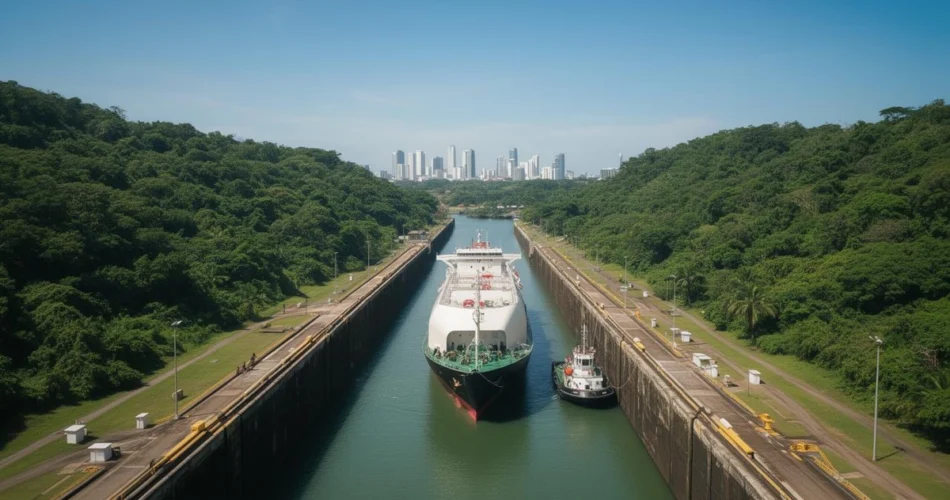
The auction prices for Panama Canal transit slots are surging. The Panama Canal Authority disclosed on the 25th that some vessels paid over $1 million (approximately ¥160 million) to secure transit slots, attributing the spike to global trade supply-demand fluctuations.
Last week, the authority reversed its previous policy of forgoing additional restrictions this year, citing expectations of a prolonged El Niño. It announced that daily transits would be limited to 34 vessels starting September 4, with a further reduction to 32 vessels on September 15. The Panama Canal has a daily handling capacity of approximately 40 vessels, and the average daily transit count through June was 35 vessels.
The median auction price for transit slots averaged approximately $55,000 (approximately ¥8.7 million) between October last year and February this year. However, amid the recent surge in demand, the median price has been pushed up to roughly three times that level.
According to a Bloomberg News report on the 25th, a South Korean shipping company agreed to pay a record $5.3 million (approximately ¥840 million) for a September 1 transit. This surpasses the previous record of $4.6 million (approximately ¥730 million) set earlier this month.
The Panama Canal Authority explained that the high bids reflect short-term market fluctuations and do not represent an increase in canal tolls. Auction prices are determined by multiple factors, including customer urgency, commercial priorities, and overall supply-demand conditions.
Background Behind Stricter Transit Restrictions
The Panama Canal is a critical artery for international maritime transport connecting the Pacific and Atlantic Oceans, handling the world’s container ships and liquefied natural gas (LNG) carriers. Canal transits require substantial volumes of fresh water, and water levels in surrounding lakes such as Gatun Lake determine operational feasibility.
Rainfall shortages caused by El Niño have lowered lake water levels, forcing the authority to reduce transit numbers. As available slots shrink, competition among shipping companies seeking to deliver cargo by deadlines has intensified.
Impact on Shipping and Logistics
The surge in transit slot auction prices directly translates to higher costs for shipping companies using the canal. Routes connecting Asia and the U.S. East Coast in particular have a high utilization rate of the Panama Canal, and rising transport costs could ultimately burden shippers and consumers.
Some shipping companies are considering bypassing the Panama Canal, rerouting via the Suez Canal or around Cape Horn at the southern tip of South America. However, detours involve longer voyage times and higher fuel costs, forcing each company to weigh these against canal transit fees.
Concerns are also emerging that if auction prices remain elevated, cargo shipments for the year-end holiday shopping season could be affected. The canal authority has not specified when transit restrictions will be lifted, making rainfall conditions over the coming months a key focus.
Source link
Author

- Ytv Market News
- Share-market news writer and analyst with deep experience covering equities, commodities, forex, and cryptocurrencies for readers in the USA, UK, Canada, and Australia. Ytv Market News delivers timely market updates, practical trading insights, and clear explanations of macro and company-level catalysts that move prices. Combines on-the-ground financial reporting with technical analysis, using concise charts and actionable ideas to help investors and traders make smarter decisions.
Latest entries
 Stock Market VideosAugust 26, 2026Why The Gold Price Doesn’t Matter To Him
 CanadaAugust 26, 2026Canadian Investment Regulatory Organization Trading Halt
![Volatility Regime Range Map [AFD] — Indicator by AuctionFoundry — TradingView](https://ytvmarketnews.com/wp-content/uploads/2026/08/BK9h3hTP_big-1200x675.png) Trading IndicatorsAugust 26, 2026Volatility Regime Range Map [AFD] — Indicator by AuctionFoundry — TradingView
Trading IndicatorsAugust 26, 2026Volatility Regime Range Map [AFD] — Indicator by AuctionFoundry — TradingView Stock Market VideosAugust 26, 2026Market Report: What’s Actually Holding Gold Up

