
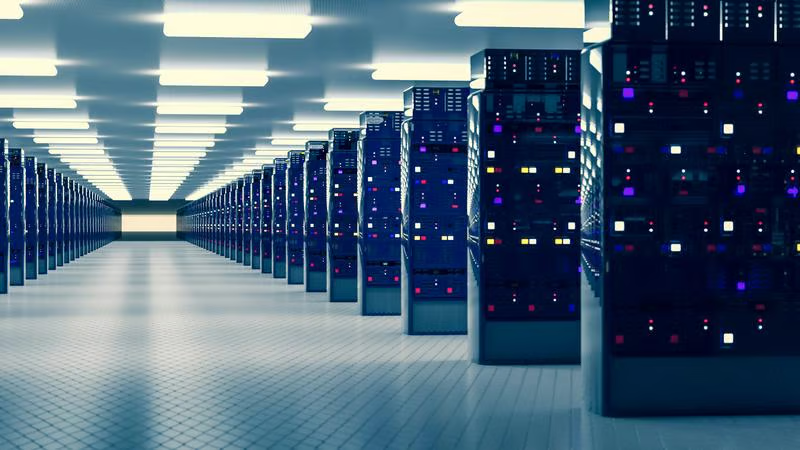
Alphabet (GOOG -0.36%)(GOOGL -0.32%) expects its capital expenditures to reach $195 billion to $205 billion this year, a range management raised in July from a prior $180 billion to $190 billion. And on the earnings call that set it, chief financial officer Anat Ashkenazi said about 60% of the second quarter’s technical infrastructure investment went to servers. The other 40% went to data centers and networking equipment.
That mix makes servers the largest single line in the budget. On Saturday, Bloomberg reported that the most important artificial intelligence (AI) servers may be about to cost more — more than 15% more, in many cases.

Image source: Getty Images.
Servers: the biggest line
Start with the midpoint of Alphabet’s guidance, about $200 billion. Technical infrastructure investment accounts for the vast majority of that total, and if the second quarter’s mix holds, servers’ 60% share would put server purchases near $100 billion this year.
And the spending has been accelerating for a year. Alphabet’s capital expenditures went from $24.0 billion in the third quarter of 2025 to $27.9 billion in the fourth quarter, $35.7 billion in the first quarter of this year, and $44.9 billion in the second, about double the year-ago figure.
The company can point to demand for every dollar. Google Cloud revenue grew 82% year over year to $24.8 billion in the second quarter, an acceleration the company called out in its release. Total revenue climbed 24% to $119.8 billion, and operating income rose 30% year over year, with the operating margin expanding 2 percentage points to 34%.
In short, servers keep being bought because customers keep renting the computing resources they provide. I’d argue that part of the case is working.
The increase lands on 2027
Bloomberg’s report said contract manufacturers that build AI servers for major data center operators have told customers that prices are rising by more than 15% in many cases. The affected systems include those built around Nvidia (NVDA +2.19%) chips such as its Vera Rubin and Grace Blackwell lines. The operators served include Microsoft, Google, and Oracle.
The increases reportedly vary by chip generation and memory configuration, and they take effect on systems shipped early next year.
The cause, according to the report, is memory, with prices soaring as AI demand outruns supply. Nvidia’s representatives didn’t respond to Bloomberg’s requests for comment, and the company hasn’t confirmed any of it.
However, the timing is worth noticing. Alphabet set its capital spending range a month before the report surfaced, and the increases reportedly apply to systems shipped in early 2027. This year’s budget is probably safe. The budget the higher prices land on is the one Alphabet hasn’t sized yet.
“[W]e continue to expect our CapEx to increase significantly in 2027, and we’ll provide more details at a later date,” Ashkenazi said on the July call.
Of course, Alphabet has some insulation. The company designs its own tensor processing units (TPUs) and offers them through Google Cloud, so not every server it buys is built around Nvidia silicon. But the root cause here is memory, and Bloomberg noted that the operators pursuing in-house chip programs still depend on access to memory from the industry’s three big suppliers. A company that designs its own chips still has to buy the memory that goes into them.
Can Alphabet carry it?
Alphabet has the war chest for it. The company held $242.5 billion in cash and marketable securities at the end of June, and its operating income grew 30% year over year last quarter.

Today’s Change
(-0.32%) $-1.10
Current Price
$346.96
Key Data Points
Market Cap
Day’s Range
$345.60 – $350.16
52wk Range
$205.65 – $408.61
Volume
20.6M
Avg Vol
32.1M
Gross Margin
60.94%
Dividend Yield
0.24%
The pressure shows up in the cash flow instead. Alphabet’s operations generated $39.1 billion in cash in the second quarter, while capital spending totaled $44.9 billion, resulting in free cash flow of $5.9 billion. Over the trailing 12 months, it was $53.3 billion.
And the company supplemented its own cash during the quarter, collecting $49.6 billion from a June stock sale and $20.3 billion from a debt offering.
In other words, a business that generates enormous cash is building faster than the cash arrives, and it has sold stock and borrowed to help cover the difference. That was true before the reported price increases.
I don’t think the report changes the investment case by itself. Shares trade near $347 as of this writing, or about 23 times the earnings analysts expect the company to produce next year, and 24% revenue growth arguably carries that price. What the report changes is 2027’s bar. Management has said only that next year’s spending will be significantly higher. If Bloomberg’s reporting holds, many of those dollars would buy a little less computing than they did. The returns on this build-out were already the thing shareholders were watching. Now the bill for it is rising, too.
Source link
Author

- Ytv Market News
- Share-market news writer and analyst with deep experience covering equities, commodities, forex, and cryptocurrencies for readers in the USA, UK, Canada, and Australia. Ytv Market News delivers timely market updates, practical trading insights, and clear explanations of macro and company-level catalysts that move prices. Combines on-the-ground financial reporting with technical analysis, using concise charts and actionable ideas to help investors and traders make smarter decisions.
Latest entries
 Investing InsightsAugust 26, 2026Bitcoin Tops $81,000 for First Time in Three Months as Bets Build on U.S. Treasury TGA Deployment — BigGo Finance
 GermanyAugust 26, 2026Spain plans new, stricter data centres rules, sources say
 JapanAugust 26, 2026Falling oil prices help calm the stock and bond markets
 Crypto NewsAugust 26, 2026Where are Bitcoin, Ethereum, and Ripple price heading now?