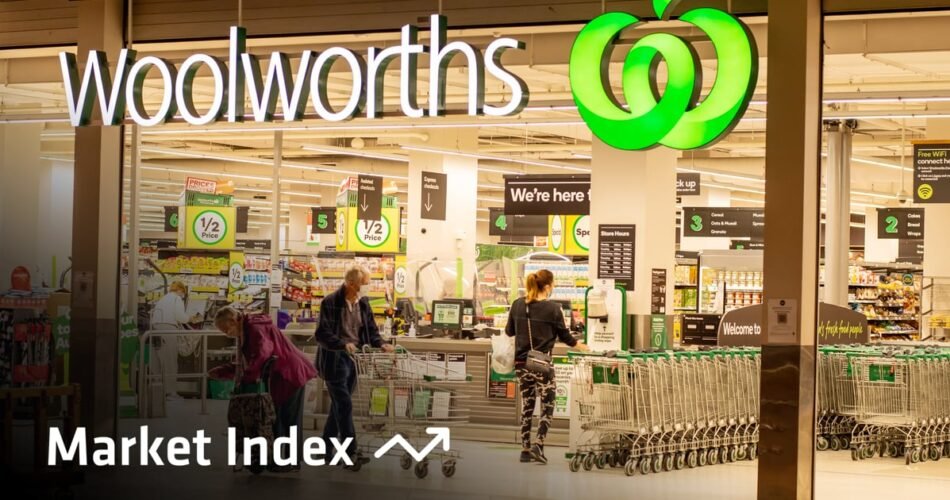
Woolworths (WOW) delivered a result that beat analysts’ expectations for earnings and dividends, with every trading segment contributing to growth. The supermarket giant’s profit 15% and allowed the board to raise its full year dividend 15.5% to 97 cents.
It caps a year in which the supermarket giant set out to win shoppers back and largely succeeded, with price cuts and sharper execution in Australian Food bringing customers through the doors more often.
“The action we have taken in FY26 to deliver more value for customers, greater convenience and better execution has improved customer advocacy and sales momentum in our key Australian Food business, particularly in H2,” said Woolworths CEO Amanda Bardwell.
The result was well received, with Woolworths shares up as much as 6.0% to $41.19, the highest since August 2021.
Woolworths FY26 results in focus
The numbers below are compared to analyst consensus estimates:
-
Group sales up 3.6% to $71,539m vs $71,609m ests (in line)
-
EBITDA up 6.7% to $6,089m vs $6,206m ests (2% miss)
-
Group EBIT (ex-items) up 12.7% to $3,105m vs $3,052m ests (2% beat), with all trading segments delivering growth
-
NPAT (ex-items) up 15.4% to $1,599m vs $1,545m ests (3% beat)
-
Final dividend up 15.6% to 52 cps fully franked, taking the full year to 97 cps vs 94.8 cps ests (2% beat), up 15.5%
-
Australian Food sales up 4.6% with EBIT up 8.5%, though excluding cycled industrial action and supply chain costs the underlying figures were 4.1% and 4.8%
-
New Zealand Food EBIT rose 8.8% for the year in NZD but fell 7.7% in H2, with gross margin down on customer investment and higher stock loss tied to the new store operating model rollout
-
W Living swung to $116m EBIT from a $31m loss, with BIG W returning to a $64m profit and Petstock EBIT up 33.5%
Woolworths group EBIT growth of 12.7% is flattered by a soft comparison, with industrial action in November and December 2024 costing Australian Food an estimated $95 million in EBIT. Excluding that and supply chain implementation costs, group EBIT rose 8.7%.
The same adjustment applies to the supermarket business, where underlying earnings grew 4.8% against sales of 4.1%. Woolworths has a stated aspiration for Australian Food earnings to grow faster than sales, which is the test of whether price investment is paying for itself. On an underlying basis it cleared that bar, but only just.
Woolworths’ non-supermarket division, W Living, which consists of BIG W and Petstock, was the group’s biggest single contributor to earnings growth this year. It swung $147 million to a $116 million profit, after losing money last year.
BIG W got there by selling at higher margins rather than selling more, with sales up just 0.9% while the chain cleared less stock at discount prices and sold more at full price. Petstock added $14 million of earnings growth on stronger sales and cost control.
New Zealand earnings grew 8.8% in local currency for the year but fell 7.7% in the second half. The business cut prices, which squeezed margins, and lost more stock to waste and markdowns after rolling out a new way of running its stores, which also disrupted trading.
Forward guidance
Australian Food sales rose 7.6% in the first eight weeks of FY27, though Woolworths estimates the Disney Ooshies collectibles program contributed 1.5 to 2 percentage points of that growth. New Zealand sales rose 4.2% in local currency over the same period with some Ooshies benefit, while BIG W sales declined modestly on cost-of-living pressure and weaker trade in its Everyday range.
Operating capex is guided to $1.9 to $2.0 billion, above the $1,837 million spent in FY26. Wage growth is expected to stay elevated, with Bardwell pointing to the 4.75% annual increase in Australia and progressive pay changes for 18 and 19 year old team members.
The group also expects the benefits from Moorebank to materially offset supply chain implementation costs in FY27. Moorebank is a distribution precinct in south-west Sydney where Woolworths has built two warehouses, now moving more than 4.5 million cartons a week between them. Building and commissioning those sites has cost the company $113 million this year and $111 million last year, and FY27 is the point where the savings start to cover the spend on the next round of facilities.
The bottom line
Woolworths’ price cuts brought shoppers back, momentum built through the second half, and every trading segment grew earnings. But Bardwell expects household budgets to stay under pressure in FY27, with customers remaining value-focused.
Cheap groceries are where Woolworths is winning, while the same squeeze is hurting BIG W, where the company says budget customers are feeling it most. Australian Food sales are up 7.6% in the first eight weeks of FY27, with Ooshies alone estimated to have added 1.5 to 2 percentage points. The question for FY27 is whether the supermarket momentum holds once the Ooshies program cycles out, with New Zealand still soft and BIG W facing what the company expects to be another challenging year.
Source link
Author

- Ytv Market News
- Share-market news writer and analyst with deep experience covering equities, commodities, forex, and cryptocurrencies for readers in the USA, UK, Canada, and Australia. Ytv Market News delivers timely market updates, practical trading insights, and clear explanations of macro and company-level catalysts that move prices. Combines on-the-ground financial reporting with technical analysis, using concise charts and actionable ideas to help investors and traders make smarter decisions.
Latest entries
 CanadaAugust 26, 2026S&P Dow Jones Indices Announces Change to the S&P/TSX Canadian Dividend Aristocrats Index
 AustraliaAugust 26, 2026Metallium Advances Flash Joule Heating Activities at New Gator Point Technology Campus
- Crypto NewsAugust 26, 2026Cardano (ADA) Jumps Past $0.20: 3 AIs Debate Whether a Rally to $1 Is Possible in 2026
 UsaAugust 26, 2026Alphabet Spends About 60 Cents of Every Technical Infrastructure Dollar on Servers. Nvidia’s Biggest Customers Were Just Told Prices Are Going Up More Than 15%.