
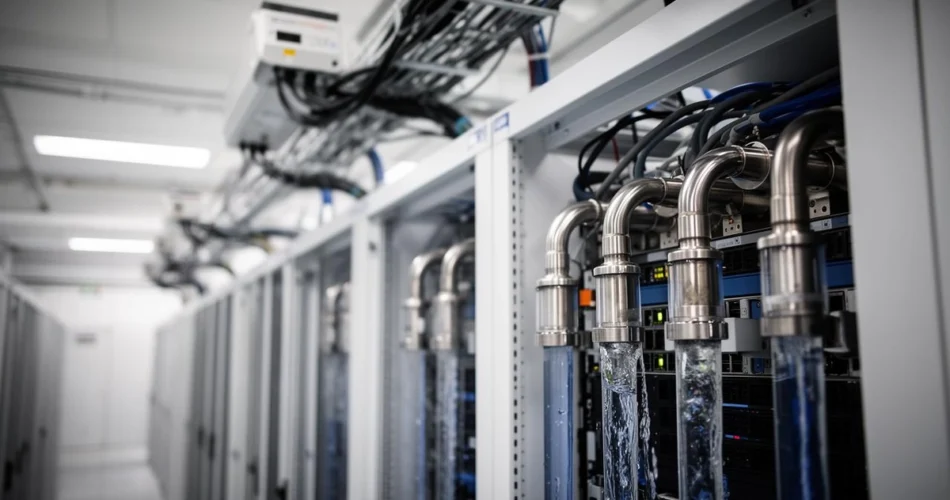
The investment focus in the AI supply chain is gradually expanding from core hardware such as GPUs and optical modules to liquid cooling, power management, and data center electrical infrastructure. As Nvidia’s Rubin platform advances its fully liquid-cooled design, and as high-power AI racks drive demand for 800V DC power architectures, liquid cooling and AI power systems are poised to become significant new growth areas within compute infrastructure.
According to a report by 36Kr, trading activity in China’s A-share market has recently declined. AI technology stocks are being pressured by multiple factors including valuations, liquidity, geopolitics, industry costs, and expectations around Nvidia’s earnings. Capital is rotating away from high-flying sectors such as optical communications and semiconductor equipment toward more niche areas with clearer expectation gaps. The liquid cooling sector has notably strengthened recently, with China’s Shenling Environment leading gains and Envicool hitting its daily limit up. Other Chinese names including Strong State, Goaland Energy, Feirongda, and Feilong Auto Parts all rose more than 5%.
In the past, liquid cooling, thermal management, and rack infrastructure were typically viewed as laggards within AI hardware rallies. After primary beneficiaries such as optical modules, servers, PCBs, and semiconductor equipment rallied, capital would often seek relatively low-positioned sub-sectors. However, as AI chip power consumption and rack density rapidly increase, the industrial role of liquid cooling is fundamentally changing.
Nvidia’s Rubin platform adopts a fully liquid-cooled design, with Vera Rubin NVL72 featuring a 100% liquid-cooled architecture and coolant inlet temperatures of up to 45 degrees Celsius. Nvidia has stated that warm-water liquid cooling can, in some regions, operate directly with dry coolers, reducing or even eliminating traditional mechanical refrigeration equipment. As a result, liquid cooling is no longer merely an accessory to servers but is becoming system-level infrastructure for AI data centers.
According to TrendForce, AI chip liquid cooling penetration is expected to climb from approximately 33% in 2025 to 53% in 2026, approaching 60% in 2027. Nvidia’s rack-level liquid cooling solution shipments are expected to double in 2026. Industry sources also indicate that more than 80% of Google’s AI servers already use liquid cooling. Rising liquid cooling penetration will drive demand growth for cold plates, CDUs, pumps, piping, rack thermal management, and overall data center thermal management systems.
The AI Power Bottleneck Emerges
As AI server deployments scale up, the constraints facing data centers have extended beyond pure compute supply to encompass power, power distribution, cooling, and energy efficiency. Goldman Sachs expects U.S. data center electricity demand to rise from 31GW in 2025 to 41GW in 2026, and further to 66GW in 2027. By then, data centers would account for 8.5% of U.S. summer peak electricity load, up from 4.1% in 2025. Corresponding new installed capacity is projected to jump from 8.5GW in 2025 to 13.6GW in 2026 and 36.3GW in 2027. Morgan Stanley estimates a potential U.S. data center power shortfall of approximately 38GW between 2026 and 2028, with grid connection timelines in some regions already stretching to 5–7 years.
Against this backdrop, Nvidia is pushing the 800VDC architecture, using higher supply voltage to reduce current and alleviate pressure on copper materials, cabling, connectors, and power losses in high-power racks. The supply chain has already demonstrated 800VDC Power Rack and 110kW Power Shelf solutions. Future technology evolution paths also include high-voltage DC, solid-state transformers, and DC microgrids.
According to official Nvidia data, under the 800VDC architecture, conductors of the same gauge can transmit more than 150% more power than traditional 415VAC systems, saving approximately 200 kilograms of copper busbars per rack. The next-generation Kyber rack, planned for 2027, is expected to accommodate 576 Rubin Ultra GPUs, a timeline that aligns with the full rollout of the 800VDC architecture.
From a supply chain perspective, PSUs and power shelves are the most direct beneficiaries. As per-rack power continues to rise, the power density and value content of power shelves increase correspondingly, and power systems are transitioning from supporting components to relatively independent infrastructure within servers. BBUs are primarily used to handle instantaneous power fluctuations from GPU loads and may in the future form a combined architecture with facility-level battery energy storage systems—short-duration voltage stabilization paired with long-duration energy storage.
Large-scale 800VDC deployment will also boost demand for solid-state DC circuit breakers, or SSCBs. DC circuits lack the natural zero-crossing points found in AC systems, so traditional AC protection schemes cannot be directly applied. Once high-voltage DC enters AI racks, the importance of fast interruption and safety protection will rise significantly. Over the longer term, if 800VDC extends from racks to data center power hubs and DC microgrids, solid-state transformers could become critical equipment connecting the grid to AI racks.
Relevant supply chain companies include Chinese firms Zhongfu Circuit, Kstar, and Zhongheng Electric, which are positioned around PCB, power supply, and high-voltage DC ancillary products, as well as Sifang Automation, China XD Electric, and Jinpan Technology, which have capabilities in power electronics, transformers, or grid equipment. However, solid-state transformers remain a relatively long-dated industry thesis. PSUs, BBUs, UPS systems, and high-voltage DC products are much closer to actual orders, and the two categories differ significantly in commercialization timelines.
| Segment | Primary Function | Industry Progress |
|---|---|---|
| Liquid Cooling Systems | Reduce thermal load of high-power chips and racks | Rubin platform driving full liquid cooling into production architecture |
| PSU/Power Shelf | Deliver high-density power to AI racks | Value content rising with rack power |
| BBU | Handle instantaneous GPU power fluctuations | Expected to form layered power delivery with facility-level storage |
| SSCB | Protect high-voltage DC power systems | 800VDC adoption creating new demand |
| SST | Power conversion between grid and AI racks | Still in early-stage development |
Note: Industry progress in the table is compiled from provided materials and does not represent order or earnings confirmation for any specific company.
Diverging Performance Among Supply Chain Companies
The broadening of AI infrastructure demand is also reflected in the operating results of some overseas chip companies. Analog Devices (ADI) is an analog chip company providing energy management and power connectivity hardware. Its products are used to connect and distribute power within data centers and to enable safe operation of multiple servers.
For its fiscal third quarter of 2026 ended August 1, the company reported revenue growth of 40% year over year, with data center and industrial businesses serving as the primary growth drivers. The company expects fiscal fourth quarter 2026 revenue midpoint of $4.3 billion, implying approximately 40% year-over-year growth. Adjusted earnings per share midpoint is projected at $3.86, up from $2.26 in the prior-year period, representing roughly 71% year-over-year growth.
Analog Devices posted third-quarter net income of $1.34 billion, more than doubling year over year, with a net margin of 33%. During the quarter, the company returned $1.7 billion to shareholders through dividends and share repurchases. Third-quarter net operating expenses rose approximately 13% year over year to $1.09 billion, with the first nine months of fiscal 2026 showing a similar 13% year-over-year increase.
Compared with GPU and memory chips, analog chip manufacturing equipment has a relatively longer replacement cycle, and manufacturers typically face lower capital expenditure pressure. Data shows Analog Devices trades at a forward P/E of approximately 22.5x, with a PEG of approximately 0.56. Its results demonstrate that AI investment is not only improving revenue for GPU and memory makers but is also flowing through to power management, power distribution, and industrial control segments.
That said, whether the industrial logic of AI power and liquid cooling can translate into sustained market momentum still depends on data center capital expenditure, Nvidia’s earnings and subsequent guidance, and overall market liquidity. Currently, A-share daily turnover is below 2 trillion yuan (approximately $298 billion), making it difficult for primary sectors such as optical communications and semiconductor equipment to sustain simultaneous trends. Capital rotation among sub-sectors remains a prominent feature.
From an industry perspective, data center construction is expanding from “buying GPUs” to simultaneously purchasing power, land, grid connections, cooling systems, and energy storage equipment. Nvidia’s recent moves around projects involving Lancium, SB Energy, and Cloverleaf reflect the emphasis on stable power sources for AI data center development. The International Energy Agency has also noted that reliable, affordable, and rapidly accessible electricity is becoming a critical condition for AI development.
For the market, the rise of liquid cooling does not necessarily signal the end of the AI trade, nor should it be simplistically equated with the start of a new broad-based rally. Liquid cooling already has a solid foundation of industrial demand, but some longer-dated power technologies still require order and product validation. Going forward, if market turnover recovers and Nvidia’s earnings and capex guidance continue to support demand expectations, the scope of AI infrastructure attention may extend further from chips to power, thermal management, and grid equipment. If liquidity remains insufficient or earnings fall short of expectations, sub-sectors may continue to exhibit rotational, phase-based moves.
Source link
Author

- Ytv Market News
- Share-market news writer and analyst with deep experience covering equities, commodities, forex, and cryptocurrencies for readers in the USA, UK, Canada, and Australia. Ytv Market News delivers timely market updates, practical trading insights, and clear explanations of macro and company-level catalysts that move prices. Combines on-the-ground financial reporting with technical analysis, using concise charts and actionable ideas to help investors and traders make smarter decisions.
Latest entries
 Politics News TodayAugust 26, 2026Surrogate McKenna West continues fight for medical custody of heart defect baby
 Market Movers TodayAugust 26, 2026Why Methode Electronics (MEI) Stock Is Trading Up Today
 Forex NewsAugust 26, 2026Japanese Yen remains vulnerable despite softer Greenback
 IndiaAugust 26, 2026Persisting retail F&O losses spur call for tighter eligibility filters