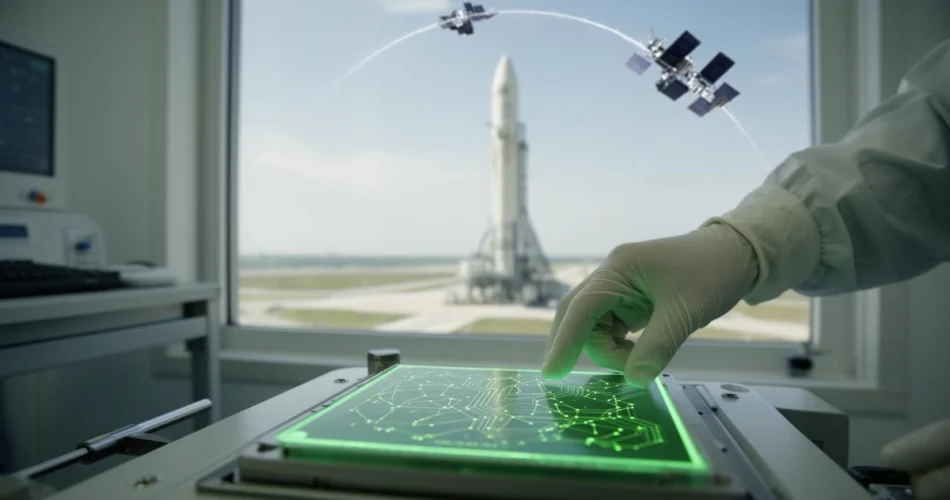
Global space industry leader SpaceX has recently racked up substantial wins in U.S. military satellite programs, accumulating orders worth more than $8 billion (approximately NT$250 billion), injecting strong momentum into Starlink’s commercial monetization. Under the Trump administration’s deregulatory policy environment, SpaceX’s defense and enterprise orders have both expanded, driving procurement across the satellite supply chain. Compeq (2317.TW), regarded as the near-exclusive supplier of Starlink high-density interconnect (HDI) boards, stands as the primary beneficiary, with analysts projecting its earnings per share (EPS) could reach NT$14 next year.
Following the Trump administration’s relaxation of space industry regulations, SpaceX’s ability to secure defense contracts has improved markedly, with cumulative military satellite program value surpassing $8 billion. Analysts note that these orders will directly bolster Starlink’s commercial monetization capacity, while the V3 satellite specification upgrades and steady growth in launch volume are driving higher value for upstream components. As the key supplier of Starlink HDI boards, Compeq’s space board business is expected to see a “volume and price both rising” dynamic this year, with satellite-related revenue share projected to climb from the current 20% to 26%, providing positive support for overall gross margin and profitability.
Compeq’s recent financial performance already reflects this growth momentum. July revenue reached NT$6.96 billion (approximately $218.2 million), up 0.6% month-over-month and 16.01% year-over-year. Cumulative revenue for the first seven months totaled NT$46.49 billion (approximately $1.5 billion), up 13.61% year-over-year. Profitability was even more impressive, with first-half net profit of NT$2.98 billion (approximately $93.6 million), up 39.08% year-over-year, and EPS of NT$2.5. Second-quarter net profit came in at NT$1.48 billion (approximately $46.4 million), up 77.86% year-over-year, with EPS of NT$1.24. Analysts point out that the low-earth-orbit satellite industry will see continued Starlink rocket launches and steady V3 satellite deployment in the second half of the year, with new capacity from upstream material suppliers coming online and raw material supply gradually improving, ushering in an accelerated growth phase for the global low-earth-orbit satellite industry.
Compeq shares saw early buying pressure push the stock up from below the flat line on the 25th, but selling pressure subsequently emerged. As of around 10 a.m., the stock was up 0.7% at NT$215, with trading volume exceeding 6,900 lots. Market participants interpret the short-term volatility as primarily reflecting profit-taking pressure, but institutional investors maintain a positive medium-to-long-term outlook, believing that satellite upgrades driving higher component value, combined with expanding low-earth-orbit satellite revenue scale, will further lift Compeq’s revenue and profitability.
SpaceX Operational Milestones and Starship Testing
SpaceX itself is at a critical juncture operationally. Last weekend, the company completed two consecutive Starlink deployment missions—one Falcon 9 rocket lifted off from Cape Canaveral carrying 29 satellites, while another launched from Vandenberg Space Force Base, delivering 27 Starlink satellites into orbit. These two launches pushed SpaceX’s cumulative orbital missions in 2026 past the 100-mission mark. By comparison, the company reached the same milestone later in 2025, completing 170 launches for the full year—accounting for more than half of all global orbital launches.
Starlink’s commercial performance has been equally robust. As of the end of the second quarter, Starlink paying subscribers reached approximately 12 million, with quarterly revenue climbing to $4.3 billion (approximately NT$140 billion), a substantial increase from $2.6 billion (approximately NT$83 billion) in the same period last year. The segment’s adjusted EBITDA (earnings before interest, taxes, depreciation, and amortization) reached $2.6 billion, up from $1.6 billion (approximately NT$51 billion) a year earlier. However, average monthly revenue per user declined from $85 to $66, indicating that the user base is expanding toward the mass market.
On the Starship development front, SpaceX successfully conducted a static fire test of the six Raptor engines on the Starship upper stage on August 21, a routine pre-launch verification procedure. The Super Heavy booster’s static fire test has yet to be conducted and is expected to be completed before integrated launch, with Starship’s 14th test flight (Test 14) targeted for September. Investors are closely watching this test, as it may demonstrate Starship’s ability to achieve stable Earth orbit for the first time. The company aims to use Starship for commercial payload deployment missions by the end of 2027.
CEO Elon Musk, in a separate announcement on August 21, revealed that SpaceX is targeting more than 30 launches per day by 2030, equivalent to roughly 10,000 launches annually. That figure far exceeds the U.S. government’s own projection of 1,000 launches per year by 2030 and significantly surpasses the Federal Aviation Administration’s (FAA) earlier estimate of 385. Musk also emphasized that Starship is critical for placing AI data centers into orbit, positioning SpaceX advantageously in the AI infrastructure market.
Post-IPO Liquidity Test
SpaceX (SPCX) has recently faced a post-IPO market liquidity test. The company released 319 million new shares last Thursday (August 20), equivalent to 2.68 times that day’s total trading volume, with the stock falling as much as 4.05% intraday to a low of $130.39. However, it rebounded 2.22% on Friday (August 21), closing at $136.97 per share, 1.46% above the IPO pricing of $135. Notably, Friday’s trading volume declined 34% from Thursday, suggesting no significant involuntary selling pressure emerged ahead of the weekend.
In pre-market trading on Monday (August 24), SPCX shares fell 1.9% to $135.28, just slightly above the $135 IPO pricing. Market focus has shifted to whether sellers will capitalize on Friday’s rebound to take profits. The stock currently trades 39% below its intraday high set on June 16.
According to SpaceX’s latest financial report, second-quarter revenue surged 92% to $7.81 billion (approximately NT$250 billion), while operating losses narrowed from $970 million (approximately NT$31 billion) to $143 million (approximately NT$4.6 billion). CFO Bret Johnsen stated that the company has ample investment capacity. Among its business segments, Starlink connectivity services remain the primary revenue source, but the AI division, while posting the highest growth rate, accounts for 86% of total capital expenditures, underscoring the high concentration of execution and investment.
Following its IPO, SpaceX holds $100 billion (approximately NT$3.2 trillion) in cash and marketable securities, total debt of $39.4 billion (approximately NT$1.3 trillion), and has accumulated $47.5 billion (approximately NT$1.5 trillion) in orders. Analyst price targets remain divided, with 35 analysts’ consensus target at $213.50, but individual forecasts ranging from $75 to $450. Future factors that could affect the stock include additional share unlock events potentially accelerating market supply, Starship development delays, Starlink price competition, and heavy reliance on AI customers along with substantial infrastructure investment.
Institutional investors broadly assess that SpaceX’s simultaneous progress across defense orders, Starlink user growth, and Starship testing will further manifest in procurement effects for Taiwan’s low-earth-orbit satellite supply chain in the second half of the year. As the leading supplier in the space board segment, Compeq is expected to see continued optimization of its revenue mix and much-anticipated earnings momentum, driven by the dual forces of Starlink V3 specification upgrades and increased launch volume.
Source link
Author

- Ytv Market News
- Share-market news writer and analyst with deep experience covering equities, commodities, forex, and cryptocurrencies for readers in the USA, UK, Canada, and Australia. Ytv Market News delivers timely market updates, practical trading insights, and clear explanations of macro and company-level catalysts that move prices. Combines on-the-ground financial reporting with technical analysis, using concise charts and actionable ideas to help investors and traders make smarter decisions.
Latest entries
 Company NewsAugust 25, 2026Die CESC-Aktie bleibt nach Dividendenausschüttung stabil
 Stock Market VideosAugust 25, 2026Nigel Farage Wins UK Special Election Over Count Binface
 UkAugust 25, 2026Tungsten West secures UK government investment in minerals project
 UsaAugust 25, 2026Modine Manufacturing falls as investors appear to revisit margin and execution concerns