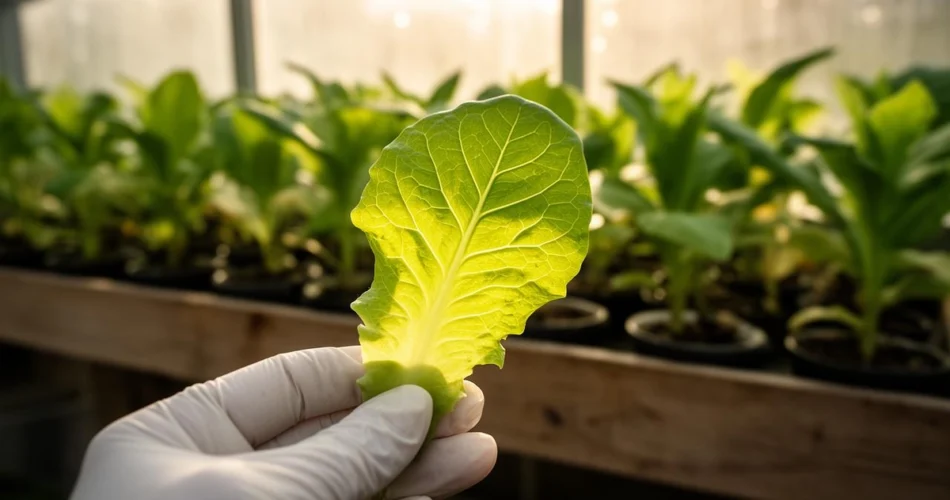
The first thing to understand about the future of meat is that it might be grown in sunlight rather than brewed in stainless reactors. In a recent conversation on Talking Biotech, plant biotechnologist Dr. Alexia Groff outlined a compelling proof-of-concept: she has engineered the chloroplasts of tobacco and lettuce to produce porcine myoglobin, the exact protein that makes a pork chop taste like a pork chop. The science is real, the folding was perfect, and the plants didn’t suffer—but the protein is only one-third loaded with the heme that gives meat its distinctive color and bioavailable iron. That gap, more than any other problem, is what separates this work from your dinner plate.
Dr. Groff’s doctoral research at Imperial College London, sponsored by the Cambridge-based food-ingredient startup Kyomei, was not aimed at making a purple tomato. She was testing whether the subcellular structures responsible for photosynthesis—chloroplasts—could be repurposed as miniature factories for animal proteins. In theory, the idea is almost perfect. In practice, the plant’s own metabolism refused to keep up.
Why the chloroplast beats the nucleus as a biofactory
To understand why this approach is exciting, you have to understand the strange biology of the chloroplast. It is, in essence, a domesticated bacterium living inside every plant cell. It has its own genome, its own high-capacity expression system, and—crucially—it is the site of heme biosynthesis. That made it a uniquely attractive target for producing myoglobin, a protein that requires precisely that cofactor.
The comparison to traditional nuclear transformation is stark. When you insert a gene into a plant’s nucleus, you fight against gene-silencing mechanisms and a lack of control over copy number. When you insert it into a chloroplast, you exploit a system with dozens of genome copies in each organelle, and hundreds of organelles in each cell. The amplification effect is enormous.
“Expressing the protein directly in the chloroplast means that there’s no need for a targeting sequence and import, so you can express the native sequence without the need of an N-terminal signal peptide,” Groff explained. The protein goes straight to work where it is manufactured.
There is also a biosafety advantage. Chloroplast genomes are maternally inherited in many crops, meaning transgenes do not hitch a ride in pollen. For regulators worried about modified genes escaping into wild relatives, this is a meaningful—though not decisive—benefit.
But the method has teeth. Chloroplast transformation is not the gentle, Agrobacterium-mediated process familiar to most plant geneticists. It requires a gene gun: a device that fires DNA-coated gold particles into leaf tissue at high pressure. Then comes the real patience test. You must achieve homoplasmy, replacing every wild-type chloroplast genome copy with the transformed version. That takes months of regeneration under selection pressure, and it only works well in a handful of species.
| Attribute | Nuclear transformation | Chloroplast transformation |
|---|---|---|
| Delivery method | Agrobacterium (domesticated soil bacterium) | Biolistic gene gun (gold microcarriers + helium) |
| Expression level | Lower (gene silencing, lower copy number) | Higher (many genome copies per cell, no silencing) |
| Time to stable transformant | Faster | Months (homoplasmy required) |
| Species applicability | Broad | Limited to well-established species |
| Post-translational modifications | Eukaryotic (glycosylation possible) | Prokaryotic-like (no N-glycosylation) |
| Gene flow risk | Higher (pollen transmission) | Lower (maternal inheritance in many crops) |
| Cofactor availability | Varies | Heme available (relevant for hemoproteins) |

Tobacco proved the concept. Lettuce is the commercial bet.
Groff’s team expressed the protein in three host organisms: tobacco, lettuce, and the single-celled alga Chlamydomonas. The results were not uniform.
Tobacco was the workhorse. It is the model organism of plant biotechnology, easy to transform and fast to grow. It produced approximately 94 milligrams of myoglobin per kilogram of fresh leaf weight. Lettuce, the commercial target because it is edible and familiar to consumers, produced about half that—48 milligrams per kilogram.
The discrepancy, Groff said, likely stems from host-specific differences in chloroplast genome copy number, protein stability, or folding capacity. The team did not investigate the mechanistic cause directly. But the strategic logic of lettuce was clear: it fits into existing fresh-produce supply chains, and the leaf itself could conceivably be used as a heme-iron-biofortified food without any protein extraction at all. That is, if regulators ever approve it.
The catch with lettuce is equally practical. It has not been tested in meat-analog formulations, and its poor behavior under heating may limit its use in anything that gets cooked. Tobacco, by contrast, is a stepping stone, not a destination.
| Host | Yield (mg/kg fresh weight) | Role in research | Key advantage |
|---|---|---|---|
| Tobacco | ~94 | Model organism, primary experimental platform | Ease of transformation |
| Lettuce | ~48 | Commercial target | Edible, consumer familiarity, supply-chain fit |
| Chlamydomonas | Not specified | Proof of concept in algae | Single-celled, fast growth |

A perfect protein, starved for heme
The most scientifically satisfying result was that the plant-produced myoglobin was correctly processed. The initiator methionine—the first amino acid in the chain—was cleaved off precisely. The protein folded into its characteristic all-alpha-helical structure. Mass spectrometry confirmed the plant had done the job right.
Groff was not surprised. “We were actually not too surprised to see correct post-translational processing, partly because the initiator methionine cleavage is one of the most highly conserved steps in protein synthesis across all three domains of life,” she observed. Myoglobin is a simple protein: no disulfide bonds, no glycosylation. It was already known to fold correctly in E. coli.
The failure came elsewhere. The plant produced the protein, but it could not supply enough heme to fill it. In tobacco, the recombinant myoglobin achieved only about 35% heme saturation. The benchmark: E. coli-based precision fermentation systems routinely hit 80% or higher.
“We still did not see sufficient heme occupancy in the myoglobin,” Groff said, with the kind of understated honesty that marks a genuine scientific dead-end reached after years of work.
This is the binding constraint. Myoglobin without heme is like a lock without a key—the protein is there, but it cannot perform its function. No amount of clever protein engineering can fix a metabolic supply chain problem.
The leading hypothesis is that the chloroplast’s tetrapyrrole biosynthesis pathway—the same pathway that makes chlorophyll—simply cannot keep pace. The team could not conclusively prove this was the single rate-limiting step, but it is the obvious target. Groff identified two engineering strategies: overexpress ferrochelatase 1, the enzyme that catalyzes the final step of heme-B biosynthesis, or feed plants ALA, a precursor that increases flux through the pathway. Both were on the to-do list, but neither was completed within the PhD timeframe.
A surprising resilience in photosynthesis
There was a genuine surprise in the data. Expressing high levels of a hemoprotein in a photosynthetic compartment should, in theory, compete with chlorophyll synthesis and disrupt photosynthetic electron transport—a process in which heme participates directly. It did not.
“We did not observe a significant penalty on photosynthesis,” Groff stated. “We looked at several parameters, so effective quantum yield of PSII, for example, also electron transport rate and non-photochemical quenching. And we found that they were similar between all of the tobacco plants, myoglobin producing and the controls.”
The numbers backed her up. Photosynthetic efficiency was statistically indistinguishable between the engineered plants and controls. There was a slight delay in plant growth, but the empty-vector control—plants that went through the transformation process but did not express myoglobin—showed the same delay. The effect was from the process, not the protein.
Even more remarkably, the myoglobin-expressing plants showed a significant increase in total chlorophyll and total heme. The plants sensed the additional demand and ramped up production. They just didn’t ramp it up enough. This is a classic systems-biology problem: you can engineer the protein, but the metabolic network has its own constraints.
Plants versus precision fermentation: an honest comparison
The commercial stakes are clear. Precision fermentation—using engineered microbes like E. coli to brew proteins in bioreactors—is the dominant alternative-protein technology. Companies like Impossible Foods have built their products around it. Groff’s plant-based system offers a fundamentally different value proposition.
Plants scale like agriculture: open fields, sunlight, no sterile conditions, no stainless-steel infrastructure. Lettuce, if used directly, could eliminate protein extraction costs entirely. But Groff is explicit that the techno-economic analysis has not been done. The data does not yet exist to say whether the resource efficiency of plants offsets their lower yields and incomplete heme loading.
She identified techno-economic analysis as a vital next step. The theoretical advantages are compelling, but “theoretical” is the operative word.
| Factor | Plant molecular farming (this work) | Precision fermentation |
|---|---|---|
| Infrastructure | Open-field or greenhouse cultivation | Bioreactors, sterile conditions |
| Scale-up | Highly scalable, low capital | Capital-intensive, capacity-constrained |
| Heme occupancy | ~35% (tobacco) | ~80%+ in E. coli |
| Downstream processing | Potentially minimal (edible host) | Protein extraction and purification required |
| Techno-economic data | Not yet produced | Established |
What comes next: from proof-of-concept to product
Myoglobin was a strategically lucky choice. It is simple, it requires no disulfide bonds or glycosylation, and its cofactor is already produced in the chloroplast. Groff identified other animal proteins as candidates for chloroplast-based production—collagen for gelatin, caseins and whey for dairy analogs, egg proteins—but was quick to note that these are far more complicated. Many require N-glycosylation, a post-translational modification the chloroplast cannot perform.
The immediate roadmap is clear. First, improve heme loading by overexpressing ferrochelatase 1 or supplying ALA precursors. Second, increase protein yield. Only then can the team assess the properties that actually matter to consumers: “color changes during processing and the bioavailability of the heme iron to determine how closely the plant-produced myoglobin compares to the animal-derived myoglobin,” as Groff put it.
The work also raises a more immediate question: could the lettuce itself be commercialized as a heme-iron-biofortified food? That is a lower-barrier application than meat substitution. A leaf that delivers bioavailable iron directly, with no protein extraction and no meat analog formulation, might reach market sooner—assuming regulatory approval. It would not taste like a burger, but it could address iron-deficiency anemia, a problem far more widespread than the market for premium plant-based meat.
The through-line of Groff’s research is honesty. This is a proof-of-concept, not a product. The plant can produce a functional mammalian hemoprotein, which is a genuine scientific milestone. But the chloroplast’s metabolic capacity, not the protein expression machinery, is the binding constraint. The solution—engineering the heme pathway—is straightforward in principle and entirely untested in practice. Whether it works, and whether it can ever compete with a 300,000-liter fermenter on cost, is an open question. What is certain is that the next few years of work at Kyomei and elsewhere will determine whether plant molecular farming is the next great platform in alternative proteins, or a scientifically elegant footnote.
Source link
Author

- Ytv Market News
- Share-market news writer and analyst with deep experience covering equities, commodities, forex, and cryptocurrencies for readers in the USA, UK, Canada, and Australia. Ytv Market News delivers timely market updates, practical trading insights, and clear explanations of macro and company-level catalysts that move prices. Combines on-the-ground financial reporting with technical analysis, using concise charts and actionable ideas to help investors and traders make smarter decisions.
Latest entries
 Crypto NewsAugust 25, 2026Binance launches 5 stock perpetuals with 20x leverage
 Politics News TodayAugust 25, 2026More details about Jed York’s arrest in a prostitution sting come to light and begs questions about the 49ers
 Market Movers TodayAugust 25, 2026NSSC Q2 Deep Dive: Recurring Revenue and Leadership Transition Drive Margin Expansion
 Forex NewsAugust 25, 2026RBA’s Jacobs: Transition from RBA controlling reserves quantity to banking system managing it