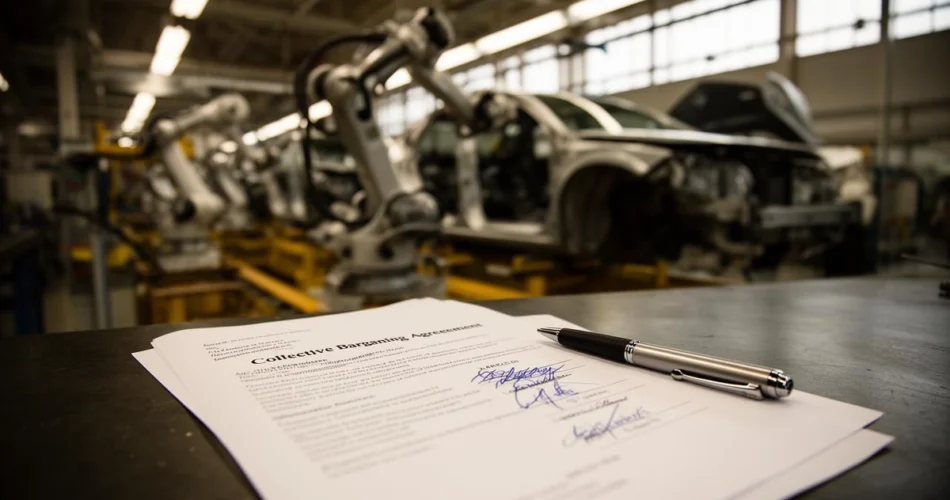
Hyundai Motor and its labor union have reached a tentative agreement in 2026 wage and collective bargaining negotiations. The deal comes 111 days after their initial meeting on May 6, following a prolonged standoff that included union strikes beginning in July and raised concerns about vehicle production disruptions and financial strain on parts suppliers.
The two sides began their 17th round of main negotiations at 2 p.m. on August 24 at the Ulsan Plant, engaging in marathon talks that stretched through the night into the early hours of August 25. The union had originally planned partial strikes for August 24–25 but suspended them to focus on negotiations once main bargaining resumed. This year’s cumulative strike time reached 60 hours, including an eight-hour full-scale strike on August 21 — the first such action in a decade since 2016.
The core of the tentative agreement includes a 100,000 won (approximately $72) base pay increase (including seniority step increases) and a performance bonus of 400% plus 12.7 million won (approximately $9,200). Added to this are 15 Hyundai Motor shares and 500,000 won (approximately $360) in Hash Points. Compared with the company’s fourth proposal, the lump-sum payment increased by 500,000 won from 12.2 million won (approximately $8,800), and a plan to pay 200,000 won (approximately $140) in Digital Onnuri gift certificates was converted to cash. The union said that when factoring in the annual wage increase effect of 6 million won (approximately $4,300) from the base pay hike, the total increase amounts to approximately 40.84 million won (approximately $30,000).
The two sides also agreed on workforce expansion. Labor and management decided to hire 500 new technical workers, with 200 to be recruited in the second half of 2027 and 300 in 2028. Hyundai Motor explained that large-scale workforce redeployment planned as part of domestic plant restructuring makes new hiring difficult, but agreed to proceed with recruitment focused on core positions.
On retirement age extension, the two sides reached agreement contingent on relevant legal revisions. If the law is amended, the company will implement a normal retirement age extension without further expanding the current wage peak system. For example, if the retirement age is raised to 65, existing wage increases would apply at ages 61–63, wages would be frozen at 64, and only at 65 would a 10% reduction apply. In effect, labor and management have agreed on wage principles for the post-extension period even before the legal change takes effect.
The issue of bonus increases will be revisited in 2027 collective bargaining. Summer vacation pay will increase by 200,000 won from the current 800,000 won (approximately $580) to 1 million won (approximately $720), effective from 2027. The two sides also reached agreement on items related to basic labor rights for indirectly employed workers, and confirmed progress on regional agenda items for the Namyang Research Center, Jeonju Plant, Asan Plant, and sales division through working-level discussions.
The reinstatement of dismissed workers and damage compensation attachments were also included in the tentative agreement. The company agreed to withdraw all 10 damage compensation attachments filed during union activities, which according to the union total 21.37 billion won (approximately $15.5 million).
The agreement also addresses responses to future industrial transformation. Labor and management shared the view that adopting future technologies such as physical AI and robotics is essential for corporate survival, and agreed to jointly respond to industrial transition by sharing progress on new businesses and technologies. They will also pursue discussions on institutional improvements, productivity, and manufacturing competitiveness.
A Hyundai Motor official said, “We apologize for the concern caused to shareholders, customers, parts suppliers, and numerous other stakeholders due to the prolonged negotiation difficulties and strikes. As labor and management reached this agreement with a sense of urgency to prevent further damage, we will devote our full efforts to second-half production and new vehicle manufacturing to repay customer support with world-class quality mobility.”
The tentative agreement will be finalized through a ratification vote by all union members on August 31. If it passes with majority approval, Hyundai Motor’s 2026 wage and collective bargaining negotiations will officially conclude.
This year’s strikes halted production lines for approximately 120 hours. Based on Hyundai Motor’s hourly production volume and average selling price, an estimated 55,200 units of production were lost, with revenue losses estimated at 2.35 trillion won (approximately $1.7 billion).
Source link
Author

- Ytv Market News
- Share-market news writer and analyst with deep experience covering equities, commodities, forex, and cryptocurrencies for readers in the USA, UK, Canada, and Australia. Ytv Market News delivers timely market updates, practical trading insights, and clear explanations of macro and company-level catalysts that move prices. Combines on-the-ground financial reporting with technical analysis, using concise charts and actionable ideas to help investors and traders make smarter decisions.
Latest entries
 AustraliaAugust 25, 2026Everything you need to know about the Coles dividend
 Crypto NewsAugust 25, 2026Gemini enables XRP transfers via XRPL in Singapore
 Politics News TodayAugust 25, 2026Rob Manfred addresses possibility of cancelling 2027 Major League Baseball season: ‘We want to play’
 Market Movers TodayAugust 25, 2026Williams-Sonoma (WSM) Reports Q2: Everything You Need To Know Ahead Of Earnings