


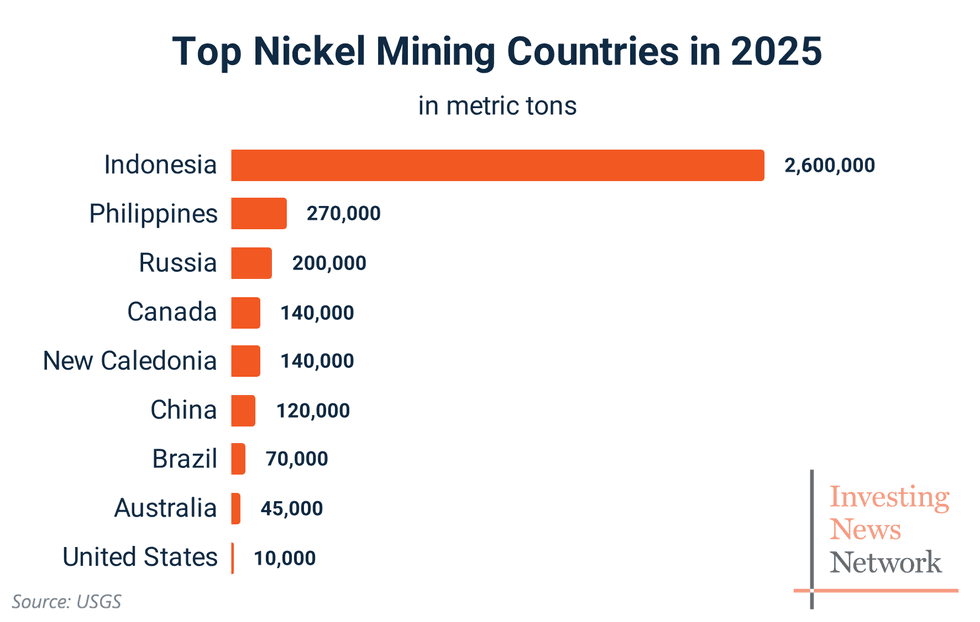
The list of top nickel producing countries has been shaken in recent years by Indonesia’s rapid rise to the top, beating the Philippines and New Caledonia, and it continues to widen the gap.
Demand for nickel is mounting. Stainless steel accounts for the vast majority of nickel demand, but electric vehicle (EV) batteries represent a growing application for the base metal as the shift toward a greener future gains steam.
While nickel’s long-term outlook appears bright, it has been facing headwinds over the last several years, including soft demand in both the construction and EV sectors, as well as oversupply from the sharp increase in output from Indonesia. This has resulted in much lower nickel prices compared to their highs earlier this decade, subsequently leading many mining companies to shutter operations in the near term.
In December 2025, news of Indonesia’s plans to tighten output quotas in successfully provided a large boost to prices, which had bottomed below US$15,000 per metric ton last year, and they continued higher in April to over US$19,400. However, the price hasn’t sustained levels needed for Western companies to resume output.
These trends have also significantly impacted the top nickel countries, some of whom rely on the success of the nickel sector. For those interested in the nickel market, it is essential to learn about the top producers of the base metal.
This list of the top nickel-producing countries breaks down operations and news affecting the world’s top nickel countries in recent years. Nickel production figures are sourced from the US Geological Survey’s 2026 Mineral Commodity Summary.
Top nickel production by country
1. Indonesia
Nickel production: 2.6 million metric tons
Indonesia produced a whopping 2.6 million metric tons of nickel in 2025, accounting for 67 percent of global output. Indonesia also hosts the world’s largest economic nickel reserves with 62 million metric tons.
Indonesia’s output of the base metal has grown tremendously in the last 10 years, compared to just 130,000 metric tons in 2016.
While the majority of the country’s nickel is destined for stainless steel production, demand from the EV sector has grown for use in nickel-cobalt-manganese batteries.
As such, Indonesia has been actively working to support the sector, and Indonesia’s close proximity to China, the world’s current leader in EV manufacturing, has made for an ideal setup. Significant investment from China supported Indonesia’s nickel buildout.
In May 2021, the country welcomed the commissioning of the PT Halmahera Persada Lygend, a joint venture between Indonesia’s Harita Group and China’s Ningbo Lygend Mining. The plant is the first to use a wet-method high-pressure acid leaching (HPAL) to process laterite ore into mixed hydroxide precipitate (MHP), an intermediate material used to make battery-grade nickel sulfate.
Western investment has also entered the sector, with Ford Motor (NASDAQ:F) announcing in December 2023 that it is taking a direct stake in the proposed US$3.8 billion Pomalaa battery nickel plant. Zhejiang Huayou Cobalt, one of the world’s largest nickel producers, has a 73.2 percent stake in the project, followed by Vale (NYSE:VALE) at 18.3 percent. Ford agreed to an initial 8.5 percent stake, with an option to raise it to 17 percent.
Pomalaa is planned to produce 120,000 metric tons of nickel in MHP annually using HPAL technology. The Pomalaa mine began production in early 2026, and construction of the plant reached mechanical completion as of August 2026, with next steps being testing and commissioning.
Likewise, the country has been working to attract investment across the supply chain, including the construction of HLI Green Power, a partnership among Hyundai Motor Group, LG Energy Solution and Indonesia Battery. The plant opened in July 2024 and was designed to produce 10 gigawatt-hours of battery cells annually.
The country has introduced and altered a range of policy changes in recent years to respond to the impacts of oversupply and environmental damage. Additionally, while the Indonesian nickel sector benefits from lower costs than other operations worldwide, it has still been affected by falling nickel prices over the last couple of years.
In December 2025, news that the Indonesian government planned to reduce mining quotas for 2026 led nickel prices to spike significantly in anticipation. Ultimately, in February, it introduced the steep cuts, limiting industry output from 379 million wet metric tons of ore last year to a range of 260 million to 270 million wet metric tons of ore for 2026.
2. Philippines
Nickel production: 270,000 metric tons
In 2025, the Philippines produced 270,000 metric tons of nickel, a 24 percent decrease from the 330,000 metric tons produced in 2024.
The USGS attributes the lowered output to significant production cuts at several mines due to low prices. Additionally, it noted that the Province of Palawan introduced a 50 year ban on new mining permits.
The Philippines currently has more than 30 nickel mines, including Rio Tuba, which is operated by Nickel Asia, one of the nation’s top nickel ore producers.
The Philippines has been one of the top nickel-producing countries for quite some time, as well as a significant nickel ore exporter, with much of its output being sent to China.
Despite the country’s lower mine output, its nickel exports to Indonesia actually surged in 2025 to 15.33 million metric wet tons of ore. The material was destined for Indonesian upgraders, which have been struggling with weak supply conditions.
3. Russia
Nickel production: 200,000 metric tons
Russia produced 200,000 metric tons of nickel in 2025. Even though it holds the third spot on this list of the world’s top nickel producers, Russia has seen its nickel output drop from totals seen earlier this decade. In 2020, the nation’s nickel output totaled 283,000 metric tons.
Russia’s Norilsk Nickel is one of the world’s largest high-grade nickel and palladium producers. Nornickel’s flagship nickel asset is its Norilsk Division on the Taymyr Peninsula in Siberia, which includes multiple mines, concentrators and metallurgical plants. It also has assets in the Kola Peninsula in Northwest Russia.
In mid-2024, the United States and the United Kingdom joined forces to place a ban on Russian nickel imports.
4. Canada
Nickel production: 140,000 metric tons
Canada’s nickel production in 2025 totaled 140,000 metric tons, down significantly from 235,000 metric tons in 2015. The country’s Sudbury Basin is the second largest supplier of nickel ore in the world, and Vale’s Sudbury operation is located there.
Another key nickel producer in Canada is Glencore (LSE:GLEN,OTCPL:GLCNF), which owns the Raglan mine in Québec and the Sudbury Integrated Nickel Operations in Ontario. The major miner’s Sudbury site includes the Nickel Rim South mine, the Fraser mine, the Strathcona mill and the Sudbury smelter.
Canada Nickel Company’s (TSXV:CNC,OTCQX:CNIKF) Crawford nickel sulfide project was announced as one of the first projects to be included under the Canadian Government’s Major Project Office mandate to help accelerate infrastructure and mining projects to completion. While the company has not reached a final investment decision, in July 2026 it did receive critical approvals needed to begin construction of the mine.
In February 2024, the company announced plans to develop a US$1 billion nickel processing plant in Ontario, which once complete would be North America’s largest and is expected to begin processing material in 2027.
In 2025, Canadian steel and aluminum became the subject of a 25 percent tariff imposed by the US Trump administration, which he increased to 50 percent in June.
Nickel metal originating from Canada is currently exempt under the Canada-US-Mexico Agreement that replaced NAFTA in July 2020 under Trump’s first administration, but the metal’s use in stainless steel could cause a trickle-down effect.
Last year, Canada was the largest exporter of nickel to the United States with more than US$1 billion worth of nickel and accounting for more than 40 percent of total US nickel imports. The next biggest supplier was Norway with 11 percent.
4. New Caledonia
Nickel production: 140,000 metric tons
In 2025, New Caledonia produced 140,000 metric tons of nickel, a significant jump from the 116,000 it produced in 2024 but still well below its typical production.
The economy of New Caledonia, a French territory just off the coast of Australia, depends heavily on its nickel mining industry. In recent years, New Caledonia’s nickel industry has suffered due to lower nickel prices, rising energy costs and sociopolitical unrest.
Although New Caledonia saw a bump to its nickel output in 2025, the state of the industry there remains in flux as nickel prices haven’t seen the broad, sustained increases needed to increase mine output to pre-2024 levels, when output was routinely above 200,000 metric tons per year.
In February 2024, major miner Glencore made the decision to place its Koniambo nickel mine on care and maintenance and put it up for sale, citing high operating costs and a weak nickel market.
Given these circumstances, at the time the French government offered a 200 million euro bailout package for New Caledonia’s nickel industry. But the move didn’t go as planned, with trader Trafigura deciding not to contribute to the bailout of Prony Resources Nouvelle-Caledonie and the Goro mine, in which it has a 19 percent stake. While the mine remains operational, its future is still in limbo.
In July 2025, negotiations with New Caledonian leaders resulted in the Bougival Accord, a non-binding agreement that aimed to replace the current accord between France and New Caledonia. Along with many proposed reforms, it included commitments to support New Caledonia’s nickel industry. However, the process remains stalled in 2026 due to insufficient support in France and disagreements between New Caledonian political groups.
6. China
Nickel production: 120,000 metric tons
China’s nickel production in 2025 was 120,000 metric tons, up slightly from 115,000 metric tons in the previous year.
Nickel production in the Asian nation has remained relatively consistent in recent years. In addition to being a top nickel-producing country, China is the world’s leading producer of nickel pig iron, a low-grade ferronickel used in stainless steel. Jinchuan Group, a subsidiary of Jinchuan Group International Resources (HKEX:2362), is a large nickel producer in China.
With Indonesia’s surplus weighing on the market, China’s position as a major importer of the country’s nickel and a top producer of stainless steel means that it also influences nickel price dynamics. The country also imports a large amount of nickel from the Philippines.
7. Brazil
Nickel production: 70,000 metric tons
Brazil’s nickel production came in at 70,000 metric tons in 2025, up slightly from the 67,500 produced in 2024, but still well short of the 160,000 metric tons it produced a decade earlier in 2016.
Major nickel mining operations in the country include Atlantic Nickel’s Santa Rita nickel-copper-cobalt sulfide mine in the state of Bahia.
Anglo American (LSE:AAL,OTCQX:AAUKF) is set to sell its nickel portfolio in the country, including its Barro Alto mine, to MMG (OTCPL:MMLTF,HKEX:1208) subsidiary MMG Singapore Resources for up to US$500 million in cash. The deal is currently making its way through EU’s regulatory process, and the pair extended the deadline for the deal to October 2026.
Centaurus Metals (ASX:CTM,OTCQX:CTTZF) is advancing the Jaguar nickel sulfide project in the Carajás mineral province. The project hosts a measured and indicated resource of 138.2 million metric tons at an average grade of 0.87 percent nickel, totaling 1.2 million metric tons of contained nickel.
In June 2026, Centaurus reported that it was granted tax incentives by the Pará state government for the development of the project and expected a final investment decision before the end of September 2026.
8. Australia
Nickel production: 45,000 metric tons
Australia produced 45,000 metric tons of nickel in 2025, a more than 54 percent drop from its output of 98,000 metric tons in 2024 and over 100,000 below its 2023 production.
Low prices have wreaked havoc on nickel mining in the country, leading to many of the country’s nickel operations being put on care and maintenance in 2023 and 2024.
The situation was enough to prompt the Australian government to add nickel to its critical minerals list in early 2024, which allows the country’s nickel industry to receive support through the government’s AU$4 billion Critical Minerals Facility.
Australia’s largest nickel mines include Glencore’s Murrin Murrin, First Quantum Minerals’ (TSX:FM,OTCPL:FQVLF) Ravensthorpe and BHP’s (ASX:BHP,NYSE:BHP,LSE:BHP) Nickel West operations.
However, Murrin Murrin is currently the only one of those three that has remained in operation.
Many of the country’s nickel mines remain in care and maintenance as of mid-2026, including Ravensthorpe and Nickel West. Other operating nickel mines include the Nova and Forrestania mines, operated by IGO (ASX:IGO,OTCPL:IPGDF), but both will reach the end of their mine life by the end of 2026, and are being divested by the company.
9. United States
Nickel production: 10,000 metric tons
Lastly, the United States produced 10,000 metric tons of nickel in 2025, a jump from the 7,490 metric tons it produced in 2024.
The Eagle mine is the only primary nickel-mining property in the US. The asset, located on the Yellow Dog Plains in the Upper Peninsula of Michigan, is a small, high-grade nickel-copper mine owned by Lundin Mining (TSX:LUN,OTCPL:LUNMF). Output from the mine was exported to smelters in Canada and overseas.
Nickel was included in the US’ critical minerals list, and in September 2023, under the Defense Production Act, the US Department of Defense awarded US$20.6 million to Talon Metals (TSX:TLO,OTCID:TLOFF) for further exploration and mineral resource definition at its Tamarack nickel-copper-cobalt project in Minnesota.
An environmental review process is underway for the proposed Tamarack underground mine. The company plans to process ore from the mine at a proposed battery mineral processing facility in North Dakota. Talon has said it intends to initiate the permitting process for the facility in 2025.
Other significant projects in the works include Antofagasta’s (LSE:ANTO,OTCPL:ANFGF) Twin Metals project in Minnesota, which is advancing again after the US Senate’s April 2026 decision to overturn a 20 year mining ban on the federal land that’s home to the project; and Homeland Nickel’s (TSXV:SHL,OTCQB:SRCGF) portfolio of nine surface depth laterite projects in Southern Oregon.
FAQs for nickel production
How is nickel mined and processed?
How nickel is mined and processed depends upon many factors, such as the size, grade, morphology and depth of the nickel deposit that’s under consideration. While lateritic nickel deposits are generally mined from open pits via strip mining, sulfide nickel deposits are often mined using underground extraction methods.
After mining, nickel ore is processed into higher-grade concentrates through crushing and separating nickel-bearing material from other minerals using various physical and chemical processing methods. Next, the concentrates are smelted in a furnace before the final stage of refinement using pyrometallurgical and hydrometallurgical processes.
How bad is nickel mining for the environment?
Nickel mining involves serious environmental concerns, including air and water pollution, habitat destruction, community displacement, wildlife migration pattern disturbances, greenhouse gas emissions and carbon-intensive energy use. Nickel-mining companies looking to supply the EV market are feeling the pressure to lessen the environmental footprint of their operations.
Don’t forget to follow us @INN_Resource for real-time news updates!
Securities Disclosure: I, Dean Belder, hold no direct investment interest in any company mentioned in this article.
From Your Site Articles
Related Articles Around the Web
Author

- Ytv Market News
- Share-market news writer and analyst with deep experience covering equities, commodities, forex, and cryptocurrencies for readers in the USA, UK, Canada, and Australia. Ytv Market News delivers timely market updates, practical trading insights, and clear explanations of macro and company-level catalysts that move prices. Combines on-the-ground financial reporting with technical analysis, using concise charts and actionable ideas to help investors and traders make smarter decisions.
Latest entries
 Crypto NewsAugust 25, 2026Neo News: Week in Review – August 17 – August 23
 Investing InsightsAugust 25, 2026Amazon Plans $530 Million Push to Automate Last-Mile Delivery Hubs — BigGo Finance
 GermanyAugust 25, 2026Sonova unveils new AI-powered hearing-aid platform to support growth targets
- CanadaAugust 25, 2026Canadian Investment Regulatory Organization Trading Halt

