As performance differences between AI models shrink, the competitive focus has shifted from “which model to use” to “how to connect models to business operations.” Companies are currently fighting over the tooling that makes AI easier for developers to work with — what’s known as the harness. But some argue this too will soon become commoditized. Simply making models easier to use isn’t enough to get AI running in real business environments. You need to connect it to enterprise data and workflows, and even manage permissions governing who can do what. The layer responsible for that is called the “control plane” — one level above the harness. A growing consensus in the industry holds that whoever wins control of this layer will emerge as the winner of the enterprise AI market, and companies are rushing to enter the space.
Yet there is one company that has been providing this layer to enterprise customers for nearly 20 years: U.S. data analytics software firm Palantir Technologies. Back then, the company used this layer to manage human workers. It mapped them onto what could be called a “map of business operations” and used that to run organizations. Now, AI agents are beginning to move across that same map. The competitive arena has shifted to where Palantir already stands.
The second-quarter results announced on August 3 defied conventional expectations for a software company. Revenue came in at $1.935 billion (approximately ¥310 billion), up 93% year-over-year. GAAP operating income was $912 million (approximately ¥150 billion), representing a 47% operating margin. Adjusted operating income was $1.194 billion (approximately ¥190 billion), or 62%. The “Rule of 40” — growth rate plus profit margin — reached 155%. U.S. commercial revenue grew 149% year-over-year.
Co-founder and CEO Alex Karp’s remarks on the earnings call can be distilled into three points. First, he said demand for AI sovereignty has been unleashed — meaning that the conviction among corporate leaders that they should decide where AI runs and where data resides has spread rapidly. Second, he stated that Palantir is the only company that has demonstrated the ability to convert tokens into real economic value. Third, he said customers trust Palantir to give them maximum control over their operations, data, and decision-making. In other words, customers are choosing Palantir as the custodian of their control plane.
The “Ontology” at the Core of the Control Plane
At the heart of that control plane is what the company calls its “ontology” — a mechanism that captures how a company’s operations actually function. It includes not just objects and their attributes, but all executable actions, permissions, and relationships. In a spreadsheet, order numbers, customer names, and factory names are merely meaningless strings arranged in separate columns. But when you map out in advance what each column refers to and how they connect to one another, you can see — on a single canvas — that if this factory stops, which orders will be delayed and which customers will be affected.
It’s not just relationships that get mapped. What can be done with each element, and who is authorized to do it, is also recorded in the same place. In an era when AI agents place purchase orders and halt payments, what companies will be judged on is not model intelligence. It’s: What data was the decision based on? Who granted the authority? Can it be revoked? If these three things are scattered across different systems, reconciliation remains a manual human task. If they reside in the same place, a record of who did what is automatically preserved and can be audited after the fact.
As 2026 began, moves around the control plane kicked off in earnest. The approaches fall into three categories, distinguished by where each player is reaching from.
The Three Factions’ Offensive
The first faction attacks from where data accumulates. Snowflake, the U.S. data platform company, announced on January 8 that it would acquire Observe, a U.S. systems monitoring firm, for approximately $1 billion (approximately ¥160 billion). It was the largest acquisition in Snowflake’s history and made explicit its pivot from cloud data warehousing to a production AI control plane. At its annual event in June, the company unveiled a vision called the “Agentic Enterprise,” centered on “CoWork” and “CoCo” as the core of an agentic control plane. It has also begun formally offering a system that assigns every agent a cryptographic identity, sets permissions per agent, and maintains a complete audit trail.
Rival Databricks is attacking from the same position. On June 16, it announced “Genie Ontology,” which continuously and automatically learns business context. Co-founder and CEO Ali Ghodsi said that if AI cannot explain to a CFO why margins changed, that’s not a problem of AI capability — it’s a problem of not knowing the business context. “Ontology” is the term Palantir has used to describe its core capability. Databricks adopting the same name to claim the same territory amounts to a direct challenge.
The second faction is the cloud camp, attacking from where business systems live. Amazon Web Services announced on June 30 that it would invest $1 billion (approximately ¥160 billion) to establish an organization that embeds engineers directly within customer companies. These embedded engineers are called “Forward Deployed Engineers,” or FDEs — a practice Palantir pioneered more than a decade ago. On July 2, Microsoft launched “Frontier Company” with a $2.5 billion (approximately ¥400 billion) investment and a headcount of 6,000.
AWS’s FDE teams build a layer equivalent to Palantir’s ontology within the customer’s AWS environment, connect it to internal data sources, and then have AI draw the map of business operations. Compensation is tied not to hours worked but to measurable business outcomes for the customer. Teams of five to six people enter each customer on a 45-day cycle, with AI agents handling everything from requirements definition to implementation and testing, while human engineers focus on validation and direction-setting. It’s a system where what used to take humans months to map can now be drawn by AI in days.
The third faction attacks from where intelligence resides: the model camp. Anthropic announced on May 4 that it had established an enterprise services company with investment firms Blackstone and Hellman & Friedman, along with Goldman Sachs, as founding partners. Valued at $1.5 billion (approximately ¥240 billion), it targets mid-sized companies that cannot maintain in-house AI talent. OpenAI followed on May 11, raising more than $4 billion (approximately ¥640 billion) from 19 investors to launch “The Deployment Company” and acquiring Tomoro, a UK-based AI consulting firm with 150 implementation specialists. Both moves represent efforts to fill the weakness of having excellent models but lacking knowledge of customer operations — by building deployment forces backed by outside capital.
NVIDIA, the U.S. semiconductor company, belongs to none of these three factions. It is not competing for control of the control plane itself; rather, it is positioned to sell components and computing infrastructure to all the companies building one. At its annual “GTC Taipei 2026” event on June 1, the company announced a suite of components for building agents. CEO Jensen Huang said that while major software companies are each trying to embed their own AI agents into enterprise systems, NVIDIA is offering an open agent foundation called “NemoClaw” that anyone can use. Whoever wins the battle for control plane dominance, NVIDIA’s semiconductors and computing infrastructure will be used underneath.
Three Conditions That Will Decide the Outcome
Three conditions will determine the trajectory of this competition. The first is how deeply a company can understand enterprise operations. Collecting data alone isn’t enough. You need to grasp how information about customers, orders, and factories connects, who makes what decisions, and how far execution authority extends. Palantir has spent 20 years accumulating this as its ontology. Snowflake and Databricks, by contrast, are trying to capture business context from where enterprise data already resides. How accurately each can build a “map of business operations” is the first battleground.
The second is how broadly operations can be executed on top of that map. Even if AI understands the business, if it cannot actually place orders, halt payments, or trigger other systems, the company’s work doesn’t change. That requires connecting not just data but also permissions and business systems. AWS and Microsoft are entering from where business systems live precisely because they hold an advantage on this front.
The third is how quickly and at what scale it can be deployed across many enterprises. No matter how excellent a control plane is, if it requires engineers to spend months studying each customer’s operations, adoption will be limited. AWS is using AI agents for everything from requirements definition to implementation and testing, with human engineers focused on validation and direction-setting. Anthropic and OpenAI are also building deployment forces rather than just providing models. Whether the work of creating the business map itself can be accelerated with AI is the third battleground.
Each company’s starting point is different. Palantir entered this market from business understanding, Snowflake and Databricks from data, AWS and Microsoft from business systems, and Anthropic and OpenAI from AI models. But ultimately, all must satisfy the same three conditions: deeply understanding the enterprise, driving a broad range of operations, and deploying it all in a short timeframe.
Source link
Author

- Ytv Market News
- Share-market news writer and analyst with deep experience covering equities, commodities, forex, and cryptocurrencies for readers in the USA, UK, Canada, and Australia. Ytv Market News delivers timely market updates, practical trading insights, and clear explanations of macro and company-level catalysts that move prices. Combines on-the-ground financial reporting with technical analysis, using concise charts and actionable ideas to help investors and traders make smarter decisions.
Latest entries
 Crypto NewsAugust 25, 2026Crypto bros are harassing WNBA players… again
 Investing InsightsAugust 25, 2026WRC 2026 Data Wars: 1,900 Autonomous Mining Trucks Generate the Industry’s Most Coveted “Dirty Data” — BigGo Finance
 GermanyAugust 25, 2026Surge in bond yields is a result of “Trump’s war”, German minister says
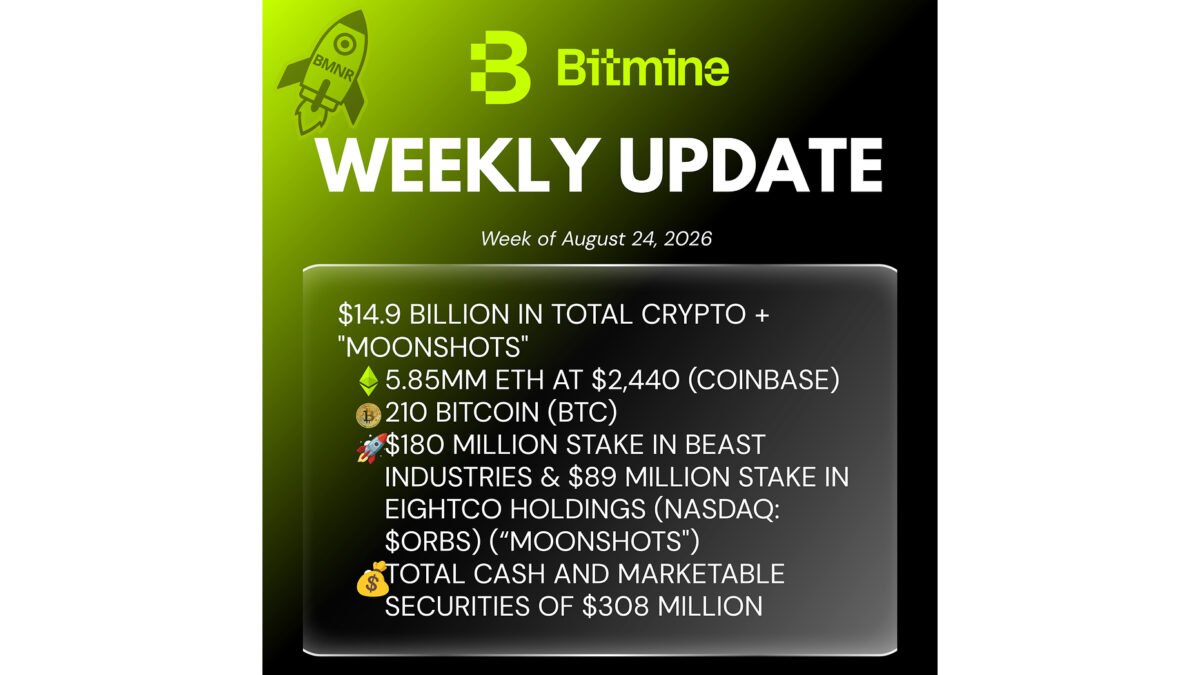 CanadaAugust 25, 2026Bitmine Immersion Technologies (BMNR) Announces ETH Holdings Reach 5.85 Million Tokens, and Total Crypto and Total Cash Holdings of $14.9 Billion