
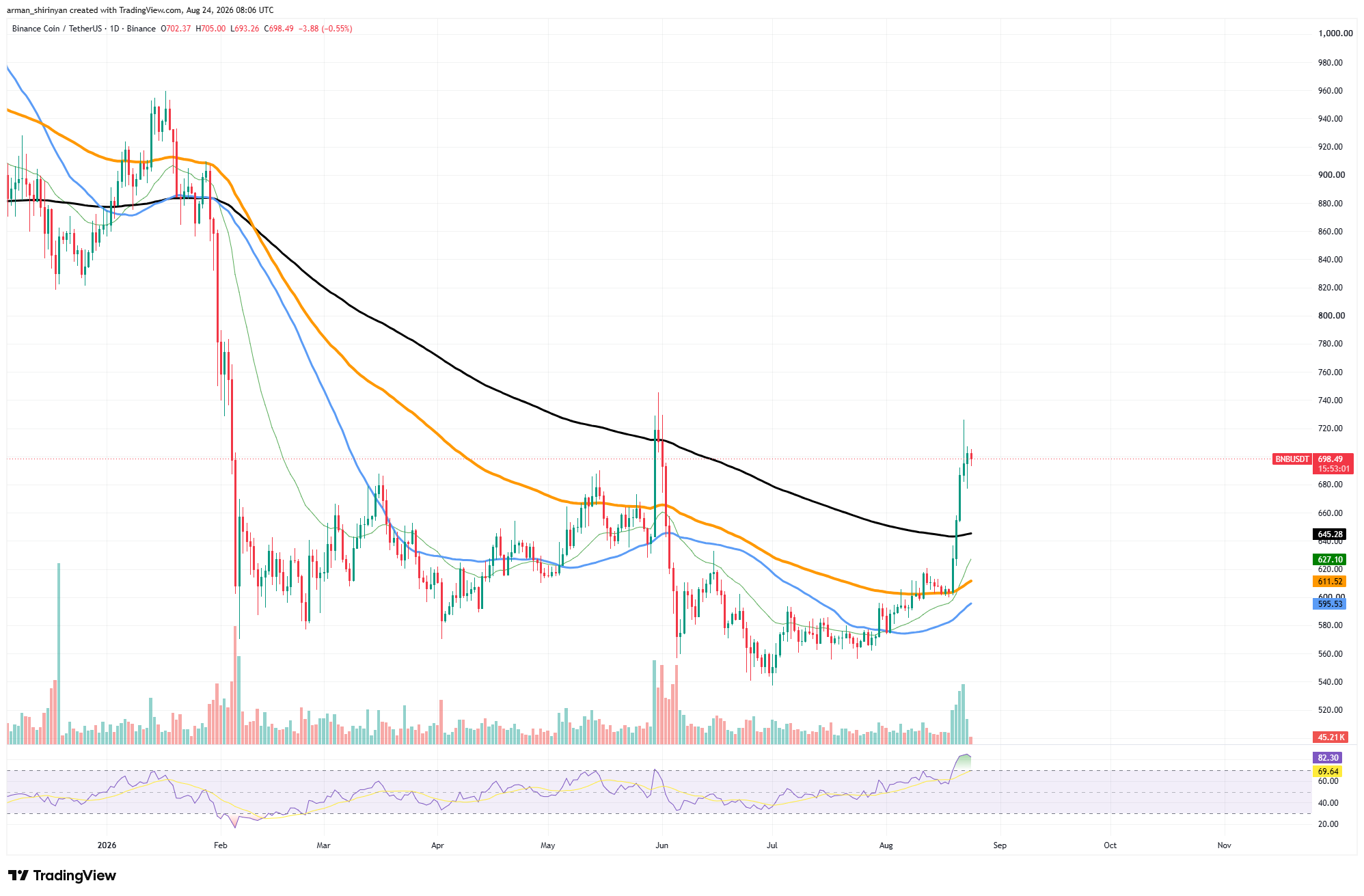
The Pasteur hardfork is less than a day away from BNB Smart Chain, and mainnet activation is set for August 25, 2026, at 02:30 AM UTC. Pasteur targets security around validators and cross-chain operations while also producing significantly more usable block capacity, in contrast to recent upgrades that were primarily concerned with cutting block times. The deadline for node operators is the shortest.
Client v1.7 should already be installed on BSC mainnet nodes. Additionally, operators must remove [Eth] EnableBAL from config.toml because leaving the setting in place may stop the updated node from starting. Pasteur lists three significant upgrades under BEP-673.
Key changes
The first, BEP-682, makes bridge verification more robust. Blocks used in cross-chain transfers are verified by BSC using validator signatures. In the past, the verification process did not guarantee that each validator in the provided validator set appeared only once. Theoretically, the voting power of the same validator could be counted more than once due to duplicate entries.
Duplicate validators are rejected by BEP-682, guaranteeing that the necessary threshold reflects a true validator supermajority. BEP-695 deals with the governance and rotation of validators. Pending slash evictions stay attached through key changes, old consensus keys lose validator-admin privileges after rotation, and blacklisted addresses are no longer able to get around restrictions through signature-based governance voting.
You Might Also Like

BEP-675 is the most noticeable performance improvement. At the moment, validators execute transactions once more before signing, whereas builders execute them before submitting a block. Within the 450-millisecond block interval of BSC, that duplication takes up valuable time.
Isolating the process
By allowing builders to submit blocks that have already been executed, BEP-675 shifts a significant portion of the validator’s complete verification outside of the crucial block-production path. Validator processing on that path decreased from 125 milliseconds to 15 milliseconds on QANet, which mimics BSC’s cross-region validator topology.
As a result, average block gas usage rose from 46.35 million to 84.15 million out of the current 100 million limit, and TPS increased from 1,237 to 2,324. Both block time and finality lag did not change. Instead of ensuring mainnet performance, those numbers are still controlled testnet results.
Even so, Pasteur could significantly increase BSC’s capacity during times of high demand without lowering block time or raising the gas limit. Migration is not necessary for the majority of developers and regular users. Upgrading to v1.7 prior to Pasteur’s activation on August 25 is the crucial task for node operators.
Source link
Author

- Ytv Market News
- Share-market news writer and analyst with deep experience covering equities, commodities, forex, and cryptocurrencies for readers in the USA, UK, Canada, and Australia. Ytv Market News delivers timely market updates, practical trading insights, and clear explanations of macro and company-level catalysts that move prices. Combines on-the-ground financial reporting with technical analysis, using concise charts and actionable ideas to help investors and traders make smarter decisions.
Latest entries
 GermanyAugust 24, 2026High oil prices, subsidies and affordable models rev up European EV sales
 Crypto NewsAugust 24, 2026European Carbon Is Expensive: Russian Bitcoin Mining Takes Over
 Crypto NewsAugust 24, 2026Is this the ultimate XRP bottom?
 CanadaAugust 24, 2026Holland America Evolution Expands Live Music Offerings with New Poolside Bandstands on Oosterdam and Zuiderdam