

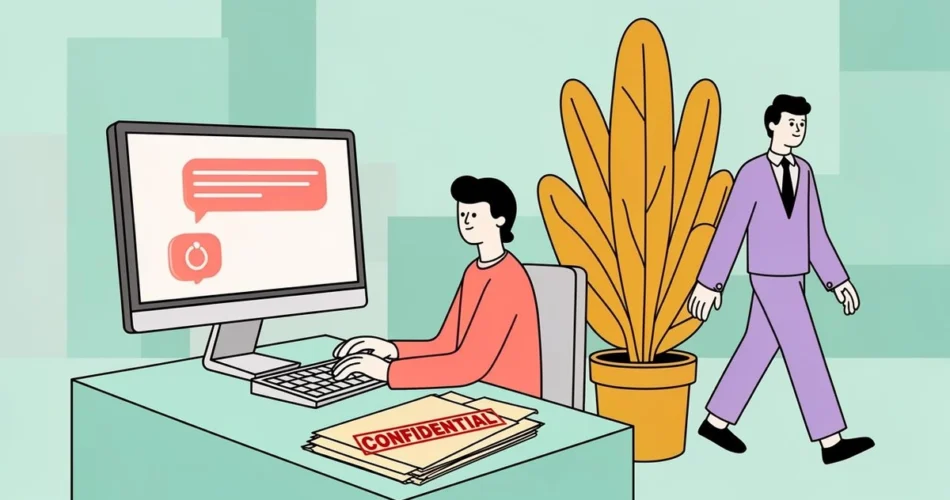
As generative AI adoption in the workplace spreads rapidly, the problem of “shadow AI”—where companies cannot grasp the actual extent of usage—is intensifying. A Japanese survey found that 59% of respondents said they “do not disclose that they used AI” when submitting or reporting work products created with generative AI. An international survey found that 46% have uploaded confidential company information and documents to free generative AI tools. Behind employees’ concealment of AI use from their employers lies a workplace environment where disclosure brings no recognition, and experts point out that simply banning usage will not solve the problem.
“Invisible AI Usage” Advancing in Japan
A survey conducted by Interg in November 2025 targeting 535 working adults in their 20s and 30s across Japan found that 39% used generative AI at work at least once a week. Furthermore, when submitting or reporting work products created with generative AI, 59% said they “do not disclose that they used AI.”
Meanwhile, only 27% said their company adequately provides—or provides at all—education on generative AI. The situation reveals that employees have already started using AI, but corporate education and rule-making have not kept pace.
Another Japanese survey also found that more than half of those who use AI at work have hidden their usage from supervisors or colleagues. Among those in their 20s, that figure reached 63.1%.
“Hidden AI Usage” Even More Pronounced Overseas
This trend is not unique to Japan. WalkMe surveyed 1,000 U.S. workers who use AI in July 2025 and found that 78% had used AI tools not approved by their employer. 49% admitted to falsely claiming they “did not use AI” to avoid negative evaluations, with the figure rising to 62% among Gen Z. Additionally, 45% said they pretended to understand AI in meetings.
Glean’s “Work AI Index 2026,” which surveyed 6,000 digital workers in the U.S., U.K., and Australia, also found that while 87% use AI in the workplace, 32% hide their usage and 33% underreport it.
A survey conducted by the University of Melbourne and KPMG across 47 countries found that 57% of workers hide their AI usage at work and present AI-generated work as their own. U.S. data from the same survey showed that 46% have uploaded confidential company information and documents to free generative AI tools.
Key survey results are summarized below.
| Survey Organization | Target | Key Findings |
|---|---|---|
| Interg (Nov 2025) | 535 Japanese workers aged 20s–30s | 59% did not disclose AI use |
| WalkMe (Jul 2025) | 1,000 U.S. workers using AI | 78% used unapproved AI tools |
| Glean (2026) | 6,000 digital workers in U.S., U.K., Australia | 32% concealed usage |
| University of Melbourne & KPMG | Workers across 47 countries | 57% concealed AI use; 46% uploaded confidential information |
Note: Direct numerical comparison is not possible as each survey differs in questions, target demographics, and timing.
Why Employees Hide Their AI Usage
Why do employees conceal their AI usage? Economic journalist Kenichi Ogura, drawing on his experience interviewing people at corporate workplaces, offers the following analysis.
If you reveal that you used AI, you will be asked “what did you use it for?” You may be suspected of using it for non-work purposes. The company may even learn what you inputted. Furthermore, if “hallucinations”—where AI generates plausible-sounding falsehoods—were mixed in, you will be grilled with “why didn’t you verify it?” In other words, there are very few scenarios where disclosing AI usage benefits the employee.
There is no guarantee that you will be recognized for working faster. Rather, you may be questioned in detail about your methods, held responsible for any errors, and even suspected of personal use. Given that, it is safer to stay silent about AI usage and simply deliver the finished work product. From the employee’s perspective, this is a reasonably rational decision.
A “Blanket Ban” Will Not Solve the Problem
When consulted by companies, Ogura says he is often asked, “Is it safer to ban usage first?” Certainly, pasting customer names, unreleased financial figures, contracts, and personnel evaluations directly into free generative AI tools is problematic. In the aforementioned KPMG–University of Melbourne survey’s U.S. data, 46% said they have pasted company information into publicly available AI tools such as ChatGPT and Gemini. In some cases, the individuals themselves do not understand that the information is confidential. Rules are therefore necessary.
However, ending the discussion with “it’s dangerous, so ban it entirely” is naive. Even if banned, employees will use AI on their own smartphones. They will use it at home and bring only the results to the office. Usage simply becomes invisible to the company; it does not necessarily disappear.
Moreover, if employees resort to using AI in secret, the company loses the opportunity to teach them what is appropriate to input and how to verify the numbers and proper nouns that AI produces. It is like banning cars because roads are dangerous. Precisely because they are dangerous, we create rules and build an environment where accidents are less likely to occur. That is the normal approach. The same applies to generative AI.
Start with Everyday Use to Build Proficiency
Ogura points out that from the employee’s perspective, there is no need to wait for the company to complete a polished set of guidelines. The first step is to use AI every day. Start with tasks where entering confidential work information is unnecessary and where mistakes will not cause problems.
Gemini is a good starting point, he says. Gemini integrates well with Google services such as Google Maps. For example, you could ask: “Near Tokyo Station, using Google Maps ratings as a reference, recommend restaurants with good cost-performance.” For everyday use, even if the answer is wrong, it is not fatal. To learn when AI lies and what it excels at, you need to internalize it through regular, hands-on experience.
Don’t just specify a location—add a budget. Add the number of people. Add the other party’s age and purpose. Add conditions you want to avoid. If you are dissatisfied with the initial suggestions, refine your request: “too expensive,” “too far from the station,” “exclude chain restaurants.” Through this process, you will gradually learn how to ask AI effectively.
There is no need to strain yourself by starting with something like “have AI draft our corporate strategy” to learn how to use generative AI. Find a lunch spot. Plan a travel itinerary. Shorten a long email. Have it predict horse races. Only those who have used AI repeatedly for trivial matters will become capable of using it for matters that are not trivial. Will you wait until the company gives approval? Will you wait until a perfect training program begins? Or will you start by searching for tonight’s dinner spot? Ultimately, that is all there is to it.
Source link
Author

- Ytv Market News
- Share-market news writer and analyst with deep experience covering equities, commodities, forex, and cryptocurrencies for readers in the USA, UK, Canada, and Australia. Ytv Market News delivers timely market updates, practical trading insights, and clear explanations of macro and company-level catalysts that move prices. Combines on-the-ground financial reporting with technical analysis, using concise charts and actionable ideas to help investors and traders make smarter decisions.
Latest entries
 Politics News TodayAugust 24, 2026Trump’s New Jersey home could hold key to GOP, Dems midterm victory
 Market Movers TodayAugust 24, 20263 Market-Beating Stocks to Keep an Eye On
 IndiaAugust 24, 2026Hy-Tech Engineers IPO opens today: Price, dates, lot size and key details
 Company Press ReleasesAugust 24, 2026Net Asset Value(s) – Janus Henderson ICAV


