

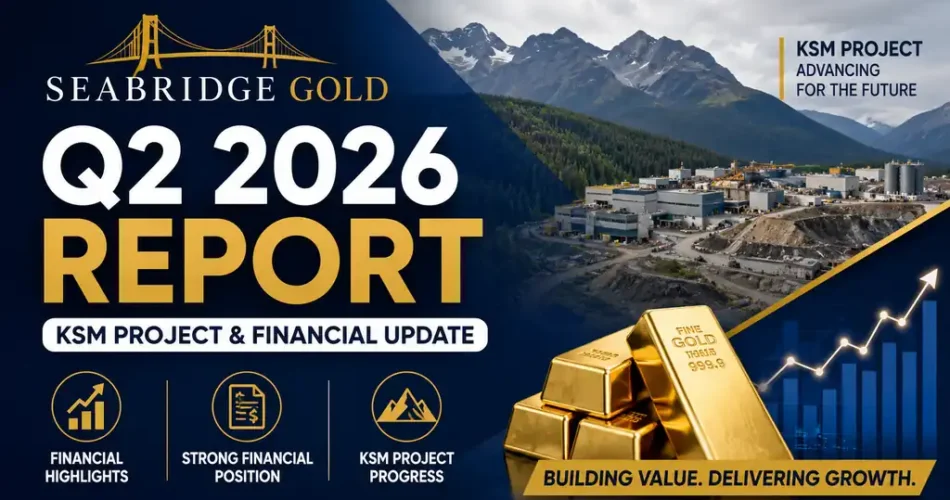
Seabridge Gold Files Second Quarter 2026 Report: Financial Results, Operations and Outlook
Seabridge Gold Inc. has filed its Second Quarter 2026 Report to Shareholders, along with its financial statements and Management’s Discussion and Analysis (MD&A), providing investors with an updated view of the company’s financial position, project activities and strategic priorities.
The latest reporting period offers an opportunity to assess Seabridge Gold’s progress as it continues advancing its portfolio of large-scale mineral assets. The company remains focused on developing its major projects while maintaining financial discipline and progressing technical, environmental and permitting work.
Seabridge Gold Reports Second Quarter 2026 Results
The second-quarter filing gives shareholders a detailed look at Seabridge Gold’s financial performance and corporate activities during the three months and six months ended June 30, 2026. The financial statements provide information on cash resources, expenses, investments and other balance-sheet items, while the MD&A explains the factors influencing the company’s results.
As a development-stage mining company, Seabridge Gold’s financial profile is different from that of a producer generating recurring revenue from operating mines. Its financial results are therefore closely linked to exploration, engineering, permitting, project development and corporate expenditures.
The company’s quarterly report is particularly important because its primary objective remains the advancement of major mineral projects toward potential future development rather than near-term production.
Focus Remains on Large-Scale Mining Assets
Seabridge Gold has built its strategy around acquiring and advancing high-quality mineral deposits with significant long-term development potential. Its portfolio includes projects containing substantial copper and gold resources, giving the company exposure to two metals that are important to global industrial and energy-transition trends.
KSM Project Continues to Drive Corporate Strategy
The KSM project in northwestern British Columbia remains central to Seabridge Gold’s long-term strategy. The project is one of the company’s flagship assets and has attracted considerable attention because of its large resource base and potential scale.
Seabridge continues to work through the technical, environmental and development requirements associated with the project. Activities surrounding engineering, infrastructure planning, environmental management and project optimization are important steps toward determining how the asset could ultimately be developed.
The company’s approach is designed to preserve the value of the project while progressing the work required for potential future construction and production.
Further Work at Other Strategic Assets
In addition to KSM, Seabridge maintains interests in other mineral properties that contribute to its broader growth strategy. Continued technical studies and exploration can help improve geological understanding and evaluate opportunities to enhance the value of these assets.
For investors, the company’s diversified project portfolio provides exposure to several potential development opportunities while reducing dependence on a single exploration target.
Financial Position Remains an Important Investor Focus
Seabridge Gold’s second-quarter financial statements are important for understanding how the company is funding its activities and managing its resources. Because the company is not dependent on operating mine revenue, maintaining adequate liquidity is an important part of its corporate strategy.
Investors generally monitor cash balances, working-capital levels, corporate expenses and project-related expenditures when evaluating development-stage mining companies. These indicators help shareholders assess the company’s ability to continue advancing projects without placing unnecessary pressure on its balance sheet.
Management’s discussion also provides context around financial movements during the reporting period. Changes in expenses, investment values and other financial items can influence quarterly results even when there are no corresponding changes in the underlying long-term value of the company’s mineral assets.
Importance of the MD&A for Shareholders
The Management’s Discussion and Analysis is a key part of Seabridge Gold’s quarterly disclosure because it provides management’s explanation of the financial statements and the company’s operating activities.
The MD&A typically helps investors understand liquidity, capital requirements, project expenditures, risks and significant developments that may not be immediately apparent from financial statements alone.
Project Development Requires Long-Term Capital
Large mining projects require substantial investment before they can generate operating revenue. Engineering, feasibility studies, environmental programs, infrastructure planning and permitting can require significant capital over several years.
For Seabridge, managing these expenditures while protecting shareholder value is therefore a central part of its strategy. The company’s financial reporting allows investors to evaluate how management is balancing project advancement with available resources.
Copper and Gold Exposure Supports Long-Term Strategy
Seabridge Gold’s portfolio provides exposure to both gold and copper. These commodities have different market characteristics and demand drivers, which can provide strategic diversification.
Gold is widely viewed as a monetary and investment asset, while copper plays a major role in construction, electrical infrastructure, power systems and many emerging technologies. Growing demand for electricity infrastructure and electrification has increased investor attention on long-term copper supply.
Seabridge’s large-scale copper-gold assets could therefore benefit from favorable commodity-market conditions over the long term, although development-stage projects remain subject to technical, financial, permitting and market risks.
Permitting and Environmental Considerations
For a major mining development, environmental assessment and permitting are among the most important stages before construction can begin. Seabridge continues to place emphasis on environmental planning and regulatory requirements associated with its projects.
Large projects can face complex regulatory processes because they may involve transportation infrastructure, energy requirements, water management, wildlife considerations and relationships with local communities and Indigenous groups.
Successful progress through these processes can reduce development uncertainty, while delays or additional requirements can affect project schedules and costs.
What the Second Quarter Means for Investors
The second-quarter report should be viewed primarily as an update on project advancement and financial management rather than as a conventional earnings report from an operating mining company.
Investors may focus on several factors, including the company’s liquidity, development milestones, technical progress, permitting activities and the broader outlook for copper and gold.
Progress on major projects can potentially create significant long-term value, but the realization of that value depends on multiple factors. Commodity prices, construction costs, financing conditions, regulatory approvals and technical outcomes can all influence future project economics.
Key Opportunities Ahead
Seabridge Gold has several potential catalysts that could influence investor sentiment. Continued advancement of its flagship projects, additional technical studies, permitting developments and strategic partnerships could provide important updates over time.
Another potential catalyst is the broader commodity environment. Sustained strength in copper or gold prices could improve the attractiveness of large undeveloped deposits, although higher prices can also be accompanied by higher costs for equipment, labor and construction.
Potential for Project Value Creation
The company’s strategy is centered on developing mineral assets with substantial long-term potential. If project studies, permitting and financing progress successfully, the value of these assets could become increasingly recognized by the market.
However, shareholders should recognize that development-stage mining investments can experience significant volatility. Project timelines can extend over many years, and economic assumptions can change as market conditions evolve.
Risks Investors Should Consider
Despite the potential of Seabridge Gold’s assets, investors should consider the risks associated with mineral exploration and development. These include commodity-price volatility, financing requirements, construction costs, permitting uncertainty, environmental obligations, technical challenges and general market conditions.
There is also no guarantee that a development project will ultimately be constructed or reach commercial production. Even projects with large resources can face economic or regulatory obstacles that affect their future viability.
These risks make regular financial and corporate disclosures particularly important for shareholders assessing the company’s progress.
Outlook for the Remainder of 2026
Looking ahead, Seabridge Gold is expected to remain focused on advancing its principal projects, managing its financial resources and completing technical and regulatory work.
The second half of 2026 could provide additional information about project development milestones and the company’s broader strategic direction. Investors will likely continue watching for updates related to engineering, environmental work, permitting, financing and potential development partnerships.
Seabridge’s long-term investment case remains closely tied to the potential value of its mineral assets and the company’s ability to move those assets closer to development while maintaining an appropriate financial position.
Conclusion
Seabridge Gold’s filing of its Second Quarter 2026 Report to Shareholders, financial statements and MD&A provides investors with a comprehensive update on the company’s financial condition and project activities.
The company remains focused on advancing major copper-gold assets, with the KSM project continuing to represent a key component of its long-term strategy. Financial discipline, technical progress, permitting and environmental work will remain important considerations as Seabridge moves forward.
For investors, the latest report reinforces the importance of viewing Seabridge Gold as a long-term development story rather than a traditional producing-miner earnings play. Future value creation will depend on successful project advancement, favorable commodity markets, responsible capital management and the ability to overcome the technical and regulatory challenges associated with large-scale mining developments.
Frequently Asked Questions
What did Seabridge Gold file for the second quarter of 2026?
Seabridge Gold filed its Second Quarter 2026 Report to Shareholders, financial statements and Management’s Discussion and Analysis, providing an update on its financial position, corporate activities and project development progress.
What is Seabridge Gold primarily focused on?
Seabridge Gold is primarily focused on advancing large-scale mineral assets, particularly copper-gold projects, through technical studies, environmental work, permitting and development activities.
Why is the KSM project important to Seabridge Gold?
KSM is one of Seabridge Gold’s flagship assets and represents a major component of the company’s long-term growth strategy because of its substantial copper and gold resources and potential development scale.
Does Seabridge Gold currently operate a producing mine?
Seabridge Gold is a development-stage mining company rather than a conventional operating producer. Its financial results are therefore influenced heavily by project development and corporate expenditures rather than recurring mining revenue.
What should investors watch after the second-quarter report?
Investors may monitor project milestones, financial liquidity, technical studies, permitting developments, capital requirements and changes in copper and gold market conditions.
Is Seabridge Gold a high-risk investment?
Development-stage mining companies can carry substantial risks, including commodity-price fluctuations, financing needs, permitting delays, construction-cost increases and technical uncertainty. Investors should evaluate these risks alongside the potential long-term value of the company’s mineral assets.
What could drive Seabridge Gold’s future valuation?
Potential valuation drivers include progress on major projects, successful technical and regulatory milestones, strategic partnerships, commodity prices and the company’s ability to advance its assets toward development.

