

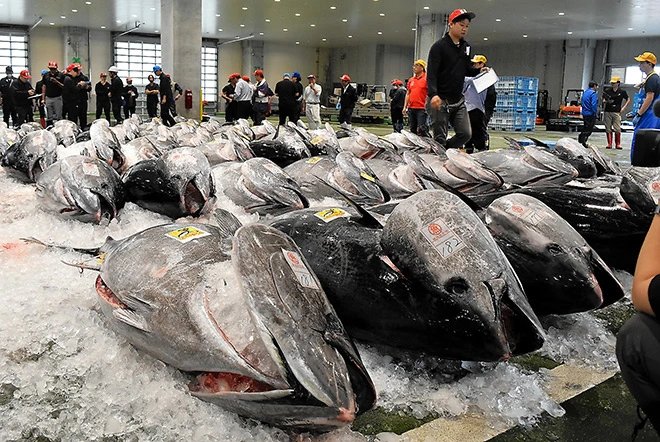
An agreement was reached at a reconvened international conference to increase the annual catch quota for large Pacific bluefin tuna by 25 percent from next year, which could lead to lower prices for the coveted delicacy in Japan.
The Western and Central Pacific Fisheries Commission and the Inter-American Tropical Tuna Commission held a joint working group session on Aug. 18.
The focus will turn to how the overall quota is allocated among countries and regions along with how Japan distributes its share among domestic fishing operators.
“We expect tough negotiations with South Korea and Taiwan,” fisheries minister Norikazu Suzuki told a news conference on Aug. 18, referring to the two Asian neighbors seeking larger allocations.
“We intend to approach the talks with a continued sense of urgency to set catch limits in a way that reflects the status of fish stocks.”
Pacific bluefin tuna stocks are managed separately on the eastern and western sides of the Pacific Ocean.
Under the agreement, the annual catch quota for large tuna weighing 30 kilograms or more in the Western and Central Pacific will increase by 25 percent, from 11,869 tons to 14,836 tons, in line with the proposal backed by Japan.
This marks the third quota increase since 2022.
By contrast, the quota for small tuna under 30 kg will be cut by 6 percent, from 5,125 tons to 4,823 tons.
In the Eastern Pacific, the overall quota will be raised by 2 percent, from 7,581 tons to 7,740 tons.
The agreement is expected to be formally adopted at an annual meeting scheduled between late November and early December.
Japan belongs to the Western and Central Pacific Fisheries Commission.
The Inter-American Tropical Tuna Commission, which has jurisdiction over the Eastern Pacific, counts the United States among its members.
Japan and other countries lobbied for larger quotas citing recovering Pacific bluefin tuna stocks, while the United States and others expressed concerns that overfishing could deplete the resource.
To accommodate those concerns, negotiators agreed to measures such as reducing the quota for immature, small tuna that have a more significant impact on the sustainability of the Pacific bluefin tuna population.
According to the Fisheries Agency, domestic supply of bluefin tuna totaled about 62,000 tons in 2024.
Imports and aquaculture made up about 80 percent of that volume, with the remainder coming from catches in the Pacific and Atlantic oceans.
While the direct impact of the increased quota for Pacific bluefin tuna on domestic catches is expected to be limited, imports could rise from countries that receive larger allocations.
Fisheries industry officials hope that higher trading volumes will bring down prices.
At a working group session held in Nagasaki in July, discussions were moving along the lines of the proposal that was ultimately agreed upon.
However, Mexico reversed its position at the eleventh hour and prevented a consensus from being reached.
Subsequently, Yuhei Yamashita, a state minister of fisheries, met with Mexican Cabinet ministers in Mexico to pave the way for reconvened talks.
Pacific bluefin tuna stocks have fluctuated widely over the years.
Due to overfishing, the population of breeding-age fish plummeted from 156,000 tons in 1961 to 11,000 tons by 2010.
It steadily recovered after country-specific catch limits were introduced in 2015, rebounding to 144,000 tons in 2022.
In response, the quota for large tuna was raised by 15 percent in 2022 and expanded by a further 50 percent in 2024.
This recovery has led to unintended complications, or accidental overfishing, in Japan.
In fixed-net fisheries and elsewhere, large numbers of bluefin tuna were encircled, causing local fisheries to reach their quota ceilings unusually early in the season.
Tuna caught after quotas have been exhausted must be released along with other target species caught in the nets.
Fishers who have suffered substantial losses have called for an early expansion of quotas.
The latest talks also introduced a resource management system known as Management Strategy Evaluation that automatically adjusts catch quotas in accordance with the extent of stock recovery.
“The agreement on a framework that enables stable resource management represents a certain degree of progress,” said a negotiator from the fisheries ministry.
The same system has already been adopted in the management of Atlantic bluefin tuna and Southern bluefin tuna stocks.
Author

- Ytv Market News
- Share-market news writer and analyst with deep experience covering equities, commodities, forex, and cryptocurrencies for readers in the USA, UK, Canada, and Australia. Ytv Market News delivers timely market updates, practical trading insights, and clear explanations of macro and company-level catalysts that move prices. Combines on-the-ground financial reporting with technical analysis, using concise charts and actionable ideas to help investors and traders make smarter decisions.
Latest entries
 Crypto NewsAugust 24, 2026NVIDIA Corporation stock: Uptrend holds, $190 downside risk looms before earnings
 GermanyAugust 24, 2026Europe EV market share tops 25% in July as France, Germany drive growth
 JapanAugust 24, 2026US-Canada trade talks collapse over new tariffs
 Crypto NewsAugust 24, 2026Cardano Targets One Billion Users by Betting on Hydra and Ouroboros Leios


