
Services PMIs in the US and Europe point to demand that still looks resilient, even as manufacturing sends mixed signals. That kind of split often rewards investors who focus on sturdier companies rather than chasing every economic swing. The Low-Risk Leaders screener targets stocks with strong balance sheets and lower model risk scores. This article highlights three of the strongest candidates from that list.
The stocks highlighted below are just a small sample of this idea. The full Low-Risk Leaders screen surfaced 57 more companies with similarly compelling narratives that are not covered here. If you want to identify and analyze the broader set of resilient candidates, head straight into the Low-Risk Leaders screener.
Hitachi (TSE:6501)
Overview: Hitachi is a diversified industrial and technology company that plays a central role in green energy and mobility infrastructure, supplying power grids, renewable and nuclear energy systems, transmission and distribution equipment, and railway solutions, alongside digital systems, IT services, and factory automation. This combination of long-lived utility and transport assets with digital platforms supports a business profile anchored in resilient, long-term contracts and recurring service work.
Operations: Hitachi generates most of its revenue from Energy at ¥3.46 trillion, Connective Industries at ¥3.35 trillion, and Digital Systems & Services at ¥3.01 trillion, with additional contributions from Mobility at ¥1.38 trillion and Others at ¥534.1 billion.
Market Cap: ¥23.30 trillion
Hitachi may be relevant for investors who want exposure to infrastructure with an emphasis on green energy and mobility. Green Energy & Mobility and Social Infrastructure activities, including grids and rail systems, are tied to long-term public-utility style contracts that can support recurring service revenue across different phases of the business cycle. The Lumada digital platform and storage business are seeing interest as enterprises modernize IT and scale AI, supported by alliances with OpenAI, Google Cloud, and Intel. The company also faces risks such as project cost inflation, tougher competition in storage and IT hardware, and weaker construction-related activities in areas like elevators and escalators. These trade-offs may be useful to consider for investors evaluating Hitachi as a potential core holding in a diversified portfolio.
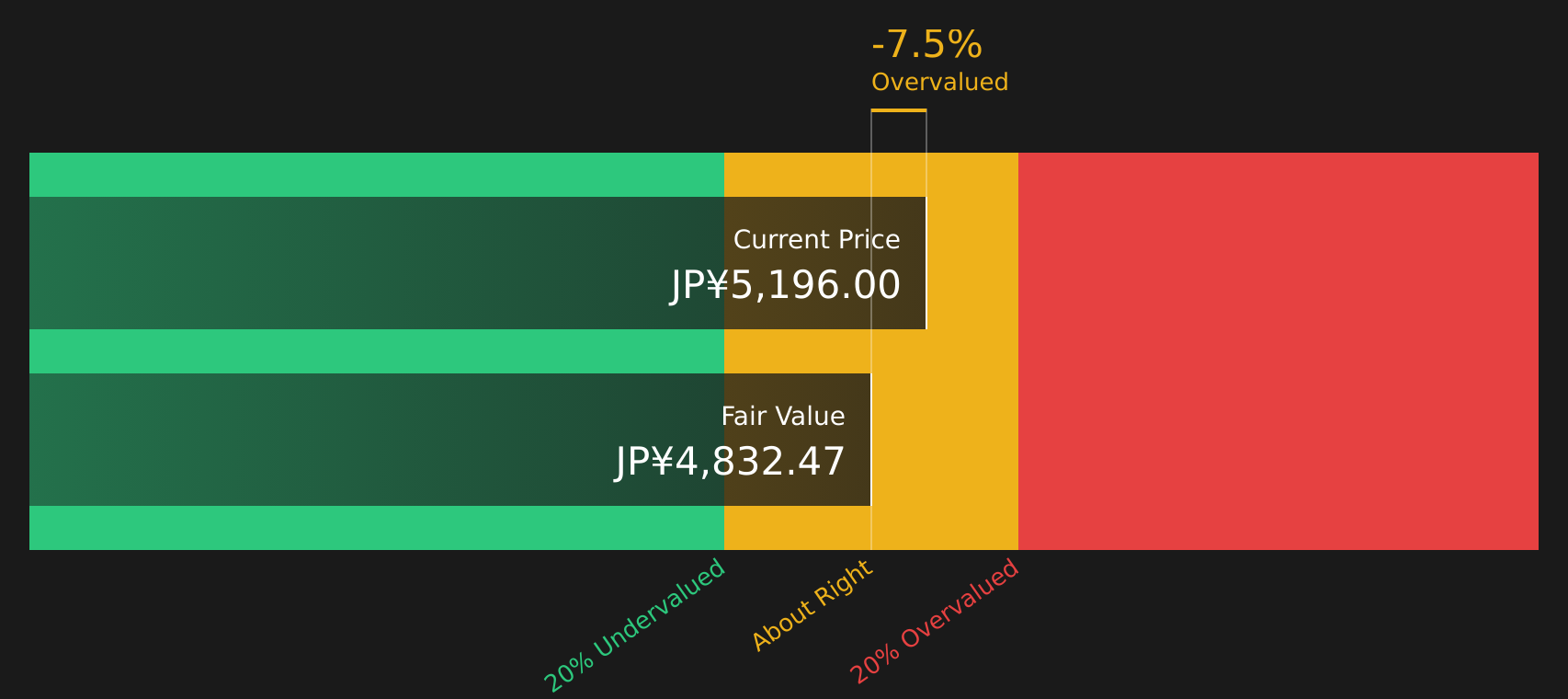
Hitachi’s mix of long-lived infrastructure and growing digital services can look resilient on the surface. The real story sits in the cash flow assumptions and contract durability inside the DCF valuation analysis for Hitachi, which also highlights a less obvious swing factor investors often miss.
Build your own resilient infrastructure shortlist
Hitachi and the two other stocks in this article came out of a single screener, but your edge comes from shaping filters around your own view of resilience, cash flows, and balance sheet strength. Test your ideas with our flexible Screener, or start from the ready-made themes in our Investing Ideas.
Keyence (TSE:6861)
Overview: Keyence is a Japan based automation company that supplies sensors, machine vision systems, controllers, barcode and mobile data devices that help factories run accurate, repeatable and highly controlled production lines. Its products are used across sectors from autos and semiconductors to food and medical technology, which spreads demand across many different end markets.
Operations: Keyence generates all of its revenue, about ¥1.25 trillion, from the manufacture and sale of applied electronic equipment.
Market Cap: ¥19.38 trillion
Keyence may appeal to investors who prioritize lower drama and steadier cash flows at the foundation of a portfolio. Its industrial sensors and automation gear are often embedded deep inside customers production lines, which can support repeat business and margin strength when factories care more about uptime and quality than squeezing every last yen. Profitability is strong, with net margins around 39.2%, and recent quarterly results show solid demand for its automation and sensing products. The trade off is a rich valuation and a balance sheet profile that leans more on external borrowing than some investors may prefer for a low risk anchor. Assessing whether that premium and funding mix still feel comfortable is a key consideration for any potential entry point.
Keyence’s rich valuation and embedded factory footprint can look like a puzzle. Untangle how its margins, cash generation and funding mix interact inside the analysis report for Keyence that flags one underappreciated pressure point investors often overlook.

Mitsubishi Heavy Industries (TSE:7011)
Overview: Mitsubishi Heavy Industries is a diversified Japanese industrial group that develops and sells large scale energy systems, including gas and steam power plants, nuclear reactors and wind turbines, alongside aircraft engines, defense equipment, ships, machinery and air conditioning systems. Its Energy Systems segment, which focuses on long life, contract backed power generation infrastructure, gives the company a direct link to the Low Risk Leaders theme of resilient cash flows and balance sheet strength, even though other segments like defense and industrial machinery also play significant roles.
Operations: Mitsubishi Heavy Industries generates most of its revenue from Energy Systems at ¥2.18 trillion, Aircraft, Defense & Space at ¥1.42 trillion and Plants & Infrastructure Systems at ¥873.0 billion, with smaller contributions from Others and internal segment adjustments.
Market Cap: ¥13.21 trillion
Mitsubishi Heavy Industries offers a mix of stability and long term characteristics that may appeal if you want a solid foundation in a diversified portfolio. The Energy Systems business supplies gas turbine, nuclear and wind projects that typically run on long contracts with utilities and governments, which can support steadier cash flows and reduce earnings swings. A record order backlog, recent large infrastructure wins such as the Dubai Al Maktoum Airport people mover, and rising dividends signal confidence in that contract base. The flip side is exposure to large defense and industrial projects, foreign exchange swings and policy risk around energy and subsidies. For investors comfortable with those trade offs, the combination of clean energy, infrastructure and defense could merit further research.
Mitsubishi Heavy Industries is being pulled by long life energy contracts and large defense projects, yet the true balance between resilience and risk still feels underappreciated. The analyst forecasts for Mitsubishi Heavy Industries hints at where that story could quietly change next.

Seeking Fresh Alternatives Before They Fly
Markets move fast and the strongest breakout ideas rarely stay under the radar for long. Spot fresh momentum and solid foundations before the crowd catches up, act now.
- Catch early strength in cash generative companies before momentum stories become crowded by scanning the curated 26 high quality undervalued stocks.
- Target durable income while yields are still holding up and pick from a focused universe of 31 dividend fortresses built around balance sheet and payout resilience.
- Ride the build out of next generation infrastructure by tracking hand picked 55 AI infrastructure stocks that could benefit while AI demand is still ramping.
This article by Simply Wall St is general in nature. We provide commentary based on historical data
and analyst forecasts only using an unbiased methodology and our articles are not intended to be financial advice. It does not constitute a recommendation to buy or sell any stock, and does not take account of your objectives, or your
financial situation. We aim to bring you long-term focused analysis driven by fundamental data.
Note that our analysis may not factor in the latest price-sensitive company announcements or qualitative material.
Simply Wall St has no position in any stocks mentioned.
Valuation is complex, but we’re here to simplify it.
Discover if Hitachi might be undervalued or overvalued with our detailed analysis, featuring fair value estimates, potential risks, dividends, insider trades, and its financial condition.
Have feedback on this article? Concerned about the content? Get in touch with us directly. Alternatively, email editorial-team@simplywallst.com
Source link